Cone Crusher Parts: A Complete Buying Guide
Selecting the right cone crusher parts — and knowing when to replace them — is one of the most direct levers you have on operating cost. This guide covers the four major component systems of a cone crusher, with selection criteria and acceptance standards for each.
The right framework for evaluating parts isn’t purchase price. It’s cost per crushed ton. A liner that costs more upfront but lasts twice as long in your application is the better buy. The sections below give you what you need to make that call — from alloy grade selection to supplier qualification.
What Are the Main Cone Crusher Parts?
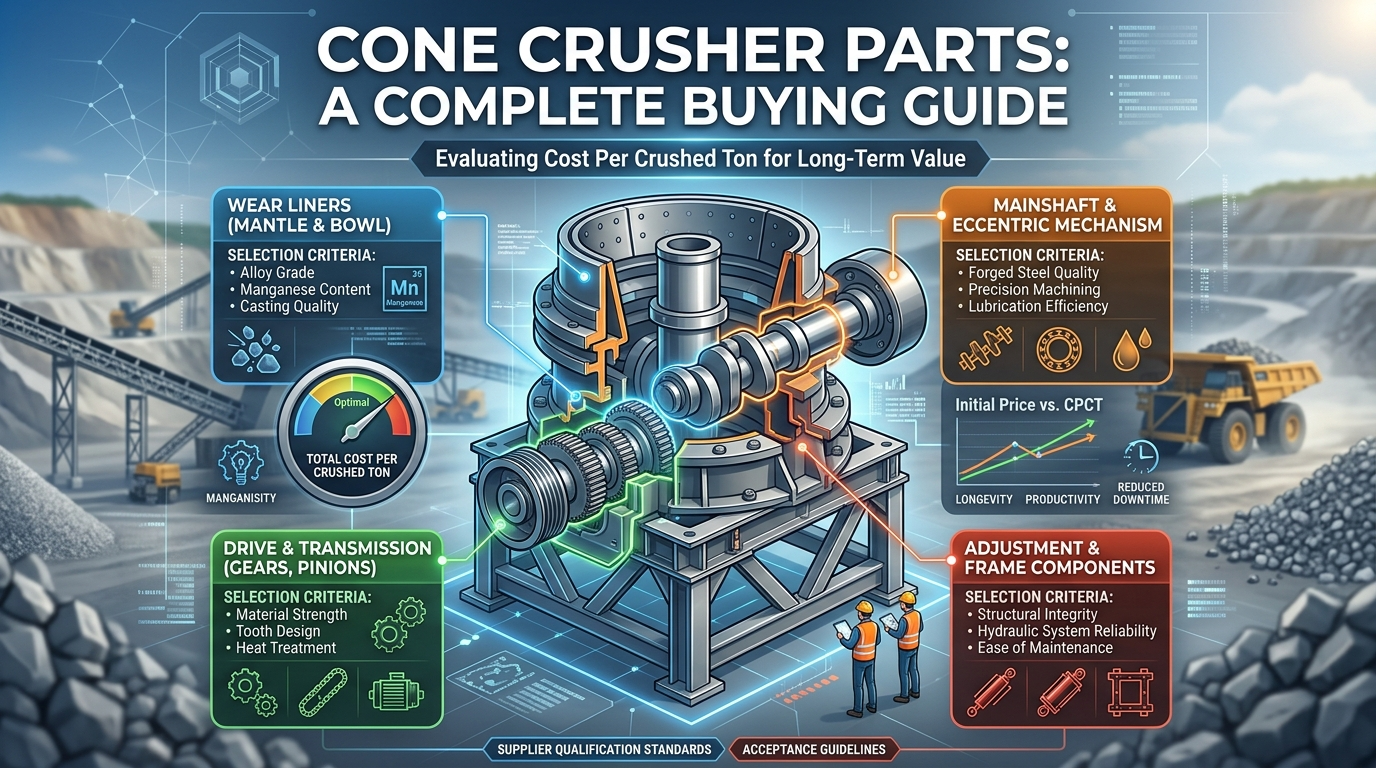
Cone crusher components fall into four functional groups based on their role and replacement frequency:
| System | Key Components | Replacement Frequency |
|---|---|---|
| Wear Parts | Mantle, concave (bowl liner), frame liners, dust seals | High (months to ~1 year) |
| Drive System | Mainshaft, eccentric, bevel gear & pinion, countershaft | Medium (years) |
| Hydraulic & Adjustment | Adjustment ring, hydraulic cylinders, bowl | Medium–low (1–3 years) |
| Lubrication System | Oil tank, filters, cooler, seals | Routine maintenance |
Wear parts drive the bulk of your procurement decisions. Getting the alloy grade and cavity profile right directly determines your operating cost.
Cone Crusher Wear Parts: Mantle and Concave Selection
How Mantles and Concaves Wear
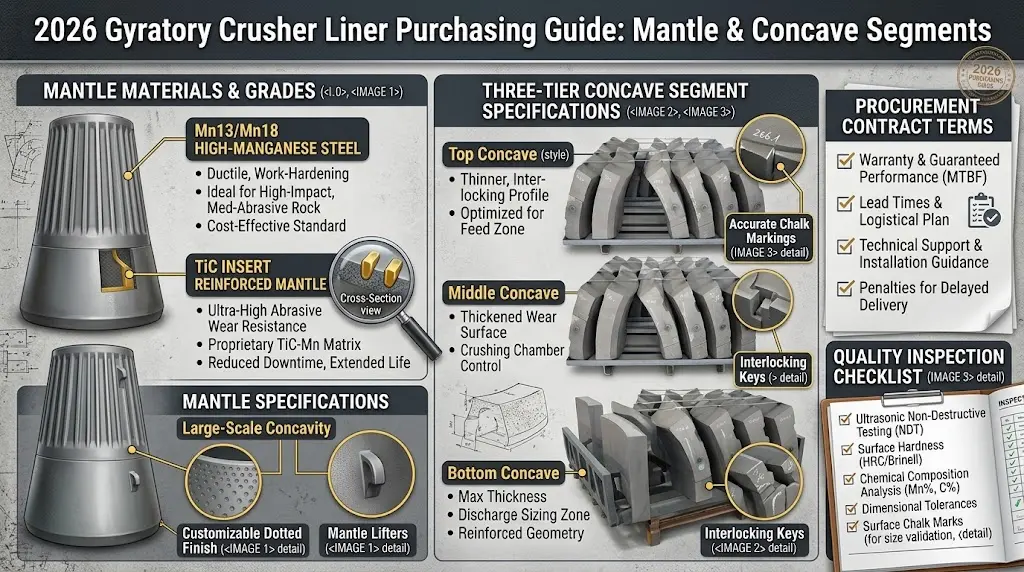
The mantle fits over the head of the moving cone. The concave (also called the bowl liner) lines the inside of the stationary bowl. Together, they form the crushing chamber and take the full force of material impact and abrasion.
Wear shows up primarily as tooth height reduction and surface spalling. As a general rule, replace liners when tooth height wear exceeds 30% of the original profile. In high-hardness applications, move that threshold up to 20% — waiting too long causes a sharp drop in crushing efficiency that’s far more costly than an early liner change. Always refer to your OEM’s maintenance manual for the exact replacement criteria, as manufacturers such as Metso and Sandvik specify these thresholds in their technical documentation.
Under normal operating conditions, mantle and concave service life depends on feed hardness, top size, and operating discipline.
Mantle and Concave Alloy Selection
Liner alloy is the single biggest lever on service life. Here’s how the main options compare:
| Alloy | Hardness | Toughness | Wear Resistance | Impact Resistance | Best For |
|---|---|---|---|---|---|
| Mn13 Manganese Steel | Low (work-hardens in service) | Excellent | Good | Excellent | Medium-hardness ore; standard secondary/tertiary crushing |
| Mn18 Manganese Steel | Low (work-hardens in service) | Excellent | Very High | Excellent | Hard, high-impact rock: granite, basalt |
| Mn22 Manganese Steel | Low (work-hardens in service) | Good | Very High | Good | Extremely abrasive conditions; very hard or high-impact rock |
| TiC-Insert Manganese Steel | High (TiC hard phase HV 3000+) | Good | Very High | Good | High-abrasion fine crushing; significantly outlasts standard manganese in abrasive conditions |
Alloy recommendations by material type:
- Granite, basalt (hard, highly abrasive): Mn18Cr2 or Mn22
- Limestone, sandstone (medium hardness): Standard Mn13 or Mn13Cr2
- Feed with tramp iron risk: Manganese steel across all grades — toughness prevents catastrophic cracking
- Highly abrasive fine crushing: Mn22 or TiC-insert manganese steel for maximum liner life
Cost note: Higher manganese content means better wear resistance and higher unit cost. TiC-insert liners carry a further premium due to manufacturing complexity. Evaluate on cost per crushed ton, not purchase price per liner.
Cavity Profile Selection
Profile (liner type) sets the feed size range and product size. It must match your crushing stage:
| Profile | Code | Crushing Stage | Feed Size | Product Size |
|---|---|---|---|---|
| Extra Coarse | EC | Primary/Secondary | Oversized | Coarse aggregate |
| Coarse | C | Secondary | Large | Medium aggregate |
| Medium | M | Secondary/Tertiary | Medium | Medium-fine aggregate |
| Fine | F | Tertiary | Small | Fine aggregate |
| Extra Fine | EF | Tertiary/Quaternary | Small | Sand-size product |
A profile that doesn’t match your feed size is one of the fastest ways to shorten liner life. Too large a cavity and the material floats around without proper nip; too small and you get localized overload and accelerated uneven wear.
Getting wear parts right controls your daily operating cost. Keeping the machine running long-term requires equal attention to the drive system.
Drive System Components
Mainshaft
The mainshaft is forged alloy steel, stress-relieved through annealing. Its short, heavy-duty profile is engineered to handle the eccentric loads generated inside the crushing chamber. Under normal operating conditions the mainshaft does not require scheduled replacement, but bend and surface wear should be checked at every major overhaul.
What to check when buying:
- Ask for forge certification. Cast steel and forged steel look the same but perform very differently — cast mainshafts carry a real fracture risk under eccentric load
- Verify journal diameter tolerances at acceptance (typically h6 grade) and confirm taper angle matches OEM drawings
- Request a material certification confirming carbon content and alloy element ratios
Eccentric Bushing
The eccentric is high-carbon cast steel with a bronze wear liner that provides the lubricated interface for the mainshaft. Swapping to a different eccentric throw lets you adjust the crusher’s characteristics in the field.
What to check when buying:
- Bronze liner wall thickness is a critical spec — match the OEM dimension exactly; undersized thickness reduces bearing clearance and causes overheating and seizure
- Measure the bronze liner bore with an inside micrometer at acceptance; typical tolerance is within ±0.05 mm
- Eccentric throw must match the machine records; mixing throws changes the crusher’s force profile
Bevel Gear and Pinion
Larger cone crushers typically use spiral bevel gears for their smooth, quiet engagement and large contact area; smaller machines use straight bevel gears. The specific gear type depends on the OEM design specification.
What to check when buying:
- Module, pressure angle, and tooth count must match the original exactly — any deviation causes meshing problems and accelerates gear face wear
- For drive components, OEM or OEM-approved equivalents are strongly recommended; third-party gears are only acceptable if the supplier provides a full tooth form inspection report (including pitch cumulative error and profile deviation)
- When replacing spiral bevel gears, always change the mating pair together; mixing new and worn gears accelerates uneven wear
Countershaft
Normal replacement interval: 3–5 years.
What to check when buying:
- Verify shaft diameter, keyway width and depth, and flange bolt circle — all dimensions must match before installation
- Request material certification; countershafts must be alloy structural steel, quench-and-temper heat treated, with typical surface hardness of HRC 28–35
Hydraulic and Adjustment System Components
Adjustment Ring
The adjustment ring drives the bowl through a hydraulic rotation system, giving you precise control over closed-side setting. You’ll see the most wear on the thread contact faces and sealing surfaces. Typical replacement interval is 12–24 months. When replacing, inspect thread form integrity and verify hydraulic actuation response accuracy.
Hydraulic Cylinders
Cone crusher hydraulic systems typically include two cylinder types:
- Clamping cylinders: Hold the adjustment ring in position and absorb crushing reaction forces
- Tramp release cylinders: Automatically relieve pressure when uncrushable material enters the chamber, protecting the machine
Typical replacement interval for both types: 2–3 years. The most common failure you’ll encounter is seal degradation leading to leakage.
Seal selection:
- Match all three seal dimensions (ID × OD × section height for lip seals; ID × section diameter for O-rings) — any deviation affects sealing performance
- NBR (nitrile rubber): Standard choice for mineral oil systems; operating temperature range -35°C to +120°C
- FKM (Viton): Handles up to +200°C for high-temperature applications; approximately 3–5× the cost of NBR
- Replace all cylinder seals as a set during annual overhaul; address any weeping seal immediately — hydraulic pressure loss causes cascading failures
Bowl
The bowl threads into the adjustment ring and is the mechanical element that executes your closed-side setting. Large machines can adjust on the fly without stopping.
Wear inspection:
- Focus on the bowl’s liner seating surface: when you see a visible step wear pattern, or uneven wear that compromises liner positioning accuracy, replace the bowl (refer to the OEM maintenance manual for wear allowance tolerances)
- Inspect bowl threads every time you change liners; any significant thread damage needs to be addressed immediately — a loose closed-side setting is a safety issue
Lubrication System Components
The lubrication system is the machine’s life support. Most cone crushers use an external forced-circulation system with an oil tank, condensing cooler, pressure filter, and motor-driven pump. Built-in flow and temperature switches automatically shut the machine down if either parameter falls out of range.
Reference oil volumes by machine size:
| Machine Size | Reference Oil Volume |
|---|---|
| 22-inch | ~30 gallons |
| 48-inch | ~100 gallons |
| 84-inch | ~240 gallons |
Key maintenance practices:
- Oil change interval: Every 3–6 months as a baseline. If you’re running oil analysis, use the data: trigger an oil change when viscosity drifts more than ±15% from the original spec, or acid number (TAN) exceeds 2.0 mgKOH/g — don’t wait for the calendar
- Filter management: Check the pressure differential indicator monthly; replace the filter element immediately when differential exceeds the manufacturer’s threshold. A clogged filter starves the system of oil pressure
- Seal procurement: Only accept seals that come with material identification and hardness data — specify the rubber compound (NBR/FKM/HNBR) and Shore A hardness when ordering. At acceptance, check with a durometer — a reading below 70 Shore A (too soft) or above 90 Shore A (too hard) is a reject
- Inventory: Lube system seals are low-cost, but unusual sizes can have long lead times. Keep a 3–6 month safety stock
Replacement Interval Reference
| Component | Normal Service Life | Replace When |
|---|---|---|
| Mantle / Concave | Varies by application | Tooth wear >30% (refer to OEM manual) |
| Frame Liners | 3–6 months | Through-wear visible on inspection |
| Dust Seals | Condition-based | Any dust ingress detected |
| Adjustment Ring | 12–24 months | — |
| Hydraulic Cylinder Seals | 2–3 years | Leakage or actuation failure |
| Countershaft | 3–5 years | — |
| Lubrication Oil | 3–6 months | — |
5 Common Mistakes When Buying Cone Crusher Parts
Mistake #1: Choosing by price instead of alloy grade
Different manganese grades carry different price points, but in hard rock applications the right alloy can dramatically extend liner life — and lower your actual cost per ton. The correct metric is cost per ton crushed, not the line-item purchase price.
Mistake #2: Not verifying cavity profile against your feed
Profile must match actual feed gradation. An oversized profile leaves material without proper nip; an undersized profile causes localized overloading and accelerated uneven wear. Any time you change suppliers or process parameters, reconfirm profile selection.
Mistake #3: Using non-OEM parts for critical drive components
Third-party drive parts — especially eccentrics and gears — may not hold OEM tolerances. Incorrect clearances accelerate mainshaft and eccentric wear. For wear parts, third-party alternatives are generally acceptable — provided the supplier can deliver a full dimensional and material inspection report. For drive components, that bar is higher: OEM or OEM-certified equivalents only.
Mistake #4: Running low on wear part inventory
Mantles and concaves are planned-replacement items with typical lead times of 4–8 weeks. Start procurement 1–2 months ahead of the expected change. In high-volume operations, keep at least one full liner set in stock at all times.
Mistake #5: Underestimating what a dust seal does
A dust seal costs almost nothing. Its failure is expensive. Dust entering the bearing area rapidly degrades the mainshaft and eccentric bushing — the resulting repair bill can far exceed the value of the seal itself. Include dust seals in your preventive maintenance replacement schedule.
Cone Crusher Parts Selection Checklist
Before placing any order, confirm these items:
- Machine model and crushing chamber spec — drives all dimensional requirements
- Material characteristics — UCS (unconfined compressive strength), abrasion index (AI value), and feed top size for alloy and profile selection
- Crushing stage — primary, secondary, or tertiary dictates the profile range
- Operating schedule — shifts per day and annual hours affect inventory strategy and procurement cadence
- Supplier qualification — require spectrographic material certification and dimensional inspection reports:
- Wear parts (manganese steel): Verify Mn content (per GB/T 5680: Mn13 range 11–14%; Mn18 ≥17.0%; Mn22 ≥21.0%), C content (0.9–1.4%), and Cr addition for Cr grades (1.5–2.5%); TiC-insert liners require additional verification of TiC content and distribution uniformity
- Drive components (forged/alloy steel): Verify primary alloy elements and heat treatment condition
- When parts arrive, sample at 5–10% per batch; focus on critical dimensional tolerances and hardness; use CMA-accredited labs domestically or ISO 17025-certified labs for international procurement
Frequently Asked Questions About Cone Crusher Parts
How often should you replace cone crusher liners?
Service life varies by application, but the right trigger isn’t a fixed time interval — it’s wear. Replace your mantle and concave when tooth height wear reaches 30% of the original profile. In hard rock or high-abrasion applications, move that threshold to 20%. Running liners past their replacement point causes efficiency loss that costs more than the liner itself.
What is the difference between Mn13 and Mn18 manganese steel?
Both are austenitic manganese steels that work-harden in service, but Mn18 has a higher manganese content (≥17.0% vs. 11–14% for Mn13), giving it better wear resistance under high-impact, hard rock conditions. For medium-hardness materials like limestone, Mn13 is generally sufficient. For granite, basalt, or any high-impact application, Mn18 or Mn22 is the better choice.
How do you know when to change a cone crusher mantle?
Two reliable indicators: tooth height wear exceeding 30% of original depth, and a measurable drop in throughput or product gradation quality. If you’re seeing either — or both — it’s time to change. Don’t wait for visible cracking; a liner that fails structurally can damage the head seat and turn a planned liner change into a major repair.
What is TiC-insert manganese steel, and when should you use it?
TiC-insert manganese steel embeds titanium carbide (TiC) hard particles into a manganese steel matrix. The TiC phase (hardness HV 3000+) provides extreme abrasion resistance that standard manganese alloys can’t match. It’s the right choice for highly abrasive fine crushing applications where standard Mn18 or Mn22 still wears too fast. The tradeoff is higher unit cost due to manufacturing complexity — evaluate on cost per ton, not price per liner.
Reference sources: 911Metallurgist technical documentation, JB/T 2501-2017 (Single-Cylinder Hydraulic Cone Crusher), GB/T 5680 (High Manganese Steel Castings), and industry application data.