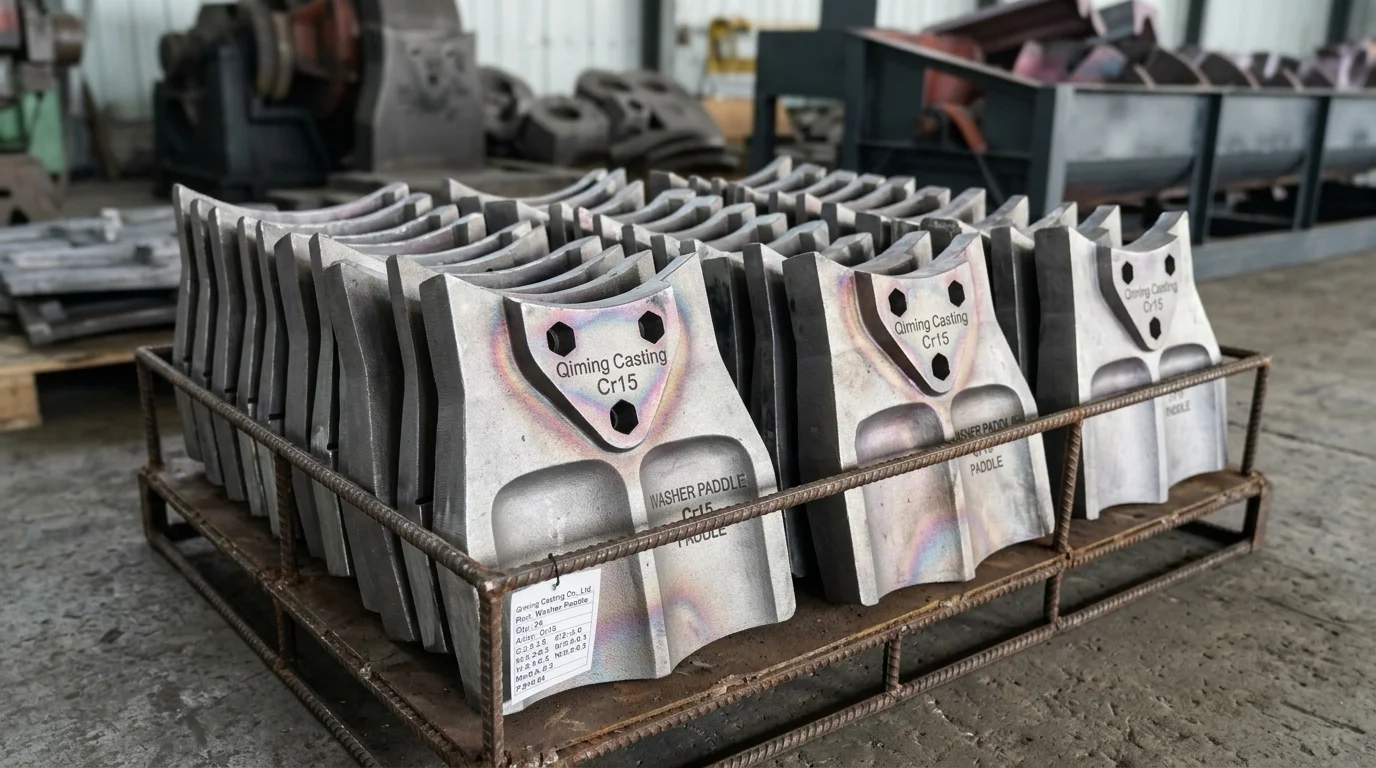
Washer Paddles For Sand Washing Machine

Washer Paddles for Sand Washing Machine By Qiming Casting

Washer paddles are the primary wear components in a sand washing machine. Mounted on the rotating central shaft, they scrub raw feed to break apart clay and loosen surface contamination, classify fines from coarser material, and convey product through the washing trough — all while running in continuous contact with abrasive silica sand and wet slurry. Because abrasion is the dominant failure mode, the alloy you choose determines how long they last and how much they cost per ton of processed material.

Cr15 High Chrome Material Specification

Qiming Casting’s washer paddles are cast from Cr15 high chromium white cast iron, a proven abrasion-resistant alloy that forms a dense network of hard M₇C₃ chromium carbides throughout the matrix. This microstructure delivers exceptional resistance to the sliding abrasion and wet corrosion that define sand washing environments.
Chemical Composition
Element Symbol Content (wt.%)
Carbon C 2.70 – 3.00
Chromium Cr 14.0 – 17.0
Molybdenum Mo 0.20 – 0.40
Nickel Ni 0.30 – 0.60
Vanadium V 0.30 – 0.50
Titanium Ti 0.08 – 0.12
Silicon Si 0.50 – 0.80
Manganese Mn 0.60 – 1.00
Phosphorus P ≤ 0.04
Sulfur S ≤ 0.04
Role of Each Alloying Element
Carbon (C) — 2.70–3.00% High carbon drives the formation of M₇C₃ chromium carbides, which are the hard phase responsible for wear resistance. At this carbon level, carbide volume fraction reaches approximately 28–32% of the microstructure — delivering sustained abrasion resistance against silica sand throughout the paddle’s service life. In practice, this means your paddles hold their cutting edge longer, extending replacement intervals and reducing unplanned downtime.
Chromium (Cr) — 14.0–17.0% Chromium is the defining element of this alloy class. A Cr/C ratio above 5:1 ensures that carbides precipitate as M₇C₃ (Vickers hardness: 1,800–2,200 HV) rather than the softer M₃C carbides found in lower-chrome irons. Chromium also forms a passive surface oxide that resists corrosion in the continuously wet, slurry-laden environment of a sand washer. For operations running multiple shifts, this corrosion resistance is what keeps paddle condition predictable between scheduled maintenance stops.
Molybdenum (Mo) — 0.20–0.40% Molybdenum increases hardenability and suppresses pearlite formation during cooling. The result is a more consistently martensitic matrix after heat treatment — higher hardness, better wear uniformity, and reduced variation between castings in the same batch.
Nickel (Ni) — 0.30–0.60% Nickel stabilizes the austenite-to-martensite transformation and adds toughness to the matrix without reducing hardness. It is particularly beneficial in thicker paddle sections where slower cooling rates could otherwise produce softer, undesirable transformation products.
Vanadium (V) — 0.30–0.50% Vanadium forms fine VC carbides that act as nucleation sites during solidification. This refines the overall carbide and grain size, producing a more uniform wear surface, improved impact resistance, and better dimensional consistency across the casting. The practical benefit is more even wear progression — paddles degrade uniformly rather than developing weak spots that trigger early failure.
Titanium (Ti) — 0.08–0.12% At this trace addition level, titanium acts as a strong grain refiner. It modifies the primary carbide morphology and improves matrix toughness — reducing the risk of brittle fracture when paddles encounter occasional impact loading during operation. This is particularly relevant in log washer applications where oversized rocks or tramp material can enter the feed unexpectedly.
Silicon (Si) — 0.50–0.80% Silicon deoxidizes the melt during casting and improves fluidity, which is important for filling complex paddle geometries cleanly. It also contributes a degree of corrosion resistance in wet service conditions.
Manganese (Mn) — 0.60–1.00% Manganese improves hardenability and combines with sulfur to form MnS inclusions. This prevents the formation of FeS at grain boundaries — a known embrittlement mechanism that Mn addition effectively neutralizes.
Phosphorus (P) ≤ 0.04% and Sulfur (S) ≤ 0.04% Both are controlled to low residual levels. Phosphorus forms brittle phosphide networks that reduce impact toughness; sulfur creates grain-boundary inclusions that weaken the casting under load. Strict control of both ensures consistent mechanical performance from batch to batch.
Mechanical Properties
Property Value
Surface Hardness 60 – 65 HRC
Carbide Hardness (M₇C₃) 1,800 – 2,200 HV
Carbide Volume Fraction ~28 – 32%
Heat Treatment Air quench + low-temperature temper
Dimensional Tolerance Per drawing / OEM specification
These properties translate directly to extended service intervals and lower per-ton processing cost in continuous sand washing operations.

Product Features

  • Extended Wear Life: The high carbide volume fraction gives Cr15 paddles a wear life of approximately 3–5× that of standard carbon steel paddles under equivalent silica sand washing conditions. Longer intervals between replacements directly reduce machine downtime and maintenance labor cost.
  • Corrosion Resistance in Wet Environments: The 14–17% chromium content forms a stable passive oxide layer on the paddle surface. Unlike manganese steel, which corrodes rapidly in continuous water contact, Cr15 maintains its surface integrity throughout its service life in slurry and high-moisture conditions.
  • Refined Microstructure for Consistent Performance: The addition of vanadium and titanium refines carbide size and distribution. A finer, more uniform microstructure means wear progresses evenly across the paddle face — avoiding the localized spalling or chipping that accelerates failure in coarser-grained alloys.
  • OEM-Compatible Profiles: Qiming Casting holds an extensive library of CAD profiles for washer paddles used on major sand washing machine brands. We supply direct-replacement paddles with matched bolt patterns, shaft bore dimensions, and paddle geometry. Custom profiles are available based on drawings, samples, or dimensional measurements.
  • Ready to Install: All paddles are delivered fully heat-treated, with bolt holes machined to specification. No further processing is required before installation.

Applications

Cr15 washer paddles from Qiming Casting are used in:
·Sand and gravel washing plants — including river sand, manufactured sand, and crushed stone fines processing, where continuous silica abrasion is the primary wear mechanism
·Log washers and paddle washers handling clay-heavy aggregate feeds, where paddles must resist both abrasion and repeated impact from coarse particles
·Mining pre-wash applications (iron ore, copper ore, gold ore beneficiation), where feed hardness and high throughput rates accelerate wear on standard alloys
·Construction aggregate processing — recycled concrete aggregate and quarry fines, where contamination levels and abrasive fines content are high
·Industrial sand processing — silica sand, foundry sand, and glass sand, where fine particle abrasion demands consistently high surface hardness throughout the paddle’s service life

Why Choose Qiming Casting?

Qiming Casting is a specialized foundry with over 20 years of experience producing high chrome and manganese steel wear parts for the mining, quarrying, and aggregate industries.
Qiming Casting combines foundry-grade metallurgical control, OEM-compatible engineering, and direct-from-factory pricing — giving you a reliable supply of high-performance paddles at significantly lower cost than OEM replacement parts.
·Annual capacity: 10,000+ tons of chromium white iron and manganese steel wear parts
·Furnace capability: Up to 18,000 kg per cast using 5-ton, 3-ton, and 1-ton electric arc furnaces
·Heat treatment: Dedicated quench-and-temper lines with controlled atmosphere for consistent metallurgy
·Quality control: Spectrometric chemical analysis, hardness testing, and dimensional inspection on every batch
·OEM capability: Thousands of original CAD profiles; custom reverse-engineering available
·Export experience: Products supplied to customers in 30+ countries across mining and aggregate markets

Frequently Asked Questions

How long do Cr15 washer paddles last compared to steel paddles?
-In typical silica sand washing conditions, Cr15 high chrome paddles last approximately 3–5 times longer than standard carbon steel paddles. Actual service life varies with feed hardness, throughput rate, and operating hours per day.
Can you manufacture paddles to fit our specific machine?
-Yes. Provide drawings, worn samples, or dimensional measurements and our engineering team will confirm fit before production. We supply OEM-compatible paddles for most major sand washing machine brands.
Do you offer alloy grades other than Cr15?
-Yes. Depending on your operating conditions — particularly the balance between abrasion and impact — we can also supply Cr20, Cr27, and Cr-Mo alloy grades. Contact us to discuss which specification best fits your application.
What information do I need to request a quote?
-Share the machine make and model (or paddle drawings), the required quantity, and your current alloy grade if known. Our technical team will respond with a material recommendation, lead time, and price within 24 hours.
What is the minimum order quantity?
-We accept both trial orders and large-volume supply contracts. Please contact us with your requirements and we will confirm the most cost-effective arrangement.