Causes, Troubleshooting & Solutions
It’s 2 a.m. The crusher goes quiet. Your operator radios in: blow bar broke again. By the time you source the replacement, get the machine opened, install the new bar, and restart — you’ve lost half a shift. And you still don’t know why it happened.
If that sounds familiar, you’re not alone.
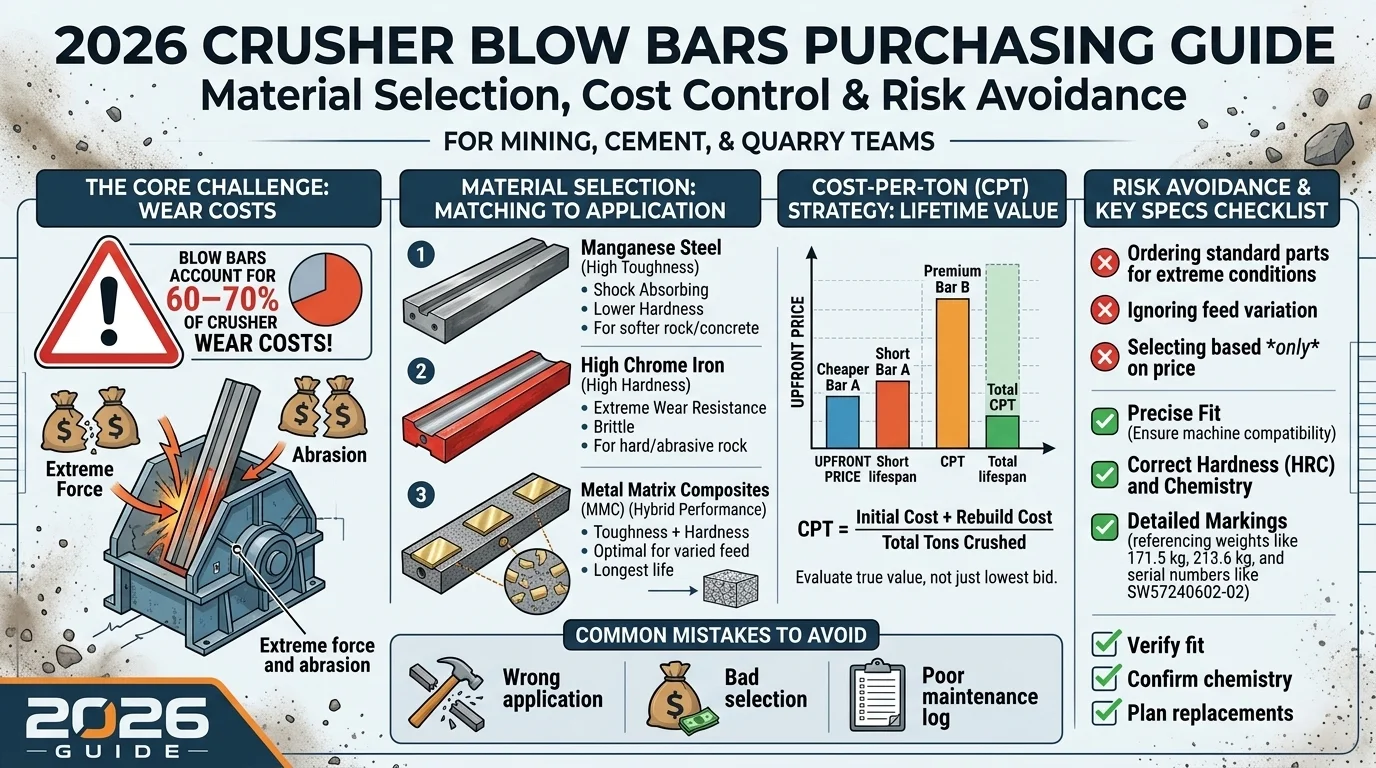
Blow bars are the most critical — and most expensive — wear parts in an impact crusher. They account for 60–70% of total wear part costs (Metso Outotec, Nordberg NP Series Impact Crushers — Wear Parts Application Guide, Doc. No. 2757-05-12-SBL, 2012), and their condition directly controls your output quality, throughput, and rotor safety.
Yet most operations follow the same cycle: replace the part, restart the machine, and wait for the next failure. The root cause never gets fixed.
This article breaks that cycle.
We cover the 8 most common blow bar problems, with clear explanations of what you see, why it happens, and what to do — so you spend less time troubleshooting and more time crushing.
Why Blow Bar Problems Deserve Serious Attention
Before jumping into the list, it’s worth understanding the stakes.
A single blow bar failure can trigger:
- Unplanned downtime (often 4–12 hours per incident)
- Reduced throughput and poor product shape
- Rotor imbalance and bearing overload
- In severe cases — rotor damage costing tens of thousands of dollars
Blow bar wear is influenced by multiple factors, with feed material composition being the single biggest driver:
| Factor | Impact on Wear Life |
| Feed material abrasiveness | ~45% |
| Rotor speed | ~20% |
| Feed moisture content | ~12% |
| Fine particle ratio in product | ~10% |
| Crushing ratio | ~8% |
| Upper/lower gap ratio | ~5% |
Source: Industry reference data compiled from Kleemann and Metso technical documentation (Kleemann GmbH / Wirtgen Group, Parts and More Compact — Blow Bars, Publication No. 2567126 EN-02/19, 2019; Metso Outotec, NP Series Wear Parts Application Guide, 2012). Exact percentages may vary by application and material type.
The good news: most blow bar problems are preventable. Correct material selection + proper operation + daily inspection = longer service life, lower cost per ton, and safer equipment.
The 8 Most Common Blow Bar Problems
Problem 1: Impact Crusher Blow Bar Wearing Out Too Fast
What you see: Blow bars wear thin after unusually short service periods. Replacement frequency is high. Cost per ton is climbing.
Why it happens:
- Wrong material grade— using manganese steel on highly abrasive granite or river gravel, when high chrome or ceramic composite is needed
- Rotor speed too high— wear rate increases with the square of rotor speed, a well-established relationship in impact crushing engineering (L = K × W², where L = wear rate, K = material-specific wear factor, W = rotor speed). Even a 10% speed increase can reduce blow bar life by approximately 20%
- Crusher gap too large— longer particle travel path = more abrasive contact
- Highly abrasive feed material— quartzite, granite, river gravel all accelerate wear
- Manganese not work-hardened— manganese steel needs impact to harden; low-impact applications leave it soft and vulnerable
What to do:
Match material grade to your feed (see material selection table below)
Start at medium rotor speed; adjust based on product quality, not maximum throughput
Set upper gap at ~30% of maximum feed size; lower gap at 100% of target product size
Pre-screen to remove fines; install a magnetic separator to eliminate tramp iron
For highly abrasive rock (granite, basalt), consider ceramic composite blow bars — service life is 3–5× longer than single-alloy options
Problem 2: Blow Bar Cracking or Breaking — Causes and Prevention
What you see: A blow bar breaks in two, corners chip off, or fragments damage the crusher chamber. This is the most dangerous failure mode.
Why it happens:
- Wrong material for the application— high chrome iron is extremely hard (approximately 600–650 HB) but brittle (impact resistance typically in the range of 5–10 J/cm²). One piece of rebar or tramp iron can shatter it
- Oversized feed— material exceeding the crusher’s maximum feed size creates sudden overload
- Casting defects— voids, inclusions, or uneven hardness in low-quality blow bars
- Running past wear limits— bars worn beyond the minimum thickness lose structural integrity
What to do:
Never use high chrome iron when feed contains steel, rebar, or tramp iron — use manganese or martensitic steel instead
Control maximum feed size (rule of thumb: no single piece larger than 80–85% of feed opening)
Source blow bars from reputable manufacturers with proper metallurgical certification
Replace at the defined wear limit — for most NP-series crushers, this means replacing when wear depth “D” reaches 55–80 mm depending on model (Metso Outotec, Nordberg NP Series Impact Crushers — Wear Parts Application Guide, Doc. No. 2757-05-12-SBL, 2012)
Replace the full set even if only one bar breaks — running mixed wear states causes dangerous imbalance
Qiming Casting manufactures blow bars in manganese, martensitic, and high chrome iron grades, with strict casting quality control and dimensional inspection. Each batch is hardness-tested before shipment — contact their team for a free material recommendation based on your feed conditions.
Problem 3: Uneven Wear — One Side Wears While the Other Side Is Fine
What you see: One end or face of the blow bar wears much faster than the other. Overall material utilization is low — you’re discarding bars that still have useful life on one side.
Why it happens:
- Off-center feed— material entering the crushing chamber off to one side creates uneven impact load
- Machine not level— a crusher tilted even a few degrees will distribute wear asymmetrically
- Unequal apron gaps— upper and lower aprons set at different gaps on left vs. right
- Blow bars of unequal weight— mixing bars from different batches or brands creates imbalance that amplifies one-sided wear
What to do:
Center the feed chute; ensure the material curtain falls evenly across the full rotor width
Check machine levelness with a spirit level — correct any inclination
Verify apron gaps are equal on both sides using a calibrated feeler gauge
Always install blow bars as a matched set from the same batch — weigh each bar before installation, tolerance should be within ±0.5 kg
Problem 4: Loose Blow Bars, Displacement, or Rattling in the Chamber
What you see: Abnormal banging or metallic rattling from the crusher. Inspection reveals a blow bar has shifted in its seat, or a wedge/clamp has backed off.
Why it happens:
- Bolts not torqued to specification during installation
- Blow bar contact faces not properly seated against the rotor pocket
- Thermal expansion during operation causing fasteners to loosen
- Worn locking wedges or clamping hardware
What to do:
Follow the manufacturer’s torque specification exactly — do not estimate by feel
Inspect rotor pockets for wear or deformation before installing new bars
After the first 2 hours of operation, shut down and re-torque all fasteners — thermal cycling will relax clamp force in the first run
Replace worn wedges, bolts, or clamping components at every blow bar change
Clean rotor contact surfaces thoroughly before installation — debris under the bar causes rocking and accelerated loosening
Problem 5: Poor Product Shape or Oversized Output
What you see: Crushed product contains too many flat, elongated, or angular pieces. Oversized material increases. Product fails gradation specifications.
Why it happens:
- Blow bar edge worn round— a dull impact edge cannot generate clean fracture planes; the rock is squeezed rather than struck
- Crusher gap too large— material passes through without sufficient reduction
- Rotor speed below rated RPM— insufficient tip speed reduces impact energy
- Worn apron plates— secondary and tertiary aprons no longer redirect material efficiently
What to do:
Monitor blow bar profile regularly — a rounded leading edge is the first sign the bar needs to be flipped or replaced
Flip reversible blow bars when the active face wears round (most designs allow one flip per bar)
Reduce apron gap incrementally until product shape improves — check for blockage risk at each step
Verify rotor speed with a tachometer; do not assume the drive system is maintaining rated RPM under load
Inspect and replace apron plate liners when worn
Pro Tip from Qiming Casting: A worn impact edge is often the first sign your blow bar needs flipping. Qiming Casting offers reversible blow bars with a precisely chamfered leading edge geometry — designed to maintain sharp impact performance longer than standard profiles. Contact their team for a geometry comparison specific to your crusher model.
Problem 6: Ceramic Tiles Spalling or Delaminating on Ceramic Composite Blow Bars
What you see: The ceramic layer peels, cracks, or falls off the blow bar surface. The exposed base metal wears rapidly. The expensive upgrade loses its advantage quickly.
Why it happens:
- Impact overload— ceramic composite bars are designed for abrasion resistance, not high-impact primary crushing with oversized feed
- Tramp iron— a single steel piece can shatter the ceramic layer on contact
- Poor bonding quality— low-cost ceramic inserts with insufficient metallurgical bonding to the base alloy
- Wrong application— ceramic composites should not be used on steel slag or applications with frequent tramp iron
What to do:
Do not use ceramic composite bars for primary crushing or any feed that may contain steel or rebar
Ensure tramp iron removal (overband or drum magnets) is working before material reaches the crusher
Source ceramic composite bars from manufacturers who use genuine MMC (Metal Matrix Composite) technology with embedded, not surface-bonded, ceramic particles
For slag crushing or demolition recycling with high steel content, switch to martensitic or manganese grades
Qiming Casting offers both standard and ceramic composite blow bars for all major crusher brands (Metso, Kleemann, Hazemag, Terex, Sandvik, and 20+ others). Their engineering team can advise whether ceramic composite is appropriate for your specific application — and prevent a costly mistake.
Problem 7: Excessive Crusher Vibration from Rotor Imbalance
What you see: The crusher vibrates noticeably during operation. Bearing temperature rises above normal. Motor current fluctuates or increases. In severe cases, bearing failure occurs.
Why it happens:
- Rotor imbalance from unequal blow bar weights— even a 1–2 kg difference between opposing bars creates measurable dynamic imbalance at operating speed
- Mixing blow bars from different brands or batches— dimensional and weight differences cause offset mass distribution
- Non-uniform wear across the bar set— if bars are replaced one at a time, the remaining bars accumulate different wear profiles
What to do:
Always replace all blow bars as a complete set, same batch, same grade
Weigh each bar on a scale before installation — opposing bars (180° apart) must be within ±0.5 kg of each other
Never mix blow bars from different suppliers or production batches on the same rotor
If vibration persists after a new set is installed, contact your crusher OEM or a qualified service technician to perform a dynamic balance check on the rotor assembly. Do not continue operating with abnormal vibration — bearing failure can follow within hours.
Monitor bearing temperature during the first hour after each blow bar change
Problem 8: Throughput Drop or Frequent Chamber Blockage
What you see: Crushing rate declines noticeably. The machine blocks more often. Power draw increases for the same feed rate. Operators slow down feed to avoid blockage.
Why it happens:
- Blow bars worn too short— reduced bar height means less projection from the rotor face, lower impact energy, and larger effective gap
- Apron gap too large— undersize bar height combined with wide apron gaps allows material to pass without full reduction
- Dull impact edge— a rounded bar no longer fractures rock efficiently; material recirculates and builds up
- Sticky or wet feed— moisture in feed material (>8%) can cause packing, especially in limestone or clay-bearing rock
What to do:
Replace blow bars before they wear to minimum height — operating past the wear limit reduces output and risks rotor damage
After installing new bars, re-set the apron gaps to compensate for the increased bar height
If feed moisture is high, consider adding a pre-drying or pre-screening step
Clean the crusher chamber daily — compacted fines around the apron zones are a major contributor to blockage
Blow Bar Material Selection Guide
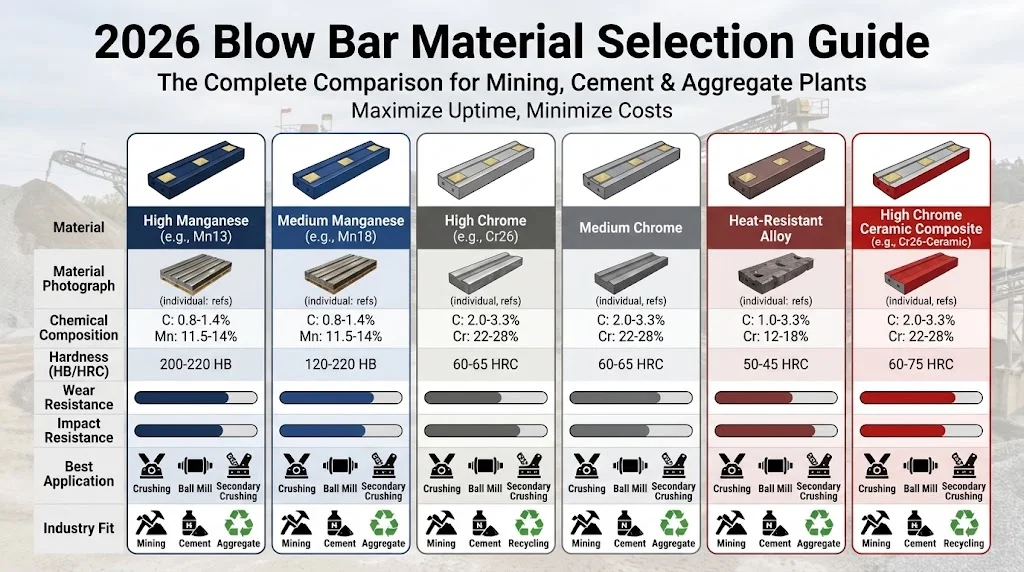
Choosing the right material is the single most impactful decision you can make. Here is a quick reference:
| Material | Hardness | Impact Strength | Best For | Avoid When |
| Manganese Steel | ~200 HV (work-hardens to 500 HV) | ~250 J/cm² | Primary crushing, large feed, feed with tramp iron | Low-impact or low-abrasion apps (stays soft) |
| Martensitic Steel | 500–550 HB | 100–300 J/cm² | Limestone, asphalt, C&D waste, secondary crushing | Highly abrasive rock without tramp iron risk |
| High Chrome Iron | 600–650 HB | ~10 J/cm² | Secondary/tertiary, clean hard stone, no tramp iron | Any feed with steel, rebar, or tramp iron |
| Martensitic + Ceramic (MMC) | 500–550 HB | High | C&D recycling, concrete, asphalt, quarry secondary | Steel slag, tramp-iron-heavy feeds |
| High Chrome + Ceramic (MMC) | 600–650 HB | Medium–High | Highly abrasive stone, quarry secondary, gravel | Primary crushing, high-iron feeds |
Source: Kleemann GmbH (Wirtgen Group), Parts and More Compact — Blow Bars, Publication No. 2567126 EN-02/19 (2019); Metso Outotec, NP Series Wear Parts Application Guide (2012)
Not sure which grade fits your operation? Qiming Casting manufactures all five grades listed above — including MMC ceramic composite — and supplies compatible blow bars for Metso, Kleemann, Hazemag, Sandvik, Terex, Powerscreen, and 20+ other crusher brands. Their engineering team provides free material recommendations based on your feed type, abrasiveness rating, and crusher model.
Daily Maintenance Checklist
Good blow bar management is 80% habit. Use this checklist every shift:
Before startup:
- Check blow bar surface for visible cracks, chips, or spalling
- Verify no loose bolts or wedges by hand inspection
- Confirm apron gaps are set correctly
- Check that the magnetic separator / tramp iron removal system is operating
During operation:
- Monitor bearing temperature (normal range: ambient + 30–40°C)
- Listen for abnormal impacts, rattling, or changes in crusher tone
- Check motor current — a sustained rise often means worn bars or gap issues
After operation:
- Measure blow bar wear depth and log it
- Re-torque fasteners if within the first 2 hours of a new installation
- Clean the crushing chamber — remove compacted fines from apron zones
Replace when:
- Wear depth “D” reaches 55–80 mm (model-dependent)
- Product shape degrades and gap adjustment no longer corrects it
- Any bar shows cracking, corner breakage, or ceramic spalling
⚠️ Always replace the full set — never swap just one bar.
Key Takeaways
The vast majority of blow bar problems trace back to four root causes:
Wrong material selection for the actual feed conditions
Improper installation — wrong torque, mixed batches, unequal weights
Off-spec feed — oversized material, tramp iron, off-center delivery
Running past wear limits — the most avoidable cause of downstream damage
Fix these four, and you will see:
- 30–50% longer blow bar service lifein most applications
- Fewer unplanned shutdowns
- Better product shape and gradation consistency
- Lower cost per ton of crushed material
Need Help Choosing the Right Blow Bar for Your Operation?
Every quarry, cement plant, and mining site has different feed conditions. A blow bar that works perfectly in a limestone quarry will fail quickly in a granite crushing plant — and vice versa.
Qiming Casting specializes in high-performance wear parts for impact crushers, including blow bars in all standard grades (manganese, martensitic, high chrome, and ceramic composite). They supply parts compatible with Metso, Kleemann, Hazemag, Sandvik, Terex, Powerscreen, and 20+ other brands.
Their engineering team offers free application-based material recommendations — just provide your feed material type, abrasiveness, feed size, and crusher model.
Because the right blow bar, properly installed and maintained, is not a cost — it’s an investment that pays back on every ton you crush.
**Drop a comment below or contact Qiming Casting directly** if you have a specific problem. Describe your feed material, crusher model, and current blow bar grade, and their team will give you a concrete recommendation.
*Data references: Metso NP Series Impact Crusher Wear Parts Technical Reference; Kleemann Wear Parts & Service Guide; Magotteaux Impact Crusher Wear Solutions*