Material Selection, Cost Control & Risk Avoidance
Introduction
Blow bars are the most consumed wear part in any impact crusher operation. They account for 60–70% of total wear-part costs per machine — making them the single biggest variable in your crushing cost structure. (Source: Metso NP Series Wear Parts Manual, 2024 Edition)
In 2026, the industry has shifted meaningfully. composite materials — martensitic-ceramic and high-chrome-ceramic MMC hybrids — are now mainstream, adopted across quarrying, mining, and recycling operations worldwide. The dominant buying logic has moved from unit price to cost-per-ton, and from single-alloy to application-matched material grades.
Three trends are defining procurement decisions this year:
- Composite materials becoming standard— MMC bars deliver 2–4× the service life of single-alloy alternatives in high-abrasion applications
- Lifespan-first thinking— buyers are calculating total operating cost, not catalog price
- Cost-per-ton optimization— operations that track wear cost per ton crushed consistently outperform those that don’t
This guide is built for procurement managers and technical engineers at mines, cement plants, and quarry operations. It covers how to match the right material to your feed conditions, what specs actually matter when placing an order, how to verify quality on delivery, and how to avoid the mistakes that damage machines and drain budgets.
Section 1: Core Materials in 2026 — What’s Available and How They Compare
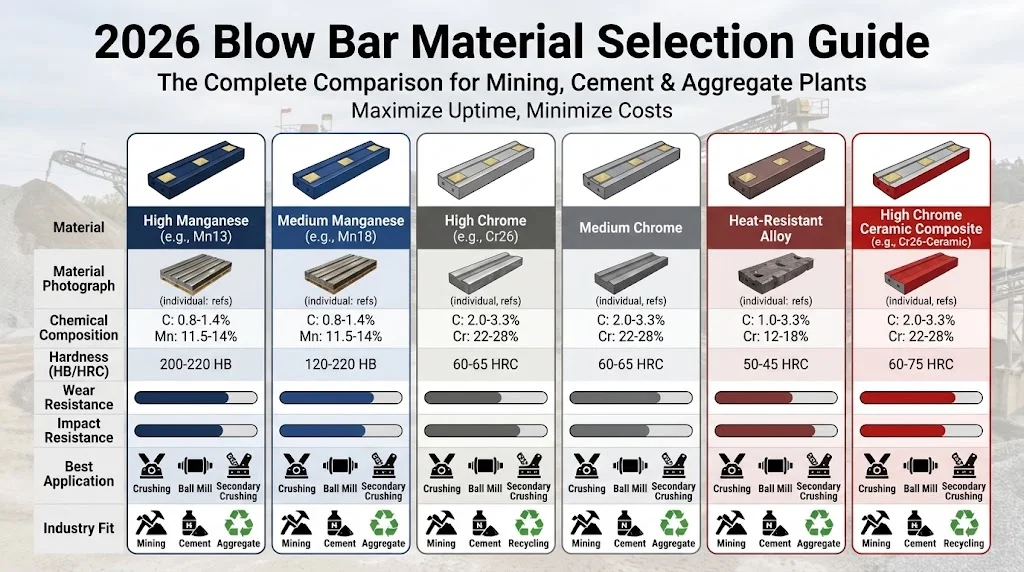
There are six material categories you’ll encounter from any serious blow bar supplier in 2026. Here’s what each one actually means for your operation.
1. Manganese Steel (Work-Hardening)
Initial hardness: ~200 HB (below HRC measurement range; not applicable in HRC scale); work-hardens to ~500 HV (≈ HRC 50) under sustained impact. (Source: BHS Crusher Wear Parts Technical Reference)
Manganese is tough. It absorbs shock without cracking. But it only hardens when it’s being hit — which means in low-abrasion conditions like soft limestone, it stays relatively soft and wears quickly.
Best for: Primary crushing with large feed, tramp iron risk, demolition applications where unexpected metal in the feed is a real possibility.
Avoid if: You’re running secondary or tertiary crushing with clean, abrasive stone. The work-hardening never fully develops and you’ll burn through bars fast.
2. Martensitic Steel
Hardness: HRC 44–57. Impact toughness: 100–300 J/cm². (Source: BHS Crusher Wear Parts Technical Reference)
Martensitic steel sits between manganese and high-chrome. It delivers both hardness and toughness — it resists wear without being brittle. It handles moderate tramp iron better than chrome-based materials.
Best for: C&D waste, reinforced concrete, blasted limestone, mixed-content primary crushing.
3. High-Chrome Iron (White Iron)
Hardness: HRC 60–64. Impact toughness: ~10 J/cm² — extremely low. (Source: BHS Crusher Wear Parts Technical Reference)
High-chrome is the hardest standard blow bar material and the most abrasion-resistant. It excels in clean, fine-feed secondary crushing. But its brittleness is a serious operational liability.
One piece of rebar in the feed can shatter a high-chrome bar and destroy your rotor.
Best for: Secondary and tertiary crushing, clean stone (granite, gravel, basalt), asphalt recycling with no metal contamination.
Never use for: Primary crushing, C&D waste with rebar, or any application with uncontrolled feed.
4. Manganese + TiC (Titanium Carbide Insert)
Manganese steel base with TiC ceramic inserts cast in. Increases wear resistance by ~100% vs. plain manganese without sacrificing impact toughness. (Source: Sunwill Wear Parts Material Comparison, Technical Whitepaper)
Best for: Primary crushing of large feed where iron contamination risk exists, but you need longer bar life than plain manganese delivers.
5. Martensitic + Ceramic (MMC)
Ceramic particles (typically TiC or alumina) cast into a martensitic steel matrix. Service life 3–5× longer than plain martensitic steel. (Source: BHS Crusher Wear Parts Technical Reference; Metso NP Series Wear Parts Manual, 2024 Edition)
The Xwin® and Recyx® product lines (produced by Magotteaux for Metso), as well as equivalent MartComp/MartXpert series from other OEMs, fall into this category.
Best for: C&D recycling (concrete, asphalt), primary quarry applications, mixed feed with occasional tramp iron.
Avoid for: Slag recycling (over-abrasive, destroys ceramic layer prematurely) and pure soft limestone (over-engineered, with thermal stress accumulation risk on extended runs).
6. High-Chrome + Ceramic (MMC)
Ceramic particles cast into a high-chrome iron matrix. Best-in-class abrasion resistance. Wear life 2–4× standard high-chrome for abrasive secondary applications. (Source: Sunwill Wear Parts Material Comparison, Technical Whitepaper)
The neoX® (Magotteaux for Metso) and equivalent ChromComp/C650C/C650X series from aftermarket suppliers are examples.
Best for: Secondary and tertiary crushing of granite, basalt, gravel, hard abrasive stone — clean feed with no tramp iron.
Material Comparison Table
| Material | Hardness | Impact Toughness | Abrasion Resistance | Tramp Iron Safe? | Typical Application |
| Manganese Steel | ~200 HB (up to HRC 50 work-hardened) | ★★★★★ | ★★ | ✅ Yes | Primary, large feed, tramp iron risk |
| Manganese + TiC | ~200 HB base | ★★★★★ | ★★★ | ✅ Yes | Primary, longer life required |
| Martensitic Steel | HRC 44–57 | ★★★★ | ★★★ | ⚠️ Moderate | C&D, blasted rock, primary-secondary |
| Martensitic + Ceramic (MMC) | HRC 44–57 | ★★★★ | ★★★★★ | ⚠️ Moderate | C&D recycling, quarry primary |
| High-Chrome Iron | HRC 60–64 | ★ | ★★★★ | ❌ No | Secondary, clean abrasive stone |
| High-Chrome + Ceramic (MMC) | HRC 60–64 | ★ | ★★★★★ | ❌ No | Secondary/tertiary, hard clean stone |
Section 2: Application-Based Selection — Match the Bar to the Job
Don’t start with material. Start with your feed conditions. Then pick the material.
Scenario A: Primary Crushing / Large Feed / Tramp Iron Risk
Typical operations: mining primary stations, demolition waste, C&D with rebar, municipal solid waste
Choose: Manganese Steel or Manganese + TiC
High-chrome will shatter. Martensitic is borderline risky. Manganese absorbs the shock. If you need longer life and your iron content is controllable, step up to Manganese + TiC.
One-line rule: Any chance of metal in the feed? Manganese only.
Scenario B: C&D / Concrete / Asphalt Recycling
Typical operations: concrete crusher stations, asphalt recycling plants, demolition recycling
Choose: Martensitic Steel or Martensitic + Ceramic (MMC)
You need toughness for rebar and reinforcement mesh, but your feed is smaller and more controlled than raw primary crushing. Martensitic handles it well. For high-volume operations, upgrade to martensitic-ceramic MMC for 3–5× the bar life.
One-line rule: Clean concrete or asphalt? Martensitic. High volume? Go MMC.
Scenario C: Secondary / Tertiary Crushing / Hard Clean Stone
Typical operations: granite quarry secondary stage, basalt crushing, gravel pit processing, cement plant secondary
Choose: High-Chrome Iron or High-Chrome + Ceramic (MMC)
Your feed is clean, smaller, and highly abrasive. High-chrome is the only cost-effective solution for abrasion resistance at this level. For very hard stone (granite, basalt, siliceous rock), step up to high-chrome ceramic MMC.
One-line rule: Zero tramp iron, hard abrasive stone? High-chrome. Very hard? High-chrome MMC.
Selection Decision Tree
- Is there tramp iron / rebar / metal in the feed?
- Yes→ Manganese Steel
- Need longer life? → Manganese + TiC
- No→ What’s the feed type?
- C&D / Concrete / Asphalt → Martensitic Steel
- High volume? → Martensitic + Ceramic MMC
- Clean abrasive stone (secondary/tertiary) → High-Chrome Iron
- Very hard stone (granite, basalt)? → High-Chrome + Ceramic MMC
- C&D / Concrete / Asphalt → Martensitic Steel
- Yes→ Manganese Steel
Section 3: Key Purchasing Specifications
When you place an order, these are the specs that must be confirmed in writing — not assumed.
Material & Hardness
Specify grade by hardness range, not just name. “Martensitic” without a hardness spec is meaningless.
Acceptable ranges:
- Martensitic: HRC 44–57
- High-Chrome: HRC 60–64
- Manganese: 200 HB minimum, with cold-work hardening capability verified
For MMC products, require a ceramic content specification and ceramic layer depth — minimum 10–15 mm for standard MMC, 20+ mm for premium grades like Recyx® or neoX®.
Hardness specification is the most commonly overlooked detail in blow bar procurement. A supplier who can’t provide batch hardness certificates should not be on your approved list.
Dimensional Tolerances & Mounting Types
Blow bars come in several mounting configurations. Confirm which type your rotor requires:
| Mounting Type | Description | Common Machines |
| X-type (wedge) | Single wedge, full contact, no gap | Metso NP series, BHS |
| S-type (slot) | Slotted recess, side-loading | Kleemann, MEKA, Rockster |
| C-type (clamp) | Top clamp with bolts | Older Hazemag, some secondary crushers |
| Wedge block | Separate wedge retainer system | MEKA MSI series, some Terex |
Dimensional tolerance: ±0.5 mm on critical fit dimensions. Loose-fit bars vibrate and cause abnormal rotor wear.
Weight & Dynamic Balance
This is where many buyers get burned.
For 4-bar rotors (standard on most machines including Rockster R-series and Metso NP), the weight difference between any two opposing bars must not exceed:
- ≤ 100 g for bars under 50 kg
- ≤ 200 g for bars 50–100 kg
- ≤ 300 g for bars over 100 kg
Imbalanced bars cause rotor vibration, bearing wear, and can crack the rotor body over time. Always request a weight certificate — and weigh bars yourself on delivery. A weight certificate plus physical verification on-site is your double layer of protection. Neither check alone is sufficient.
Surface Quality Requirements
Specify in your purchase order:
- No surface cracks(visual inspection + dye penetrant testing on request)
- No shrinkage porosityon wear faces
- No slag inclusionsin base material
- Ceramic layer uniformityfor MMC: ceramic distribution must be visually even, no bare patches on wear surface
Compatible Machine Models
When ordering, always confirm compatibility with your specific model:
- Metso NP series(NP1110, NP1213, NP1315, NP1520, NP1620, NP2023)
- Kleemann MR/MCO series
- BHS Horizontal Impact Crusher
- MEKA MPI / MSI series
- Rockster R700–R1100
- Hazemag AP/APS series
Provide rotor drawings or bar dimensions from your OEM manual. A technically capable supplier like Qiming Casting will cross-reference your model number and confirm dimensional fit before shipment — not after.
These five specification categories — material grade, mounting type, dimensional tolerance, weight balance, and surface quality — form the minimum checklist for any blow bar purchase order. The next step is verifying that what arrives actually matches what you ordered.
Section 4: Quality Inspection Standards
A single batch of out-of-spec bars that passes without inspection can cost more in rotor damage than the entire order value. Here’s what to check before anything goes near your crusher.
On Arrival — Visual Inspection
- ✅ No visible cracks on any surface (especially edges and ends)
- ✅ No shrinkage cavities on wear faces
- ✅ No visible slag inclusions or cold-shut defects
- ✅ Mounting surfaces are flat and free of casting flash
- ✅ For MMC: ceramic surface is uniform, no large bare zones
Dimensional Check
- ✅ Length, width, height within ±0.5 mm of spec
- ✅ Mounting slot/wedge recess matches your rotor drawing
- ✅ Both edges are parallel (non-parallel bars cause uneven wear)
Hardness Testing
- Use a portable Leeb hardness tester on multiple points of the wear surface
- Acceptable variance across the same bar: ≤ 3 HRC
- If readings fall significantly below spec, reject the batch — don’t negotiate on hardness
Weight & Balance Verification
- Weigh every bar individually with a calibrated scale
- Group bars into matched pairs for rotor installation
- Reject any bar where pair-weight difference exceeds the tolerance specified above
MMC-Specific — Ceramic Layer Check
- Visual: ceramic particles should be visible and evenly distributed across the wear face
- Scratch test with a tungsten carbide tool: ceramic zones should resist scratching
- Request third-party bond-strength test for high-value orders (>$10,000)
Run-In Acceptance
After installation, run the machine at normal speed for 30 minutes with standard feed. Stop and inspect if:
- Abnormal vibration is detected
- Unusual noise from the crusher chamber
- Any bar shows cracks or breakage after first run
- Rotor does not return to normal operating speed as expected
Section 5: Cost Optimization — Think Cost-Per-Ton, Not Unit Price
The cheapest bar on paper is rarely the cheapest bar per ton crushed.
This is the most important shift in how serious operations evaluate wear parts in 2026.
The Real Cost Formula
Cost per ton = Bar purchase price ÷ Total tons crushed before replacement
A high-chrome ceramic MMC bar that costs 3× a plain high-chrome bar — but lasts 4× as long — costs 25% less per ton while also delivering fewer changeovers, less downtime, and lower labor cost.
Material Wear Factors
Industry data on abrasion wear impact factors across quarry and recycling applications: (Source: BHS Crusher Wear Parts Technical Reference — operational data across multiple quarry and recycling applications)
| Factor | Share of Total Wear |
| Feed material type & abrasivity | 45% |
| Rotor speed | 20% |
| Feed moisture content | 12% |
| Fines ratio in feed | 10% |
| Crushing ratio setting | 8% |
| Top/bottom gap ratio | 5% |
Feed material accounts for nearly half of all wear. This is why material selection matters more than any other procurement variable — and why matching bar grade to feed conditions is a cost decision, not just a technical one.
Cost Strategy by Scenario
High-abrasion quarry (granite, basalt, siliceous stone): → Plain high-chrome will be consumed quickly. Upgrade to high-chrome MMC. The premium typically pays back within one quarter at standard throughput volumes.
C&D recycling with rebar: → Never use high-chrome. One shattered bar can cost more than 20 replacement bars when you factor in rotor damage. Use martensitic or martensitic MMC — every time.
Soft limestone primary station: → Don’t over-engineer. Plain manganese or manganese+TiC is sufficient. MMC for soft limestone can create thermal stress issues over long runs, and the life improvement doesn’t justify the cost premium.
Procurement Efficiency Tips
- Standardize specificationsacross machines where possible — reduces SKU count and enables volume pricing
- Maintain 2 sets of replacement bars on-site— eliminates emergency freight costs and unplanned downtime
- Order matched sets (4 bars per rotor)— individually sourced bars rarely meet weight tolerance requirements
- Negotiate blanket ordersfor 6–12 months — stable supply pricing and priority fulfillment
Qiming Casting offers blanket order programs for mining and cement plant buyers, with bar sets matched by weight and certified hardness, ready for direct rotor installation.
Section 6: Common Mistakes That Cost Operations Serious Money
❌ Mistake 1: Buying on Price, Not Material
The most expensive mistake in wear-parts procurement. A bar that’s 30% cheaper but lasts 50% less long costs more — and creates more downtime. Always calculate cost-per-ton before approving any purchase.
❌ Mistake 2: Using High-Chrome in Rebar-Contaminated Feed
This is a machine-damage risk, not just a wear issue. High-chrome bars are brittle by design. A single rebar or steel bolt in the feed can shatter a bar, and the fragments become projectiles inside the crusher chamber. Based on industry repair cost estimates, rotor damage from shattered high-chrome bars typically runs into tens of thousands of dollars — often exceeding the total value of the bar order itself.
If your feed comes from demolition sites, construction recycling, or quarry blasting near infrastructure, always use manganese or martensitic.
❌ Mistake 3: Running Bars Past the Wear Limit
When a bar wears down to its minimum dimension, the rotor body itself starts absorbing direct impact. This is how rotors get damaged — expensively and avoidably.
Replace before the wear limit — not after.
Wear limits by common Metso NP model: (Source: Metso NP Series Wear Parts Manual, 2024 Edition)
| Model | Minimum Remaining Dimension (D) |
| NP1110 | 55 mm |
| NP1213 | 60 mm |
| NP1315 | 70 mm |
| NP1415 | 70 mm |
| NP1520 | 70 mm |
| NP1620 | 80 mm |
| NP2023 | 50 mm |
❌ Mistake 4: Mixing Bar Brands or Batches on One Rotor
Different manufacturers cast bars to different density profiles — even when nominal hardness and dimensions look identical. Mixing bars from two sources on one rotor almost always creates a weight imbalance. The result: vibration, bearing wear, uneven bar consumption, and reduced throughput.
Always change all 4 bars at the same time, from the same production batch.
❌ Mistake 5: Skipping the Weight Check
Weight certificates can be inaccurate. Bars within the same batch can vary. Weigh every bar yourself on delivery with a calibrated scale before installation. It takes 10 minutes and can save you a rotor.
Section 7: Working With a Reliable Supplier — What to Expect
The blow bar market includes OEM suppliers, authorized distributors, and aftermarket manufacturers. Price ranges vary significantly — but what matters operationally is consistency, traceability, and technical depth.
What a serious supplier should provide:
- Material certification (alloy composition and heat treatment records)
- Hardness test certificate per batch
- Weight certificate with individual bar weights
- Dimensional inspection report
- Bars delivered in matched sets (weight-balanced for your rotor)
- Application-level technical support — not just a catalog
Qiming Casting is a professional manufacturer of impact crusher wear parts, specializing in blow bars for mining, cement, and aggregate applications. Their product range covers all six material grades discussed in this guide — from standard manganese and martensitic, to high-chrome MMC and ceramic composite bars — with compatibility across Metso NP, Kleemann, BHS, MEKA, Rockster, Hazemag, and other major platforms.
For buyers managing multiple crusher fleets, Qiming Casting provides application-specific material recommendations, matched-weight bar sets, and custom specifications for non-standard rotor configurations.
Section 8: 2026 Purchasing Summary and Recommendations
Blow bars are a consumable. But the decisions you make about which ones to buy, and how you manage them, are a permanent part of your cost structure.
The core selection logic:
Match the material to the feed. Protect the rotor. Calculate cost-per-ton.
Final Recommendations
- Always start with feed analysisBefore selecting a material, know your feed: rock type, abrasivity level, and whether tramp iron or rebar is a realistic risk. The answers determine your material class — everything else follows from there.
- Move toward MMC where it paysFor high-abrasion secondary crushing and high-volume C&D recycling, composite materials deliver 3–5× service life. At current pricing, the upgrade typically pays back within one quarter.
- Never compromise on tramp iron safetyNo bar-life improvement justifies using brittle high-chrome in contaminated feed. Machine protection is non-negotiable.
- Standardize and stockStandardize bar specs across your fleet where possible. Keep at least one spare set per crusher on-site. Emergency changeovers are expensive; planned ones are not.
- Verify before you installWeigh bars. Check hardness. Inspect surfaces. One hour of incoming inspection per delivery eliminates the most common causes of premature failure.
- Choose suppliers with technical depthThe right bar for your application isn’t always the one listed in a catalog. Work with suppliers — like Qiming Casting— who will review your feed conditions, machine model, and throughput targets before recommending a specification. That conversation is worth more than any discount.
In 2026, the operations that get blow bar procurement right will crush more tons, spend less on wear parts, and keep their machines running longer. The decisions are not complicated — but they do require the right information, applied consistently.