High Chrome vs. Martensitic Alloy Steel Blow Bars: A Complete Comparison for Crushers
Introduction
In horizontal shaft impact (HSI) crushers, Blow bars are the core wear parts that directly determine crushing efficiency, downtime, and operational cost. Two of the most widely used materials are high chromium cast iron (Cr15, Cr20, Cr27) and premium martensitic alloy steel (Cr4-Ni-Mo fortified).
This post breaks down their chemical composition, microstructure, heat treatment, mechanical properties, and ideal working conditions to help you select the right blow bar for your mining, quarrying, or recycling operation.
1. Chemical Composition Comparison
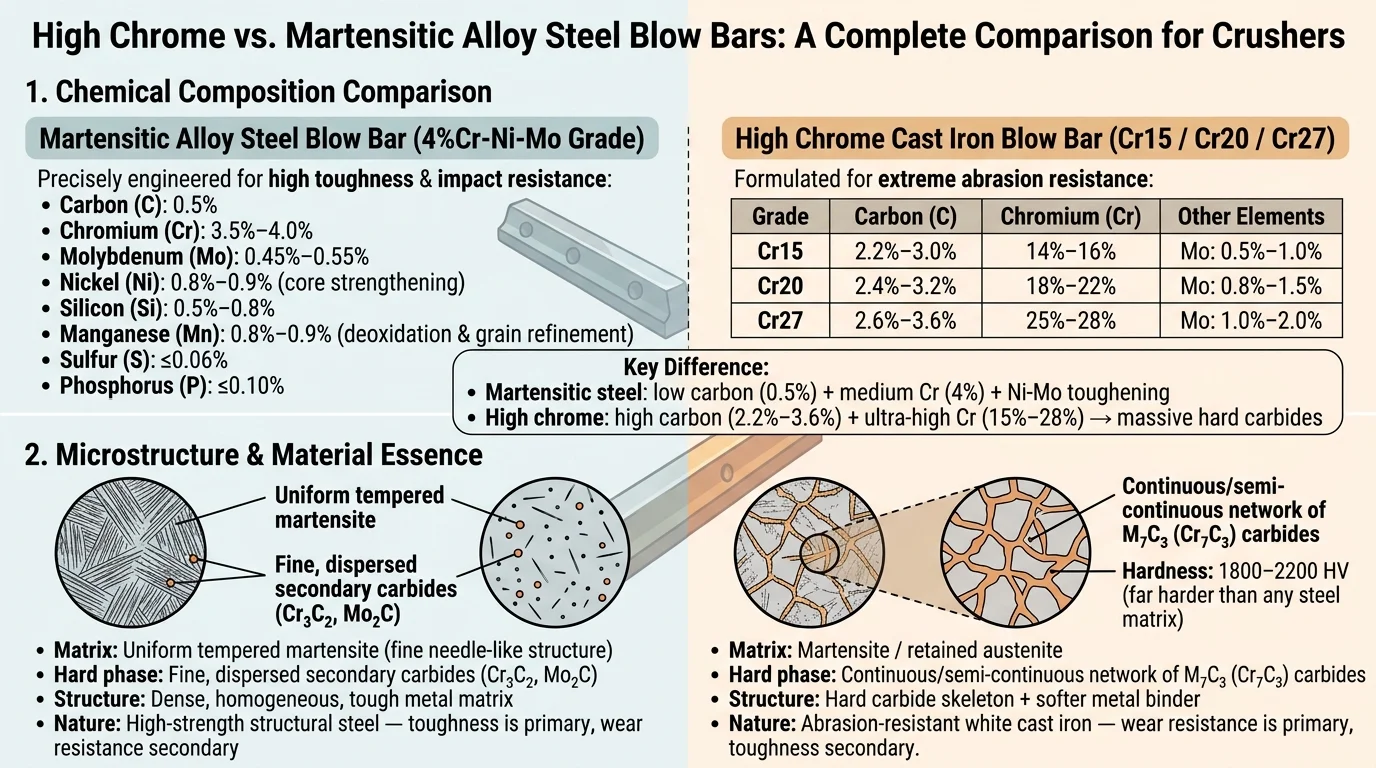
Martensitic Alloy Steel Blow Bar (4%Cr-Ni-Mo Grade)
Precisely engineered for high toughness & impact resistance:
-
Carbon (C): 0.5%
-
Chromium (Cr): 3.5%–4.0%
-
Molybdenum (Mo): 0.45%–0.55%
-
Nickel (Ni): 0.8%–0.9% (core strengthening)
-
Silicon (Si): 0.5%–0.8%
-
Manganese (Mn): 0.8%–0.9% (deoxidation & grain refinement)
-
Sulfur (S): ≤0.06%
-
Phosphorus (P): ≤0.10%
High Chrome Cast Iron Blow Bar (Cr15 / Cr20 / Cr27)
Formulated for extreme abrasion resistance:
|
Grade
|
Carbon (C)
|
Chromium (Cr)
|
Other Elements
|
|---|---|---|---|
|
Cr15
|
2.2%–3.0%
|
14%–16%
|
Mo: 0.5%–1.0%
|
|
Cr20
|
2.4%–3.2%
|
18%–22%
|
Mo: 0.8%–1.5%
|
|
Cr27
|
2.6%–3.6%
|
25%–28%
|
Mo: 1.0%–2.0%
|
Key Difference
-
Martensitic steel: low carbon (0.5%) + medium Cr (4%) + Ni-Mo toughening
-
High chrome: high carbon (2.2%–3.6%) + ultra-high Cr (15%–28%) → massive hard carbides
2. Microstructure & Material Essence
Martensitic Alloy Steel
-
Matrix: Uniform tempered martensite (fine needle-like structure)
-
Hard phase: Fine, dispersed secondary carbides (Cr₃C₂, Mo₂C)
-
Structure: Dense, homogeneous, tough metal matrix
-
Nature: High-strength structural steel — toughness is primary, wear resistance secondary
High Chrome Cast Iron
-
Matrix: Martensite / retained austenite
-
Hard phase: Continuous/semi-continuous network of M₇C₃ (Cr₇C₃) carbides → Hardness: 1800–2200 HV (far harder than any steel matrix)
-
Structure: Hard carbide skeleton + softer metal binder
-
Nature: Abrasion-resistant white cast iron — wear resistance is primary, toughness secondary
3. Heat Treatment Processes
Martensitic Alloy Steel
-
Process: Quenching + Tempering (Q&T)
-
Austenitizing at 820–880°C
-
Oil / water quenching
-
Tempering at 400–600°C
-
-
Goal: Form stable tempered martensite, eliminate internal stress, balance hardness & toughness
-
Feature: Stable process,low cracking risk, adjustable properties via tempering
High Chrome Cast Iron
-
Process: High-temperature quenching + low-temperature tempering
-
Austenitizing at 950–1050°C
-
Air cooling / forced air quenching
-
Tempering at 200–300°C
-
-
Goal: Precipitate massive M₇C₃ carbides, matrix martensitic transformation
-
Feature: Narrow process window, high brittleness, easy to crack during casting/heat treatment
4. Mechanical Properties Comparison
|
Property
|
Martensitic Alloy Steel (Cr4-Ni-Mo)
|
High Chrome Cast Iron (Cr15/Cr20/Cr27)
|
|---|---|---|
|
Hardness (HRC)
|
52–58
|
60–65 (Cr27 > Cr20 > Cr15)
|
|
Wear Resistance
|
High
|
Extremely high (best for abrasive wear)
|
|
Tensile Strength
|
850–1100 MPa
|
450–650 MPa
|
|
Impact Toughness
|
Excellent (≥30 J/cm²)
|
Poor (5–15 J/cm²)
|
|
Fracture Resistance
|
Almost no chipping/breaking
|
Prone to chipping, breaking under heavy impact
|
|
Thermal Stability
|
Good
|
Excellent (resists softening at high temps)
|
Summary
-
Martensitic steel: Strong, tough, resists shock and breakage
-
High chrome: Extremely hard, super wear-resistant, but brittle
5. Ideal Applications & Working Conditions
When to Use Martensitic Alloy Steel Blow Bars
Best for high-impact, heavy-load, unstable conditions:
-
Materials: Granite, basalt, river pebbles, ore, construction waste (**high hardness, large blocks**)
-
Crusher stage: Primary crushing (first crack)
-
Conditions:
-
Frequent large material impact
-
Risk of iron/steel tramp material
-
Unstable feed, heavy load fluctuations
-
-
Advantage: No breakage, high uptime, reliable performance
When to Use High Chrome Blow Bars
Best for severe abrasion, low-to-medium impact:
-
Materials: Limestone, dolomite, sandstone, shale, cement clinker (**highly abrasive, medium hardness**)
-
Crusher stage: Secondary / tertiary crushing, fine crushing
-
Conditions:
-
Uniform feed, low impact
-
Low risk of tramp iron
-
Focus on long wear life & low cost per ton
-
-
Advantage: Longest service life, lowest abrasion loss
6. Quick Selection Guide
|
Scenario
|
Recommended Material
|
|---|---|
|
High hardness + heavy impact
|
Martensitic alloy steel (Cr4-Ni-Mo)
|
|
High abrasion + low/medium impact
|
High chrome (Cr20 / Cr27)
|
|
Limestone, sandstone, cement clinker
|
Cr20 / Cr27
|
|
Granite, basalt, river pebble
|
Martensitic Cr4-Ni-Mo
|
|
Primary crusher (high shock)
|
Martensitic steel
|
|
Secondary/fine crusher (high wear)
|
High chrome
|
|
Risk of tramp iron / unsteady feed
|
Martensitic steel
|
|
Maximize wear life / minimize downtime
|
High chrome (stable feed)
|
Conclusion
– Martensitic alloy steel (Cr4-Ni-Mo): The workhorse for tough, high-impact jobs. It bends rather than breaks, making it ideal for hard rocks and unstable feeds.
– High chrome (Cr15/Cr20/Cr27): The champion of abrasion resistance. It delivers unmatched life in abrasive, low-shock applications like limestone crushing.
Always match your blow bar material to your material type, crusher stage, and operating conditions to optimize performance and reduce total cost of ownership.
Looking for High-Quality Blow Bars?
If you’re in need of reliable, high-performance blow bars (plate hammers) for your crushers, look no further than Qiming Casting. As a professional foundry based in China, Qiming Casting specializes in manufacturing a full range of blow bars in various materials, including high chrome (Cr15, Cr20, Cr27) and martensitic alloy steel (Cr4-Ni-Mo) as discussed in this post.
With over 10 years of experience in wear-resistant casting, Qiming Casting adopts advanced modified water glass process, boasting a designed production capacity of 15000 tons and a maximum single weight of 15 tons. We focus on researching and improving the comprehensive performance of wear-resistant materials, offering customized solutions based on your specific working conditions to help you increase production and save resources. Whether you need blow bars for mining, quarrying, cement, or metal recycling sectors, Qiming Casting has the expertise and capability to meet your needs with premium products and professional service.