2026 Gyratory Crusher Liner Purchasing Guide: Mantle & Concave Segments
Gyratory crushers handle feed sizes up to 1,500 mm and process thousands of tonnes per hour in large-scale mining, cement production, and aggregate operations. But the machine itself is not your biggest variable.
The liner is where the money is made or lost.
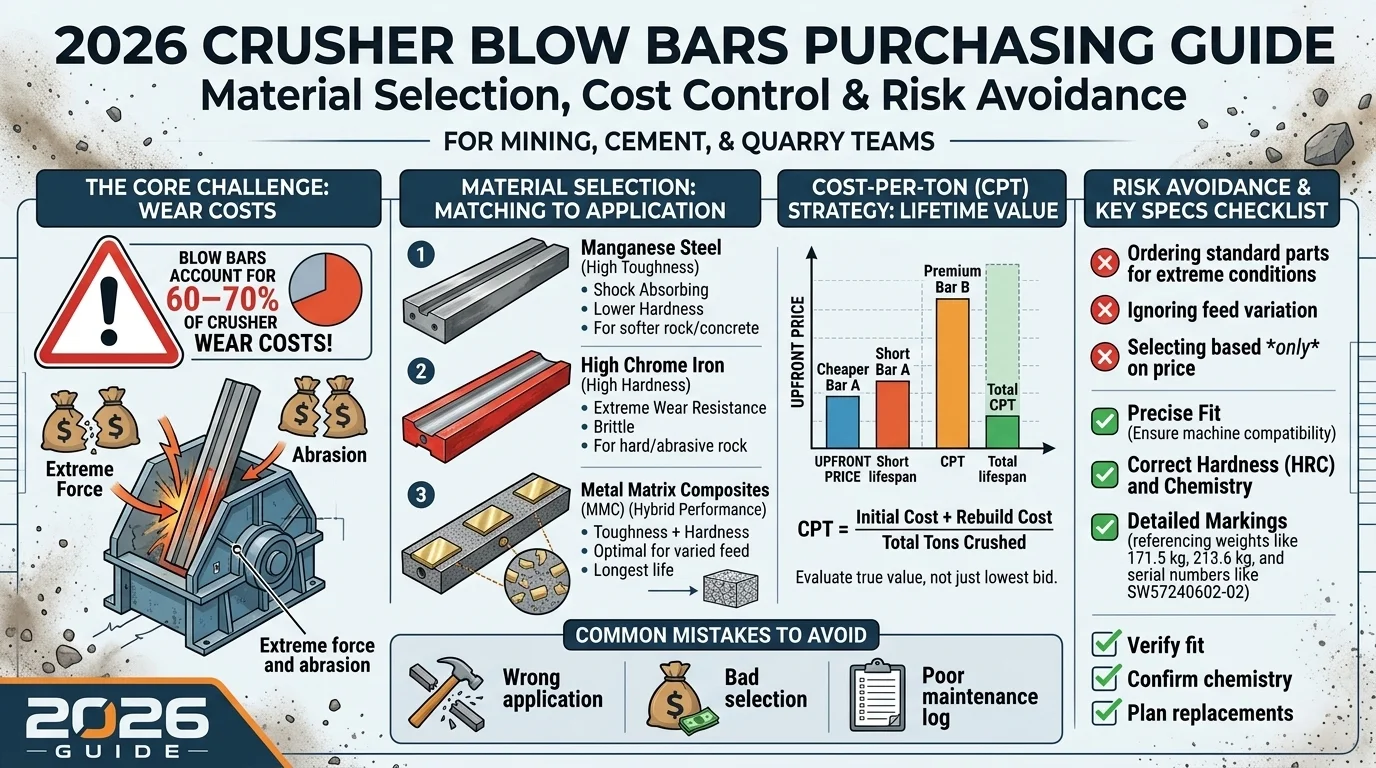
Mantle and concave segments wear faster than any other component. Choose the wrong material grade and you’re looking at premature failure, unplanned downtime, and cost-per-tonne that spirals fast. Most procurement teams focus on unit price — that’s the wrong metric. The real number is cost per tonne crushed.
For a gyratory crusher processing 5,000 t/h, a 500-hour difference in liner life translates to $300,000–$800,000 in annual savings or losses. Getting the material specification right is the single highest-leverage procurement decision at your operation.
This guide gives you the complete 2026 framework: material grades, three-tier concave specifications, procurement contract terms, incoming inspection standards, and the mistakes that cost operations millions.
How Gyratory Crusher Liners Work: Mantle vs. Concave Segments
Understanding how liners wear is the foundation of smart material selection.
1.1 The Mantle
The mantle is mounted on the main shaft and performs the gyratory motion that crushes rock against the concave.
Key stress characteristics:
- High-impact loadingfrom oversized feed blocks
- Repeated compressive stressduring each crushing cycle
- Abrasive sliding contactas rock moves downward through the chamber
- Tramp iron riskin ROM ore applications
Because of these forces, the mantle needs to be tough first, wear-resistant second. A brittle mantle can crack catastrophically — and a cracked mantle means emergency shutdown and potential damage to the main shaft bearing.
Mantles are available in one-piece, two-piece, and three-piece configurations. One-piece designs suit smaller models (42-65) or operations that prioritize installation speed. Two-piece and three-piece designs are standard on larger machines (60-89 and above) — they allow partial replacement so the upper and mid sections can be reused for 2–5 cycles, significantly reducing per-change material cost. (Metso Outotec, Superior Gyratory Wear Parts Manual, 2023)
1.2 The Concave Segments (Bowl Liner / 定锥衬板)
Concave segments are fixed to the inner shell of the crusher and form the stationary crushing surface. They are typically arranged in three tiers: upper, mid, and lower.
Each tier experiences completely different stress conditions:
| Tier | Location | Primary Stress | Material Logic |
| Upper | Feed intake zone | High-impact, large blocks | Toughness priority |
| Mid | Transition zone | Mixed impact + abrasion | Balanced properties |
| Lower | Discharge zone | High abrasion, grinding pressure | Hardness priority |
This is why a single-material concave system is always a compromise. The three-tier combination system exists precisely because no single material can optimize all three zones simultaneously.
Gyratory Crusher Mantle Material Grades: 3 Options Explained
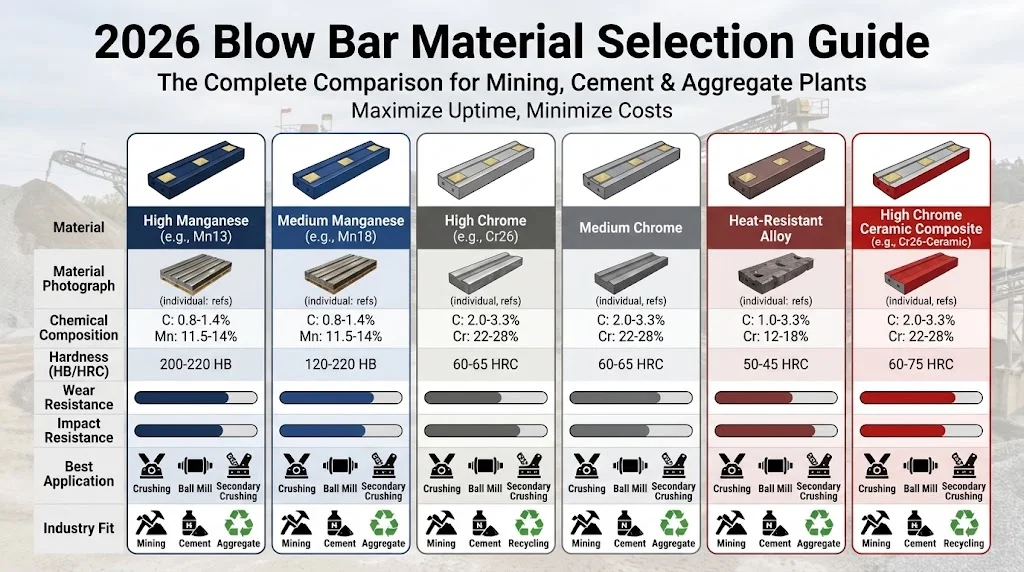
For gyratory crusher mantles, there are three material systems in common use. Each one is appropriate for a specific set of operating conditions.
Option 1 — Austenitic Manganese Steel (Mn13 / Mn18 / Mn22)
This is the original and most widely used mantle material — Hadfield austenitic manganese steel, conforming to ASTM A128 standard.
Standard grades: Mn13, Mn18, Mn22 (with Mn22 being ultra-high manganese for extreme impact applications)
Key properties:
- Initial hardness: 180–260 HB(typical range; Mn13 typically 180–220 HB, Mn18/Mn22 typically 200–260 HB)
- Work-hardened surface hardness: 500–550 HB+under sustained impact (Mn18/Mn22 grades under high-impact conditions)
- Exceptional toughness — will deform before fracturing
- High resistance to tramp iron and oversized rock
Best for:
- Run-of-mine (ROM) ore with large, irregular blocks
- High-impact feed conditions
- Applications where tramp iron in the feed is a regular occurrence
- Primary crushing of blasted rock with variable feed size
The Metso XT510 grade (Low-grade Hadfield manganese steel) is listed as the first choice for standard mantle applications in their technical documentation, precisely because of this material’s reliability under impact. (Metso Outotec Wear Parts Technical Reference, 2023)
Bottom line: If you’re unsure which mantle grade to specify, start here.
Option 2 — Modified / Alloyed Manganese Steel (Mn13Cr2 / Mn18Cr2 / Mn22Cr2 / Mn22Cr3)
Modified manganese steels add chromium — and in some grades, molybdenum — to the Hadfield base composition.
Standard grades: Mn13Cr2, Mn18Cr2, Mn22Cr2, Mn22Cr3
What changes:
- Toughness remains essentially equal to standard Mn grades
- Wear resistance improves significantly due to chromium carbide formation
- Harder baseline microstructure accelerates work hardening in moderate-impact conditions
Best for:
- Medium-hard to hard rock (granite, basalt, quartzite) with moderate impact levels
- Long-service-life requirements in primary crushing
- Operations where crushing chamber conditions allow consistent work hardening
- Cement plants and aggregate operations with relatively consistent feed gradation
The Metso XT710 and XT720 series (high-grade chromium-alloyed manganese steel) represent this category. They are specifically rated as better or recommended for medium-to-hard, abrasive ore conditions over standard XT510 grades. (Metso Outotec Material Grade Selection Guide)
Bottom line: Step up to modified manganese when you’re running hard, abrasive rock and need liner life to outlast your maintenance schedule.
Option 3 — Manganese Steel + Titanium Carbide Insert (Mn13/Mn18 + TiC Insert)
This is the performance tier — and it represents the most significant advancement in mantle technology in the past decade.
The concept: embed titanium carbide (TiC) particles into a manganese steel matrix. You get:
- Full impact resistancefrom the Mn13/Mn18 base
- ~100% improvement in abrasion resistancefrom TiC reinforcement
- Extended liner life without the brittleness risk of high-chrome iron
This technology mirrors what Metso calls their MX series — hybrid mantles with specialized wear inserts in the highest-wear zones, documented to achieve up to 2× the wear life of standard manganese mantles. (Metso Outotec MX Mantle Technical Sheet, 2024)
Best for:
- High-throughput operations (5,000 t/h+) where downtime cost is critical
- Hard, abrasive rock with residual impact risk (cannot switch to high-chrome)
- Sites where liner change frequency needs to be cut in half
- Operations seeking to reduce total cost of ownership over standard manganese
Qiming Casting has developed a specialized TiC insert mantle program for primary gyratory applications. Their engineers can match TiC insert density and placement pattern to your specific feed material and chamber geometry — which matters, because poorly placed inserts can create uneven wear profiles. For high-production mines and quarries, this is the specification worth requesting.
Gyratory Crusher Concave Segments: The Three-Tier Material System
This is arguably the most important section of this guide for procurement teams.
The wrong approach: Ordering all three concave tiers in the same material.
The correct approach: Specifying materials by zone, based on the wear mechanism in each tier.
Here is the industry-standard combination:
Upper Tier — High Manganese Steel (Mn13 / Mn18)
The upper concave tier receives the direct impact of large feed blocks entering the crushing chamber. Rocks can be 1,000–1,500 mm and weigh several tonnes.
Material: Mn13 or Mn18 austenitic manganese steel
- Absorbs massive impact without fracturing
- Work hardens rapidly under repeated block impact
- Prevents edge chipping and liner cracking
- Tolerates tramp iron without catastrophic failure
Never use high-chrome iron in the upper tier. One tramp iron event can shatter a high-chrome upper liner and potentially damage the feed opening and top shell.
Mid Tier — Alloy Steel (Medium-Carbon Low-Alloy / Mn-Mo Alloy Steel)
The mid concave tier operates in a mixed regime — some impact remains, but abrasive sliding contact begins to dominate.
Material: Medium-carbon low-alloy steel or manganese-molybdenum alloy steel
Examples from the Tuff series: TF40 (375–425 BHN, KV >15 J) or TF50 (475–525 BHN, KV >10 J), both conforming to EN 10293 40CrNiMo base composition. (Tuff Alloy Steel Technical Specification Sheet)
- Balances toughness against abrasion resistance
- Higher hardness baseline than manganese steel (no work hardening required)
- Resists the combined wear mode of the mid chamber effectively
- Replaceable independently from upper and lower tiers
Lower Tier — High-Chrome Cast Iron (Cr20 / Cr26)
The lower concave tier is a pure abrasion environment. Rock particles are already broken down and are grinding, sliding, and pressing against the liner surface at high force. Impact energy is low; abrasive stress is extreme.
Material: High-chrome cast iron, Cr20 or Cr26
- Working hardness: HRC 58–65
- Maximum abrasion resistance of any standard wear material
- Minimal toughness requirement in this zone — impact is rare
- Significantly outlasts manganese steel in this position
Critical warning: Never use manganese steel in the lower concave tier. Manganese steel requires impact to work-harden. In the low-impact, high-abrasion lower zone, it stays at 200–260 HB — and wears extremely fast. Field data from multiple primary crushing operations consistently shows lower tier wear rates 3–5× faster when manganese steel is substituted for high-chrome iron in this position. This is one of the most expensive specification errors in crusher maintenance.
Qiming Casting’s Tuff-series alloy concave liners are engineered specifically for the three-tier system — with upper tiers in Mn18, mid tiers in TF50 alloy steel, and lower tiers in Cr26 high-chrome. This matched set approach ensures wear rates across all three tiers are balanced, so you’re not replacing the lower tier while the upper two still have 60% life remaining. Ask for their matched-set concave program for your crusher model.
2026 Crusher Liner Material Selection Tables — Ready for Procurement
Table 1: Mantle (Crushing Head) Material Selection
| Operating Condition | Feed Type | Recommended Material | Grade Examples |
| High impact, large ROM blocks, tramp iron present | Blasted ore, ROM | Standard Austenitic Manganese Steel | Mn13, Mn18, Mn22 |
| Medium-hard abrasive rock, moderate impact | Granite, basalt, quartzite | Modified / Alloyed Manganese Steel | Mn13Cr2, Mn18Cr2, Mn22Cr2 |
| High-throughput, extended life priority, abrasive with residual impact | Hard abrasive ore | Mn + TiC Insert (Hybrid) | Mn13+TiC, Mn18+TiC |
Table 2: Concave Segment Three-Tier Standard Specification
| Tier | Zone | Recommended Material | Hardness Target | Key Property |
| Upper | Feed intake / impact zone | High Manganese Steel | 200–260 HB initial, 550 HB+ work-hardened | Impact resistance, no cracking |
| Mid | Transition / mixed zone | Alloy Steel (CrNiMo) | 375–525 BHN | Balanced toughness + abrasion (TF40: KV >15 J / TF50: KV >10 J) |
| Lower | Discharge / grinding zone | High-Chrome Cast Iron | HRC 58–65 | Maximum abrasion resistance |
Table 3: Mantle Size & Weight Reference (Standard Metso Superior Models)
| Model | Feed Opening | Mantle Diameter | Standard Configuration | Main Shaft Assembly Weight |
| 42-65 | 1,065 mm (42”) | 1,650 mm (65”) | 1-piece | 23,130 kg |
| 50-65 | 1,270 mm (50”) | 1,650 mm (65”) | 2-piece | 28,120 kg |
| 54-75 | 1,370 mm (54”) | 1,905 mm (75”) | 1-piece | 38,560 kg |
| 60-89 | 1,525 mm (60”) | 2,260 mm (89”) | 2-piece | 66,220 kg |
| 60-110 | 1,525 mm (60”) | 2,795 mm (110”) | 1-piece | 103,874 kg |
| 70-89 | 1,778 mm (70”) | 2,260 mm (89”) | 1-piece | 79,855 kg |
*Source: (Metso Outotec Superior Gyratory Crusher product documentation)*
Note: Weights listed are for the main shaft assembly (mantle + shaft + head). Total crusher weights are 4–5× higher. Confirm complete assembly weights with your OEM or supplier before planning crane and rigging operations.
Gyratory Crusher Liner Procurement Specifications (Put These in Your Contract)
These are the technical specifications that must appear in every purchase order for gyratory crusher liners.
Mantle specifications:
- Initial hardness:180–260 HB (Mn13: 180–220 HB; Mn18/Mn22: 200–260 HB)
- Work-hardened surface hardness:500–550 HB+ under sustained impact (Mn18/Mn22 under high-impact conditions)
- Dimensional tolerance:≤ ±1 mm on all mating surfaces
- Casting quality:Zero cracks, zero shrinkage voids, zero slag inclusions — verified by UT or MT inspection
- Weight certification:Individual weighing required per piece; matched sets must be within ±0.5% weight tolerance to prevent vibration imbalance
- Material certification:Mill test report (MTR) with chemical composition and heat treatment record. Reputable suppliers like Qiming Casting provide full MTR documentation with every shipment — including chemical composition, heat treatment records, and hardness test results. Request this as a standard requirement from any liner supplier before approving the purchase order.
Concave segment specifications:
- Upper tier:Mn13 or Mn18 austenitic manganese, hardness 200–260 HB
- Mid tier:Alloy steel 375–525 BHN; impact toughness TF40: KV >15 J / TF50: KV >10 J at operating temperature
- Lower tier:High-chrome cast iron, HRC 58–65 minimum — reject any lot below HRC 58
- Three-tier set:All tiers must be supplied as a matched set; mixing batches from different production runs is not permitted
- Dimensional conformance:Profile accuracy verified against OEM drawing; contact surface flatness ≤0.5 mm
Compatible crusher models to confirm at order: 42-65, 50-65, 54-75, 62-75, 60-89, 60-110, 70-89 (Metso Superior series); equivalent Sandvik and FLSmidth models require separate drawing verification.
Crusher Liner Incoming Quality Inspection — 5 Checks Before Installation
Do not skip this step. Liner failure during the first weeks of operation is almost always traceable to a defect that could have been caught at incoming inspection.
Check 1 — Material verification Confirm the mantle material against the MTR: is it standard Mn, modified Mn, or TiC insert? Reject any mantle labeled “chrome steel” or “high-chrome” for the mantle position — this is a substitution risk that causes brittle fracture in primary crushing.
Check 2 — Three-tier concave confirmation Physically confirm you have three distinct material sets. High-chrome cast iron (lower tier) has a noticeably darker, more metallic surface finish compared to manganese steel. If in doubt, request the material test report (MTR) and verify the grade marking on each segment before installation.
Check 3 — Hardness spot check
- Mantle: portable Brinell test, minimum HB 200at three locations
- Lower concave tier: portable Rockwell test, minimum HRC 58at three locations
- Reject the entire lot if any single reading falls below specification
Check 4 — Visual inspection Check all surfaces for cracks (use dye penetrant if needed), porosity, cold shuts, and deformation. Pay special attention to the leading edges of concave segments — this is where casting defects concentrate.
Check 5 — Weight and fit check Weigh each mantle piece individually. Multi-piece mantles must be within tolerance. Test-fit the concave segments in the shell — there should be zero gap between the liner back and the backing material contact surface.
Gyratory Crusher Liner Purchasing Mistakes — and the Real Cost
Mistake 1: Using high-chrome iron for the mantle
High-chrome cast iron has no place in the mantle position. It cannot absorb the impact of large ROM feed. The result is catastrophic brittle fracture — fragments can damage the main shaft, the spider bearing, and the bottom shell. This is a five- to six-figure repair scenario.
Mistake 2: Specifying manganese steel for the lower concave tier
Without impact, manganese steel doesn’t work-harden. In the lower grinding zone, it stays at 200–260 HB — and wears extremely fast. Based on field performance data from multiple primary crushing operations, expected lower tier life drops from 8,000–12,000 hours (high-chrome) to 2,000–3,500 hours (manganese) (actual results vary by rock type, feed size, and operating conditions).
Mistake 3: Mixing material grades across tiers without engineering review
Running an upper tier Mn18 with a mid tier Mn13 from a different batch and a lower tier from a third supplier creates uneven wear rates. The result: you’re replacing some tiers at half-life while others are still serviceable — significantly increasing total liner spend.
Mistake 4: Mixing production batches in multi-piece mantle sets
A two-piece or three-piece mantle must come from the same casting heat. Mixing batches produces weight imbalance and hardness variation — both of which create abnormal vibration that accelerates main shaft bearing wear.
Mistake 5: Skipping incoming inspection and installing directly
A casting defect not caught at inspection becomes a liner failure in the pit. Emergency liner changes on large gyratory crushers (60-89 and above) cost $50,000–$150,000 in labor and crane costs alone — not counting lost production.
2026 Gyratory Crusher Liner Procurement Summary
The specification logic is straightforward. Apply it consistently and you will eliminate most liner-related cost problems at your operation.
Mantle (Crushing Head) — three-tier selection logic:
Standard high impact conditions → Mn13 / Mn18 / Mn22 austenitic manganese steel Hard abrasive rock, longer life required → Modified Mn13Cr2 / Mn18Cr2 / Mn22Cr2 High-production, maximum life, TiC reinforcement → Mn13+TiC / Mn18+TiC insert
Concave Segments — always specify as a matched three-tier set:
Upper tier → High Manganese Steel (Mn13/Mn18) Mid tier → Alloy Steel (CrNiMo, 375–525 BHN) Lower tier → High-Chrome Cast Iron (Cr20/Cr26, HRC 58–65)
Procurement discipline:
Order as a complete matched set. Specify material by tier in the contract. Verify with incoming inspection before installation. Record wear life data for each set to optimize your next order.
Liner cost is typically 1–3% of total site operating cost — but liner selection decisions affect 15–25% of total maintenance spend (industry reference figures; actual percentages vary by operation scale, ore type, and equipment configuration). The leverage is real. The specification work in this guide is what separates operations that control their liner cost from those that are constantly reacting to it.
If you apply this specification framework consistently, liner-related downtime becomes a manageable variable — not a recurring crisis.
References
Metso Outotec. Superior® Gyratory Crusher Wear Parts Catalog (2023). Available from Metso technical representatives or at metso.com/products/crushers.
Metso Outotec. Wear Part Material Grade Selection Guide — XT Series (2023). Available upon request from Metso regional offices.
Metso Outotec. MX™ Mantle Technical Sheet (2024). Available at metso.com.
Tuff Steels. Tuff Alloy Steel For Gyratory Liners & Shredder Hammers
ASTM International. ASTM A128: Standard Specification for Steel Castings, Austenitic Manganese. Available at astm.org.
Technical content in this guide references Metso Outotec Superior Gyratory Crusher Wear Parts documentation (2023–2024), ATF Tuff alloy steel specifications (EN 10293), and ASTM A128 austenitic manganese steel standard. For model-specific liner specifications and matched-set procurement, contact Qiming Casting or your OEM technical representative.