Mn14Cr2, Mn18Cr2, Mn22Cr2, Mn22Cr2+Mo, and TiC-Inserts Explained
If you run a cone crusher in a mine, cement plant, or stone quarry, you already know the pain: liners wear out too fast, cost too much, or crack when you least expect it.
The good news? The right liner material can double — sometimes triple — liner service life. The bad news is that most buyers still pick alloys based on habit or price, not application data.
This guide breaks down every major cone crusher liner alloy used in 2026 — Mn14Cr2, Mn18Cr2, Mn22Cr2, Mn22Cr2+Mo, and TiC-Insert composites — and tells you exactly which one fits your rock type, crushing stage, and operating conditions.
Why Liner Material Selection Matters More Than You Think
A cone crusher liner is not a commodity. It is a precision wear component that directly controls:
- Cost per ton of crushed product
- Crusher downtime for liner change-outs
- Product shape and gradation consistency
- Structural safety of the crusher head and bowl
According to field data from Element Mining and Construction (ELMC), liners supplied by the wrong alloy selection can deliver as little as 350 working hours, while correctly matched liners from the same crusher consistently reach 700+ hours — a 2× difference with zero change to the machine itself. (ELMC Crusher Wear Parts Brochure)
That gap is pure profit left on the table.
How Manganese Steel Work-Hardens in a Cone Crusher
All standard cone crusher liners are cast from austenitic high-manganese steel — a material first developed by Sir Robert Hadfield in 1882 with approximately 12% Mn and 1% C. (Note: some industry sources cite 1880, but the correct year per historical records is 1882.) (Sandvik Quarry Academy, Wear Parts for Cone and Jaw Crushers, 2005)
The key mechanism is work hardening: when the liner surface is repeatedly struck by rock under compressive force, the microstructure dislocates and densifies, forming a hard wear-resistant skin while the core remains tough and ductile.
Three things determine how well this works:
Manganese content — higher Mn expands the austenite zone, enabling more carbon and chromium to dissolve
Chromium content — improves hardness after heat treatment and abrasive wear resistance
Impact intensity — without sufficient compressive force, the liner never fully work-hardens
Key insight: A liner that never work-hardens wears out fast. A liner that work-hardens all the way through its core cracks. Matching alloy to application keeps you in the safe zone.
The 2026 Liner Alloy Lineup: A Quick Overview
| Alloy | Mn% | Cr% | Additive | Best For |
| Mn14Cr2 | ~14% | ~2% | — | Soft/medium, low-abrasion rock |
| Mn18Cr2 | ~18% | ~2% | — | General purpose, all stages |
| Mn22Cr2 | ~22% | ~2% | — | Highly abrasive rock, 2nd/3rd stage |
| Mn22Cr2+Mo | ~22% | ~2% | Molybdenum | Heavy-duty, thick castings |
| TiC-Inserts | Base alloy | — | TiC ceramic | Extreme abrasion, extended intervals |
Mn14Cr2: The Right Tool for Soft Rock Applications
Mn14Cr2 is the entry-level alloy — 14% manganese, 2% chromium. It work-hardens relatively slowly and achieves a higher peak surface hardness once fully hardened compared to higher-Mn grades.
According to the EvoQuip/Terex Crusher Wear Parts Reference Guide, lower-manganese steels (12–14% Mn) work-harden more slowly than higher-Mn grades — but once fully hardened, they can achieve comparable or higher surface hardness in low-to-medium abrasion conditions. (EvoQuip Crusher Wear Parts Reference Guide, Terex, 2018)
When to choose Mn14Cr2:
- Limestone crushing (primary or secondary stage)
- Soft sandstone or gypsum
- Applications with low abrasion index (French ABR < 600 g/t)
- Cement plant pre-crushing of relatively soft clinker feed material
When NOT to use Mn14Cr2:
- Granite, basalt, quartzite, iron ore
- High-impact primary crushing of large blasted rock
- Thick castings (carbide precipitation risk on slow heat treatment)
Mn18Cr2: The Industry Workhorse
Mn18Cr2 is the most widely used liner alloy in the world — and for good reason. The 18% manganese content delivers a balanced combination of work-hardening speed, toughness, and abrasion resistance.
ELMC classifies this as their “D” grade: “For general application. An improved formula with additional chromium alloying. A significant increase in hardness after heat treatment, increased resistance to abrasive wear.” (ELMC Crusher Wear Parts Brochure)
KLEEMANN (a Wirtgen Group brand, part of John Deere) uses MnCr 18.2 as the standard cast alloy for all MCO cone crusher tools in secondary and tertiary crushing stages. (KLEEMANN Original Wear Parts Brochure, 2024)
EvoQuip/Terex also designates 18% manganese as standard fit on all cone and jaw crushers — suitable for all applications. (EvoQuip Crusher Wear Parts Reference Guide)
When to choose Mn18Cr2:
- Mixed quarry operations (granite, dolomite, limestone in same plant)
- Secondary crushing in mining operations
- Cement plant crusher handling blended feed
- Operators who want one alloy that covers most scenarios
Typical performance benchmark: 700 working hours in river gravel containing silica (18 h/day operation), per documented ELMC field case in Romania. (ELMC Crusher Wear Parts Brochure)
Mn22Cr2: Maximum Resistance for Abrasive Rock
Step up to 22% manganese when your rock pushes abrasion indices above 1,200 g/t — think granite, quartzite, iron ore, basalt, or siliceous gravel.
ELMC designates this as “D2” grade: “Suitable for the most abrasive of rocks. We recommend using this material at the second or third stages of crushing. Possesses the highest resistance to abrasive wear among Element’s line of manganese steels.” (ELMC Crusher Wear Parts Brochure)
The higher manganese content works by expanding the austenite stability zone, allowing more carbon and chromium to stay in solid solution rather than precipitating as brittle carbides. The result is more material available to resist surface grinding and gouging.
When to choose Mn22Cr2:
- Hard rock mines: copper, gold, iron ore, chrome ore operations
- Stone quarries crushing granite, quartzite, or diabase
- Secondary/tertiary crushing stages with high recirculating loads
- Any application where Mn18Cr2 liners are wearing in under 500 hours
Trade-off to know: Higher manganese also means a slightly elevated cracking risk in very thick castings or in applications with extreme thermal cycles. Monitor heat treatment quality carefully when sourcing from third-party suppliers.
Mn22Cr2+Mo: Heavy-Duty Performance in Thick Castings
Molybdenum is added to the Mn22Cr2 base for one specific reason: improving hardenability through thick sections.
Standard manganese steel has low thermal conductivity. In large, thick castings — primary cone liners, gyratory mantles — the core cools slowly during water quenching. This slow cooling can allow chromium carbides to precipitate at grain boundaries, creating brittle zones that lead to cracking under impact loads.
Molybdenum suppresses carbide precipitation during cooling, ensuring the casting remains fully austenitic even at the center of heavy sections. This is why ELMC and similar premium manufacturers list Mo as an additional alloying element specifically “for heavy conditions” and thick-section castings. (ELMC Crusher Wear Parts Brochure)
ESCO (a Weir Group division) uses molybdenum in their 14L alloy — described as “standard material for general crushing applications” in extra-thick castings. (ESCO Crusher Wear Parts Brochure, 2020)
When to choose Mn22Cr2+Mo:
If your primary cone liner has ever cracked before it wore through — that’s your signal. Cracking before wear-through almost always means the casting core didn’t fully austenitize, and Mo is the fix.
Mn22Cr2+Mo is the right call for:
- Primary cone crushers with large, thick liners (>100 mm section thickness)
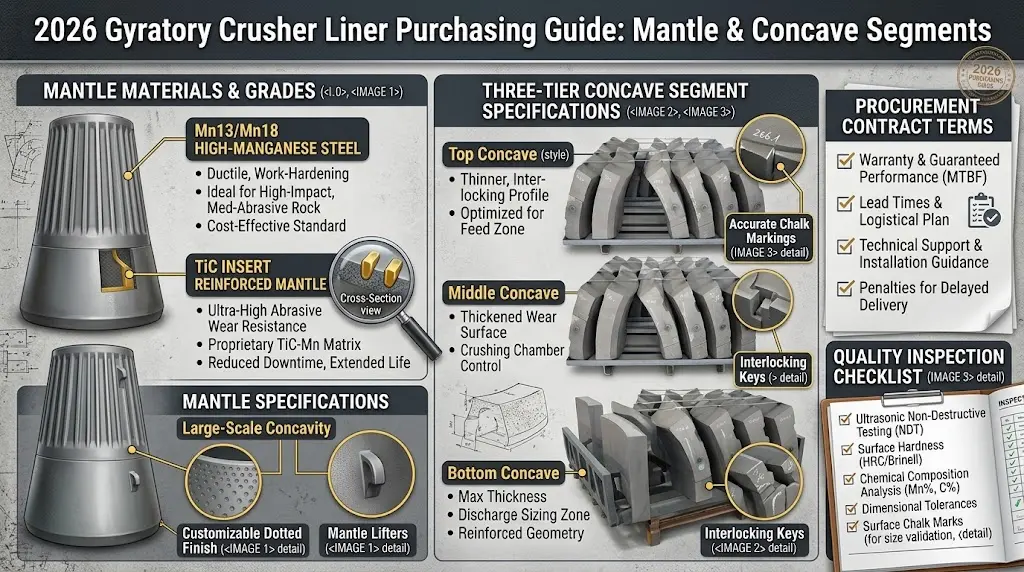
- Gyratory crusher mantles and bowl liners in high-tonnage mining operations
- Any application combining high abrasion AND high impact simultaneously
- Operations where liner cracking — not wear-through — has been the historical failure mode
Cost note: Mo-alloyed grades carry a 15–25% price premium over standard Mn22Cr2. In thick-casting, high-impact applications, this premium is almost always recovered through longer liner life and fewer catastrophic failures.
TiC-Insert Liners: The Premium Tier for Extreme Conditions
Titanium carbide (TiC) insert liners represent the highest performance category currently available for cone and jaw crusher wear parts.
The technology works by embedding pre-cast titanium carbide ceramic inserts into the manganese steel matrix during casting. The result is a composite structure: manganese steel provides the toughness and impact absorption, while TiC inserts (hardness ~3,200 HV) provide extreme localized wear resistance at the contact surfaces.
ELMC’s “Element TiC” product line describes the mechanism: “Higher resistance to shock loads and cracking… achieved by special casting processes and heat treatment of the finished product. During tests, linings with inserts showed greater operating time in comparison with classic manganese steel wears without inserts.” (ELMC Crusher Wear Parts Brochure)
KLEEMANN applies a similar ceramic insert principle in impact crusher wear parts — specifically the TRON.MC and TRON.MC+ blow bars and Impactplate.MC impact plates for highly abrasive conditions. While these are impact crusher components rather than cone liner products, the underlying TiC composite mechanism is the same: ceramic inserts embedded in a metallic matrix to extend wear life in high-abrasion applications. (KLEEMANN Original Wear Parts Brochure, 2024)
Quantified benefits of TiC-Insert liners:
- In documented field cases involving high-silica iron ore and quartzite operations, TiC-Insert liners have extended change-out intervals by 40–60% compared to standard Mn22Cr2liners under equivalent conditions (ELMC Crusher Wear Parts Brochure)
- Extended intervals between liner replacements → reduced maintenance stops
- Lower unit production costs per ton of final product
- Consistent crushing performance maintained deeper into liner life
When to choose TiC-Insert liners:
- Rock with French ABR > 1,700 g/t (quartzite, high-silica iron ore, certain granites)
- Operations where downtime cost outweighs liner purchase price(remote mines, high-throughput cement plants)
- Tertiary crushing stages with very tight closed-side settings and high recirculating loads
- Situations where standard Mn22Cr2 liners require change-out every 2–3 weeks
When TiC-Inserts may not be necessary:
- Soft-to-medium rock (limestone, dolomite) — standard Mn18Cr2 is more cost-effective
- Low-throughput or intermittent crushing operations
- Applications where impact loads are extremely high and unpredictable (risk of insert fracture)
Side-by-Side Selection Guide: Which Alloy for Your Application?
Use this table as your starting point. Always validate with a wear profile analysis from your supplier.
| Application | Rock Type | Abrasion | Recommended Alloy |
| Cement plant primary | Limestone, marl | Low | Mn14Cr2 |
| Quarry secondary | Dolomite, sandstone | Low–Medium | Mn18Cr2 |
| Quarry tertiary | Granite, gneiss | Medium–High | Mn18Cr2 or Mn22Cr2 |
| Hard rock mine secondary | Iron ore, copper ore | High | Mn22Cr2 |
| Hard rock mine primary | Granite, basalt | High + Impact | Mn22Cr2+Mo |
| High-silica grinding | Quartzite, siliceous ore | Very High | TiC-Inserts |
| Remote mine, max uptime | Any hard abrasive rock | High–Extreme | TiC-Inserts |
5 Practical Tips to Maximize Liner Life — Regardless of Alloy
Alloy selection is only half the equation. How you operate the crusher determines whether you get full value from the liner.
- Always choke-feed the cone crusher.A partially filled crushing chamber causes uneven wear and prevents proper work hardening. According to the Sandvik Quarry Academy, wrong feed arrangement directly causes “higher wear in the crushing chamber, lower capacity, and higher cost.”(Sandvik Quarry Academy, 2005)
- Keep fines out of the feed.Fine material smaller than the closed-side setting (CSS) does not need crushing — it just grinds against the liner surface and accelerates wear. Use a vibrating grizzly feeder to scalp fines before they enter the chamber.
- Run a wider CSS during the break-in period.For the first 24–48 hours after a liner change, run the crusher at a larger CSS than your target product setting. This gives the manganese time to fully work-harden before being pushed to maximum stress. A tighter CSS before work hardening is complete dramatically shortens liner life. (The exact break-in duration varies by liner thickness and alloy grade — consult your liner supplier for a specific recommendation.)
- Match crushing stage to liner profile, not just alloy.Secondary crushing liners use coarser profiles with larger feed openings. Tertiary liners use finer profiles with longer calibration zones. Running a secondary-profile liner in a tertiary application — or vice versa — wastes metal and degrades product shape.
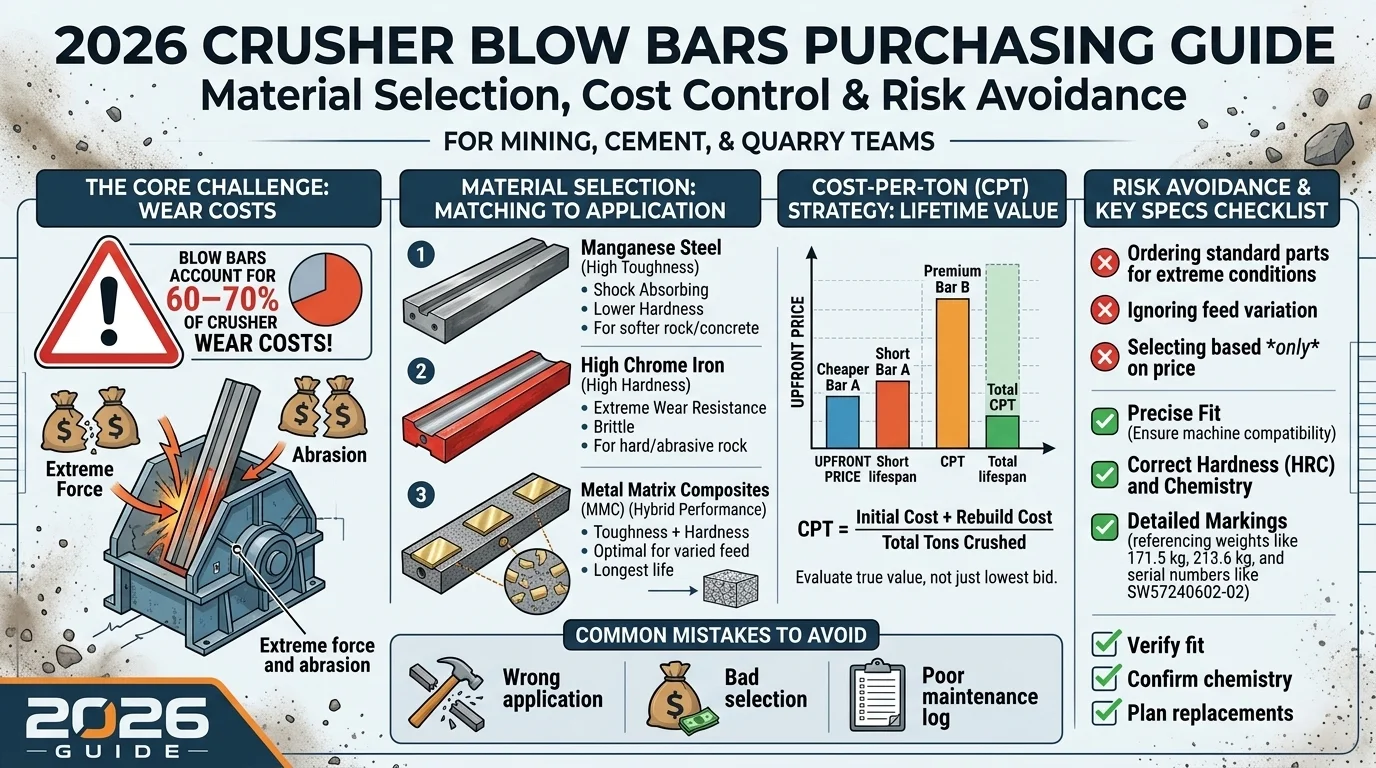
- Track liner wear by tonnage processed, not calendar time.A liner that processes 3 million tons in 30 days is not the same as one processing 1 million tons in 30 days. Cost-per-ton is the correct KPI. ELMC’s THOR liners demonstrated a cost per ton of processed ore approximately 25% lowerthan competing liners even while lasting longer in absolute time. (ELMC Crusher Wear Parts Brochure)
Frequently Asked Questions
Q: Is higher manganese content always better? No. Higher Mn (22%+) improves abrasion resistance in highly stressed applications, but increases cracking risk in thick castings without proper alloying (e.g., Mo addition) and heat treatment. For soft rock, Mn14Cr2 actually achieves higher post-hardening surface hardness than Mn22Cr2.
Q: Can I use the same liner alloy for primary and tertiary crushing? Not recommended. Primary crushing involves large feed sizes and high impact loads — Mn22Cr2+Mo or heavy-duty Mn18Cr2 is appropriate. Tertiary crushing has smaller feed sizes and higher abrasion-to-impact ratios — Mn22Cr2 or TiC-Inserts perform better.
Q: How do I know if my current liner alloy is wrong for my application? Warning signs: liners cracking before 50% wear, uneven wear profile across the chamber width, liner life consistently below industry benchmarks (< 500 hours in standard quarry operation), or frequent packing of the crushing chamber.
Q: Are TiC-Insert liners worth the higher upfront cost? In high-abrasion, high-throughput operations — especially remote mines where downtime is extremely expensive — yes. The break-even point depends on your tonnage rate and labor cost for liner changes. Request a cost-per-ton analysis from your supplier before deciding.
Final Verdict: A Decision Framework for 2026
The cone crusher liner market in 2026 offers more material science options than ever before — but the selection logic has not changed.
Start with your rock abrasion index. Then factor in crushing stage (primary vs. tertiary), casting thickness, and your operational priority (lowest unit cost vs. maximum uptime).
- Soft rock, low abrasion →Mn14Cr2
- Mixed quarry, general use →Mn18Cr2
- Hard abrasive rock, secondary/tertiary →Mn22Cr2
- Thick primary liners, high impact + abrasion →Mn22Cr2+Mo
- Extreme abrasion, maximum uptime critical →TiC-Inserts
Get the alloy wrong and you are paying for every extra change-out with hours of lost production. Get it right and your liners become a competitive advantage — not just a consumable.
Running hard rock at high throughput? Tell us your rock type, crushing stage, and current liner life — we’ll send back a specific alloy recommendation and cost-per-ton estimate within 24 hours.