High Manganese Steel Blow Bars vs Martensitic Steel Blow Bars: A Complete Guide for Qiming Casting
If you’re in the mining, construction, or metallurgy industry, you know that blow bars are the most critical wear parts of impact crushers. Choosing the right blow bar material directly impacts your crusher’s efficiency, maintenance costs, and production continuity. As a leading blow bar manufacturer, Qiming Casting is here to help you solve the common dilemma:high manganese steel blow bars vs martensitic steel blow bars—which one is the best fit for your specific working conditions?
In this comprehensive guide, we’ll compare these two popular blow bar materials from core aspects including chemical composition, mechanical properties, manufacturing process, applicable applications, and cost. Backed by Qiming Casting’s ISO9001:2015 quality control system and years of manufacturing experience, this guide provides you with authoritative, user-centric content that helps you make informed decisions and optimize your crushing operations.
1. Core Definitions: What’s the Difference Between High Manganese Steel and Martensitic Steel Blow Bars?
The fundamental difference between high manganese steel blow bars and martensitic steel blow bars lies in their chemical composition and microstructure, which directly determine their performance advantages and application scenarios. As a professional blow bar supplier, Qiming Casting specializes in both types, tailoring solutions to meet diverse customer needs.
1.1 High Manganese Steel Blow Bars (Mn14, Mn18, Mn22 Series)
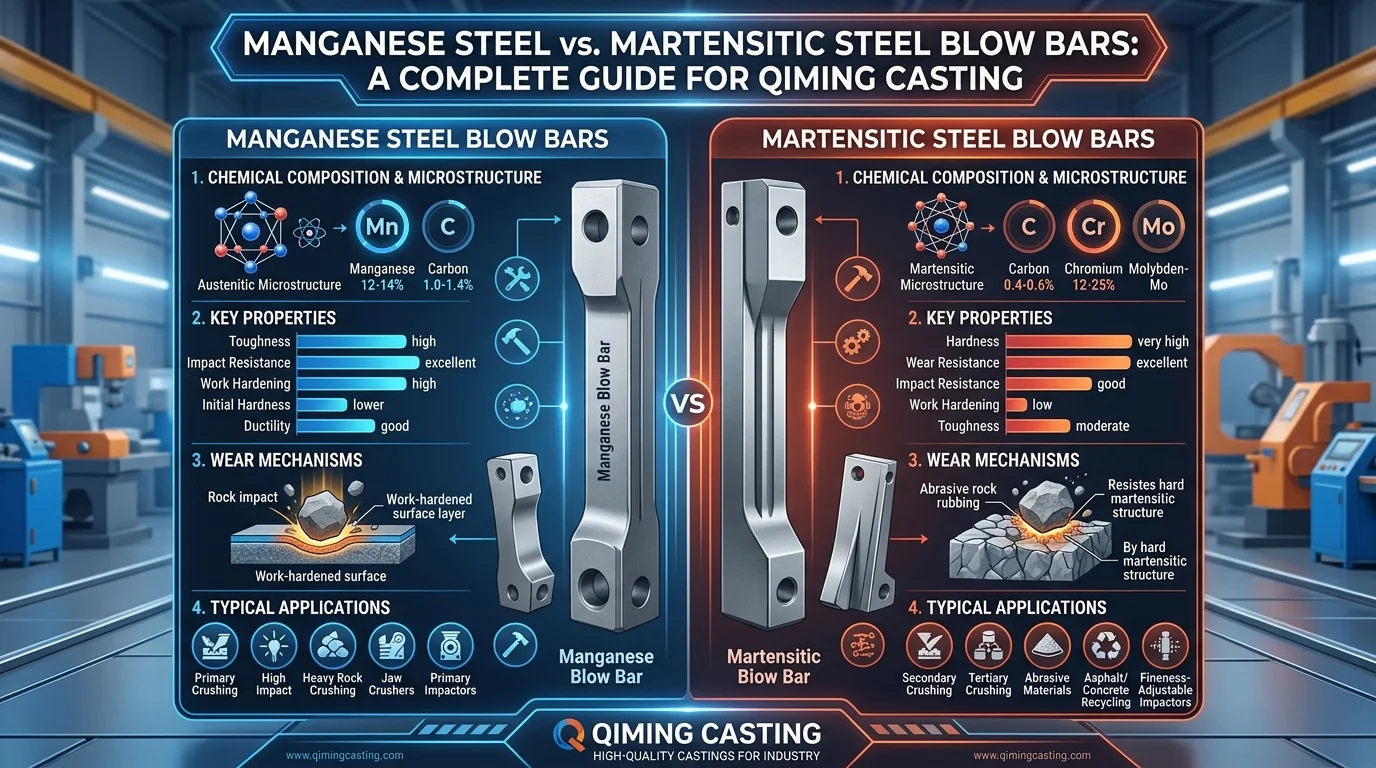
Qiming Casting’s high manganese steel blow bars mainly include three core series: Mn14, Mn18, and Mn22, all belonging to austenitic wear-resistant steel. Their key feature is “high carbon and high manganese,” relying on the “work hardening” property to achieve wear resistance—when subjected to impact loads, the surface hardness increases rapidly while the matrix maintains excellent toughness to avoid brittle fracture.
After standard heat treatment (solution treatment), the microstructure of high manganese steel blow bars becomes a single austenitic structure, which is the core reason for their outstanding toughness and work hardening performance. These blow bars are essentially “toughness-based, impact-driven wear resistance,” making them ideal for high-impact working conditions.
1.2 Martensitic Steel Blow Bars (Qiming Standard Composition)
The martensitic steel blow bars provided by Qiming Casting are core wear parts designed for high-wear, low-impact scenarios. Their key feature is “high hardness and high strength,” relying on a specific ratio of alloying elements to form a strengthened matrix, enabling excellent wear resistance without relying on impact—essentially “hardness-based, direct wear resistance”.
After “quenching + tempering” heat treatment, the microstructure of martensitic steel blow bars becomes a martensitic structure, which is the key to their high hardness and high strength. Compared with high chromium blow bars, they are less prone to breakage, and compared with high manganese steel blow bars, they have longer service life in abrasive material applications.
2. Comprehensive Comparison: High Manganese Steel vs Martensitic Steel Blow Bars
To help you choose the right blow bars for your crusher, Qiming Casting has compiled a detailed comparison of the two materials from 5 key dimensions, based on our practical manufacturing experience and customer feedback.
2.1 Chemical Composition Comparison (Performance Foundation)
The chemical composition directly determines the performance of blow bars. Qiming Casting strictly controls the element ratio to ensure product quality and stability, adhering to rigorous quality inspection standards at every production step.
|
Element Type
|
High Manganese Steel Blow Bars (Mn14, Mn18, Mn22)
|
Martensitic Steel Blow Bars (Qiming Standard)
|
|
Carbon (C)
|
Mn14: 0.90%~1.50%; Mn18: 1.0%~1.6%; Mn22: 1.1%~1.7% (adjusts hardness, lower for high-impact parts)
|
0.5% (fixed ratio for basic strengthening)
|
|
Core Alloy Elements
|
Manganese (Mn): Mn14 (13%~15%), Mn18 (17%~19%), Mn22 (21%~23%) (core for toughness and work hardening)
|
Chromium (Cr): 3.5%~4.0%; Molybdenum (Mo): 0.45%~0.55%; Nickel (Ni): 0.8%~0.9% (core strengthening elements)
|
|
Auxiliary Elements
|
Silicon (Si): 0.30%~1.0% (deoxidation, strength improvement)
|
Silicon (Si): 0.5%~0.8%; Manganese (Mn): 0.8%~0.9% (auxiliary deoxidation, grain refinement)
|
|
Impurity Control
|
Sulfur (S) ≤0.05%, Phosphorus (P) ≤0.10% (prevents brittle fracture)
|
Sulfur (S) ≤0.06%, Phosphorus (P) ≤0.10% (prevents hot cracking and cold brittleness)
|
2.2 Mechanical Properties Comparison (Directly Affects Usage Effect)
Mechanical properties are the core basis for blow bar selection. Qiming Casting focuses on key indicators such as hardness, toughness, and wear resistance to ensure our blow bars meet the diverse needs of different crushing scenarios.
-
Microstructure (After Heat Treatment): High manganese steel blow bars have an austenitic structure, laying the foundation for excellent toughness; martensitic steel blow bars have a martensitic structure, the core support for their high hardness and high strength.
-
Hardness: High manganese steel blow bars have low initial hardness (200~230 HB), and the surface work hardens to 450~550 HB after impact; martensitic steel blow bars have extremely high initial hardness (40~50 HRC), maintaining high hardness without impact.
-
Toughness: High manganese steel blow bars have excellent toughness (impact toughness ak=150~250 J/cm²), capable of withstanding severe impact without brittle fracture; martensitic steel blow bars have moderate toughness (ak=50~120 J/cm²), with high strength but lower impact resistance than high manganese steel.
-
Wear Resistance Mechanism: High manganese steel blow bars rely on “impact work hardening”—the more impact, the more wear-resistant, with general wear resistance without impact; martensitic steel blow bars rely on “martensitic matrix strengthened by alloy elements,” directly resisting abrasive wear, with wear resistance not dependent on impact.
-
High-Temperature Stability: High manganese steel blow bars have general high-temperature stability, with significant hardness reduction above 300℃; martensitic steel blow bars have excellent high-temperature stability, maintaining high hardness at 500~600℃, suitable for high-temperature crushing scenarios such as metallurgical slag.
2.3 Manufacturing Process Comparison (Affects Cost and Precision)
Qiming Casting adheres to a philosophy of rigor, precision, and commitment to quality at every step of the production process, ensuring that our customers receive the finest blow bars. Our production process is traceable, with regular progress reports and live factory monitoring available for customers to check production status in real time.
-
High Manganese Steel Blow Bars: Mainly adopt sand casting process (resin sand, water glass sand), with simple process and low cost, suitable for complex shapes; heat treatment adopts 1050~1100℃ water quenching solution treatment to obtain a single austenitic structure and activate work hardening properties; poor machinability, mainly relying on grinding without subsequent precision processing.
-
Martensitic Steel Blow Bars: Adopt a combination of forging and casting processes; heat treatment adopts “quenching + tempering” to obtain a martensitic structure, balancing hardness and toughness; good machinability, capable of cutting, drilling and other precision processing, with higher precision than high manganese steel blow bars. Qiming Casting also provides OEM customization services to meet the specific requirements of different crusher models.
2.4 Applicable Working Conditions Comparison (Core Selection Basis)
Choosing blow bars based on actual crushing conditions is the key to avoiding selection mistakes. Qiming Casting summarizes the applicable scenarios of the two materials based on years of customer cases, helping you accurately match your needs.
High Manganese Steel Blow Bars Applicable Conditions
-
Crushed Materials: High-toughness, large-sized materials (such as large ore, basalt, construction waste硬块), with strong material impact.
-
Equipment Type: Hammer crushers (mainly for primary crushing), primary crushing chamber of impact crushers.
-
Working Condition Characteristics: Large impact load, medium material hardness, frequent impact, high material water content (not easy to block), applicable in low-temperature environments (no cold brittleness risk).
-
Typical Scenarios: Mine primary crushing, construction waste crushing, large stone crushing production lines. For granite crushing, Qiming Casting recommends curved or wing-tip high manganese steel blow bars to enhance impact distribution and penetration.
Martensitic Steel Blow Bars Applicable Conditions
-
Crushed Materials: Low-toughness, high-abrasive materials (such as sand and gravel, gangue, quartz sand, metallurgical slag), with weak material impact.
-
Equipment Type: Impact crushers (secondary, tertiary crushing), impact crushers. Suitable for well-known HSI brands including Hazemag, Metso, Kleemann, Sandvik, etc..
-
Working Condition Characteristics: Stable load, severe abrasive wear, small impact load, high temperature or slight corrosion in some scenarios (such as wet material crushing).
-
Typical Scenarios: Sand and gravel plant secondary crushing, coal mine crushing, metallurgical slag crushing, fine crushing links of building materials production lines. For limestone crushing, Qiming Casting recommends straight martensitic steel blow bars for easy replacement and moderate wear resistance.
2.5 Cost and Service Life Comparison (Balancing Economy)
Qiming Casting is committed to providing customers with cost-effective blow bar solutions, balancing service life and cost to help customers reduce overall production costs. The following is a detailed comparison of the economic indicators of the two materials:
|
Comparison Dimension
|
High Manganese Steel Blow Bars (Mn14, Mn18, Mn22)
|
Martensitic Steel Blow Bars (Qiming Standard)
|
|
Raw Material Cost
|
Medium (high manganese price, Mn22 cost is slightly higher than Mn14 and Mn18, but overall lower than martensitic steel blow bars)
|
High (contains chromium, molybdenum, nickel and other alloy elements, high raw material and ratio cost)
|
|
Processing Cost
|
Low (simple process, no precision processing required)
|
Medium to high (forging + precision processing, high process complexity)
|
|
Service Life (Relative Value)
|
1.0 (benchmark value), stable service life under high-impact conditions, no sudden fracture; Mn22 service life is slightly longer than Mn14 and Mn18
|
1.0~1.2 times, obvious advantages under high-wear conditions, stable service life. Qiming’s martensitic steel blow bars can extend service life by 50~100% compared with traditional products.
|
|
Maintenance Cost
|
Low (simple replacement, no special maintenance requirements, less downtime due to not easy to break)
|
Medium (regular crack inspection required, slightly complex replacement process, higher fracture risk than high manganese steel blow bars)
|
3. Professional Selection Advice from Qiming Casting (Practical and Error-Proof)
As a professional blow bar manufacturer with rich experience, Qiming Casting provides clear selection advice based on the above comparisons, helping you avoid “choosing the expensive one instead of the right one” and achieve a balance between cost and efficiency. Our team of experts can also provide customized solutions according to your specific crushing conditions and equipment models.
-
Priority for High Manganese Steel Blow Bars: If your crushed materials are large-sized and high-toughness (such as basalt, large ore), your equipment is mainly a hammer crusher (primary crushing), the working condition has large impact load, and you pursue low cost and easy maintenance, prioritize high manganese steel blow bars (choose Mn22 for extremely large impact load, Mn18 for regular high impact, and Mn14 for cost-effectiveness).
-
Priority for Martensitic Steel Blow Bars: If your crushed materials are high-abrasive and low-impact (such as sand and gravel, quartz sand), your equipment is mainly for secondary/tertiary crushing of impact crushers, you pursue long service life and high crushing efficiency, and can accept higher cost, prioritize Qiming’s standard composition martensitic steel blow bars (strictly follow the ratio of C 0.5%, Cr3.5-4.0%, etc., to ensure stable martensitic structure).
-
Special Working Condition Selection: For low-temperature environments (-10℃ below), only high manganese steel blow bars can be selected (martensitic steel blow bars are prone to cold brittle fracture); for high-temperature working conditions (such as metallurgical slag crushing), prioritize martensitic steel blow bars (excellent high-temperature stability); for materials with high water content and easy blockage, choose high manganese steel blow bars (good toughness, not easy to get stuck and break).
-
Cost-Effective Selection: If the working condition is between high impact and high wear (such as mixed material crushing), you can choose Mn18 high manganese steel blow bars, which balance toughness and wear resistance, with lower cost than martensitic steel blow bars and service life close to martensitic steel blow bars.
4. Why Choose Qiming Casting for Your Blow Bar Needs?
Qiming Casting is a professional blow bar manufacturer dedicated to providing high-quality, durable wear parts for the global mining, construction, and metallurgy industries. Our advantages lie in:
-
Strict Quality Control: All blow bars are produced in accordance with ISO9001:2015 quality standards, with strict element detection using spectrometers and traceable production processes to ensure product stability and reliability.
-
Comprehensive Product Range: We supply both high manganese steel blow bars (Mn14, Mn18, Mn22 series) and martensitic steel blow bars, as well as customized solutions for different crusher models and working conditions, including OEM services.
-
Professional Technical Support: Our team of experts has years of experience in blow bar research and development and manufacturing, providing one-on-one selection advice and after-sales service to help customers solve practical problems in production.
-
Cost-Effective Solutions: We optimize the production process to reduce costs while ensuring product quality, providing customers with high-performance blow bars at competitive prices, helping customers reduce overall production costs by 15-25%.
5. Conclusion
High manganese steel blow bars (Mn14, Mn18, Mn22 series) are centered on the austenitic structure, relying on excellent toughness and work hardening properties to adapt to high-impact working conditions, with moderate cost and convenient maintenance. Martensitic steel blow bars are centered on the martensitic structure, following the standard composition ratio of C 0.5%, Cr3.5-4.0%, etc., relying on high hardness and high wear resistance to adapt to high-wear, low-impact working conditions, with stable service life but higher cost.
The core of blow bar selection is to match your own crushed materials and working conditions, not to blindly pursue “high hardness” or “low cost.” Qiming Casting is committed to providing you with the most suitable blow bar solutions, helping you reduce maintenance costs, improve production efficiency, and achieve sustainable development of your business.
If you have any questions about blow bar selection, or need customized blow bar solutions for your crusher, contact Qiming Casting today—your trusted partner for high-quality blow bars.