2026 Blow Bar Material Selection Guide: The Complete Comparison for Mining, Cement & Aggregate Plants
Picking the wrong blow bar is expensive. We’re not talking about a minor efficiency dip — we’re talking about catastrophic fractures mid-shift, premature wear, unplanned downtime, and replacement costs that spiral fast.
Yet most plant managers still choose blow bar materials based on habit or supplier recommendation alone.
This guide changes that.
Below, you’ll find a complete breakdown of all 6 mainstream blow bar materials in 2026 — covering chemical composition, mechanical properties, applicable conditions, pros and cons, and price positioning. Whether you’re running a limestone quarry, cement plant, or recycling facility, this guide gives you the data to make the right call.
What Is a Blow Bar — And Why Does Material Selection Matter So Much?
A blow bar (also called an impact bar or hammer bar) is the primary wear component mounted on the rotor of an impact crusher. It strikes the feed material at high speed, breaking it by impact force rather than compression.
Because blow bars absorb direct impact thousands of times per hour, material selection directly determines:
- Service life— the wrong material wears out 2–5× faster
- Fracture risk— brittle materials shatter when hit by tramp iron
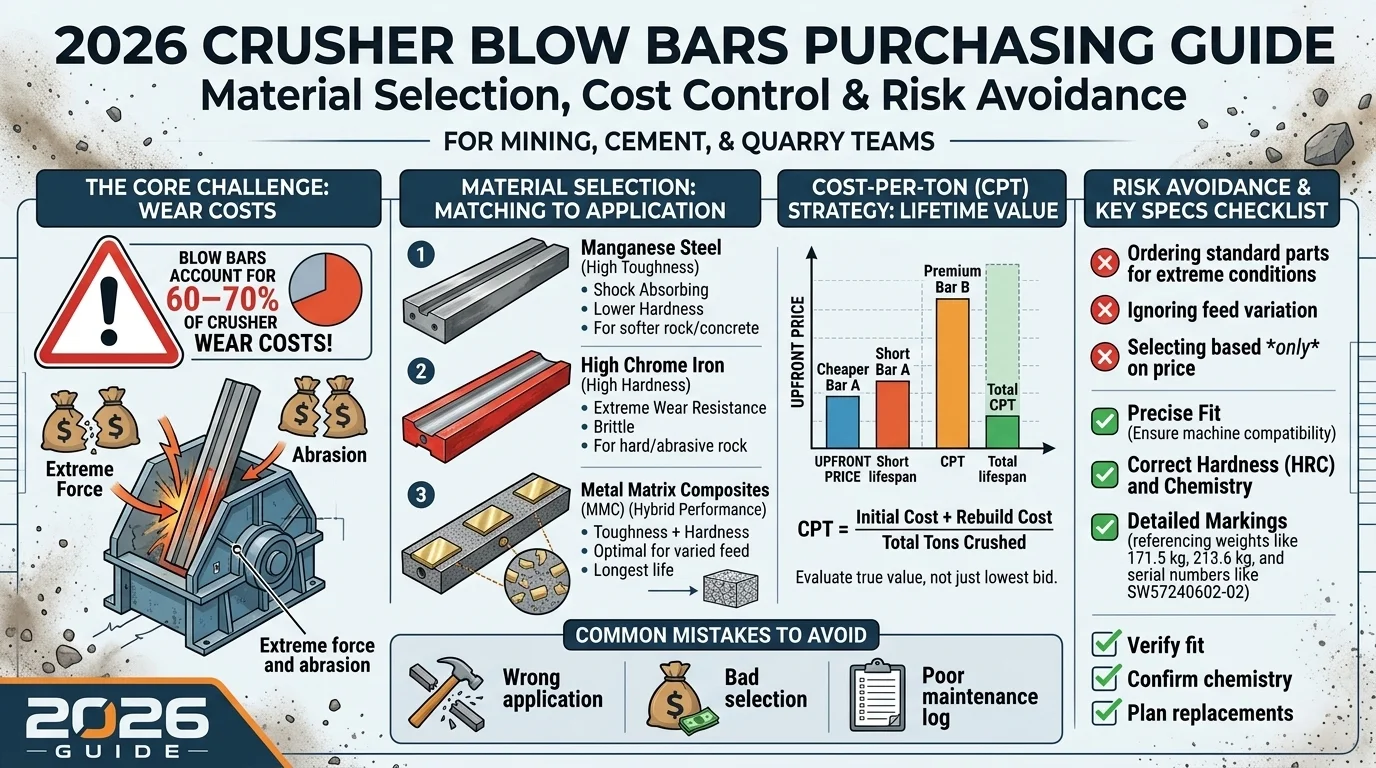
- Operational cost— blow bars are typically the single largest wear cost in impact crushers, often accounting for the majority of total wear part expenditure
- Crusher throughput— worn or broken bars reduce production efficiency significantly
The right material for a cement plant processing large limestone blocks is completely different from what a recycling yard needs. Let’s break it down.
The 6 Main Blow Bar Materials in 2026
1. High Manganese Steel Blow Bar
Best for: Primary crushing with large feed size (>1,000 mm) or iron-contaminated feed
Chemical Composition
| Element | Typical Range |
| Carbon (C) | 1.0 – 1.4% |
| Manganese (Mn) | 11 – 14% |
| Silicon (Si) | 0.3 – 0.8% |
| Phosphorus (P) | ≤ 0.07% |
Mechanical Properties
| Property | Value |
| Initial Hardness | ~200 HBW (≈ 20 HRC) |
| Work-Hardened Hardness | Up to 550–600 HV (≈ 53–58 HRC) |
| Impact Strength | ~250 J/cm² |
| Hardened Depth | ~10 mm |
High manganese steel works on a principle called work hardening: the surface layer hardens progressively under repeated impact, while the core remains tough and ductile. This combination makes it uniquely suited for absorbing enormous impact energy without fracturing.
What it’s used for:
- Primary crushing stages in mines and quarries
- Feed containing tramp iron, rebar, or other uncrushable material
- Very large feed sizes (blocks exceeding 1,000 mm)
- Low-to-medium abrasion applications such as limestone primary crushing
Pros:
- Excellent fracture toughness — virtually unbreakable under impact
- Safe to use even when feed contains metal contaminants
- Predictable, gradual wear rather than sudden failure
Cons:
- Lower initial hardness means faster wear under highly abrasive conditions
- Not suitable for fine, highly abrasive feed (river gravel, granite secondary crushing)
- Service life is harder to predict — depends heavily on actual work-hardening conditions
Price tier: ��� Entry-level — the most cost-effective starting point for primary applications
2. High Manganese Steel + Titanium Carbide (TiC) Insert Blow Bar
Best for: Cement plants, primary crushing with large feed and higher wear demands
This is the upgraded version of standard high manganese steel. Titanium carbide (TiC) rods or inserts are cast into the manganese steel matrix. TiC has an extremely high hardness (up to 3,200 HV), which creates localized wear-resistant zones while the steel base retains its toughness.
Chemical Composition (Base Matrix)
| Element | Typical Range |
| Carbon (C) | 1.0 – 1.4% |
| Manganese (Mn) | 11 – 14% |
| TiC Insert Hardness | ~3,200 HV |
Mechanical Properties
| Property | Value |
| Base Hardness | 200–250 HBW |
| Wear Life vs. Standard Mn | Up to +100% improvement (based on field performance data from leading wear part manufacturers; actual results vary by application) |
| Impact Resistance | High (inherits Mn steel toughness) |
What it’s used for:
- Cement plant primary crushers processing large limestone blocks
- Large-feed primary applications where standard manganese wears too fast
- Applications with occasional tramp iron risk but higher abrasion demands
Pros:
- Significantly longer service life than plain manganese steel (up to 2× in comparable conditions)
- Retains the fracture resistance of manganese steel
- Ideal balance of toughness and wear resistance for cement plant conditions
Cons:
- Higher cost than standard manganese steel
- TiC inserts can crack under extreme sudden impact if not properly cast
- Overkill for applications where plain Mn already delivers acceptable life
Price tier: ������ Mid-range — justified when plain manganese life is insufficient
3. Martensitic Steel Blow Bar
Best for: Secondary/tertiary crushing of medium-abrasion clean stone (feed <900 mm); also commonly used as a balancing bar during rotor maintenance
Martensitic steel is produced through rapid quenching and tempering heat treatment, creating a fine martensite microstructure that delivers a balance of hardness and toughness between manganese and chrome iron.
Chemical Composition
| Element | Typical Range |
| Carbon (C) | 0.3 – 0.7% |
| Chromium (Cr) | 1 – 5% |
| Manganese (Mn) | 0.5 – 2.0% |
| Molybdenum (Mo) | 0.3 – 1.0% |
Note: Some martensitic grades also contain Nickel (Ni, 0.5–2.0%) for additional toughness — consult your supplier for grade-specific composition.
Mechanical Properties
| Property | Value |
| Hardness | 44 – 57 HRC (500–550 HBW) |
| Impact Strength | 100 – 300 J/cm² |
| Wear Resistance | Medium-High |
In practice, martensitic steel is a solid all-round performer for secondary and tertiary crushing of blasted limestone, demolition concrete, and medium-abrasion materials — sitting between manganese’s toughness and chrome’s hardness. It also sees frequent use as a rotor balancing bar: when one bar in a set is replaced mid-life, a martensitic bar is often fitted on the opposite rotor position to maintain rotational balance without replacing the full set.
What it’s used for:
- Rotor balance configuration during planned maintenance
- Secondary/tertiary crushing of blasted limestone and demolition concrete
- Applications with feed size below 900 mm where manganese steel would over-soften
Pros:
- Good all-round balance of hardness and impact resistance
- Longer life than manganese steel in medium-abrasion applications (when feed < 900 mm)
- Readily available from most wear parts suppliers
Cons:
- Not as tough as manganese steel under high tramp iron risk
- Not as wear-resistant as high chrome in pure abrasion applications
- Primarily serves a utilitarian role; rarely the optimal primary material choice
Price tier: ��� Entry to mid-range — economical for balancing purposes
4. Martensitic Steel + Ceramic (MMC) Blow Bar
Best for: Urban demolition recycling, municipal solid waste (MSW), large natural stone (feed >300 mm)
This is a Metal Matrix Composite (MMC) — ceramic hard particles (typically aluminum oxide Al₂O₃ or zirconia-toughened ceramics) are distributed throughout or embedded into the martensitic steel matrix during casting.
The result: the toughness of martensitic steel + the surface hardness of ceramics, creating a blow bar that resists both impact fracture and abrasive wear simultaneously.
Key Characteristics
| Property | Value |
| Base Hardness | 500 – 550 HBW |
| Ceramic Particle Hardness | 1,500 – 2,500 HV |
| Service Life vs. Standard Martensitic | 2 – 4× longer (based on field performance data from leading wear part manufacturers; actual results vary by application) |
| Impact Resistance | Medium-High |
What it’s used for (primarily in European and North American markets):
- Municipal solid waste (MSW) processing — mixed feed with unpredictable contaminants
- Demolition concrete recycling with potential rebar content
- Natural stone primary crushing where feed exceeds 300 mm
- Asphalt recycling in primary stage
Pros:
- Currently one of the most widely adopted materials in European and North American marketsfor recycling applications
- Handles mixed, contaminated feed better than pure chrome iron
- Service life 2–4× standard martensitic — dramatically reduces change-out frequency
- Maintains a sharp, consistent crushing edge throughout the wear cycle (Magotteaux MMC Product Portfolio)
Cons:
- Significantly higher upfront cost than standard martensitic steel
- Not recommended for slag recycling (excessively abrasive)
- Overkill for low-abrasion, clean limestone primary crushing
- Heavier than standard bars — check rotor weight limits
Price tier: ��������� Premium — but total cost of ownership (TCO) is often lower due to extended life
5. High Chrome Iron Blow Bar (Cr20 & Cr26)
Best for: Secondary and tertiary crushing of clean stone, no tramp iron tolerance
High chrome iron (also called white iron or chromium iron) achieves its wear resistance through a hard chromium carbide microstructure. With hardness reaching 60–64 HRC, it is the hardest conventional blow bar material available — but also the most brittle.
⚠️ Critical Warning: High chrome blow bars will fracture catastrophically if the feed contains any tramp iron, rebar, or uncrushable materials. This isn’t a gradual wear issue — it’s sudden failure. A single piece of rebar passing through the crusher can shatter a Cr26 bar instantly, sending fragments into the rotor housing, damaging apron liners, and triggering an unplanned shutdown that costs far more than the bar itself. Feed preparation is non-negotiable.
Two Main Grades in 2026
| Grade | Cr Content | Primary Market | Hardness |
| Cr20 | ~20% Cr | Europe, North America | 58 – 62 HRC |
| Cr26 | ~26% Cr | Middle East, Africa | 60 – 64 HRC |
Cr26 is among the most widely used grades globally, particularly in secondary crushing applications across the Middle East, Africa, and Asia, due to its availability and cost-performance ratio in high-abrasion conditions. In European markets, Cr20 is preferred for its slightly better toughness profile.
Chemical Composition
| Element | Cr20 | Cr26 |
| Carbon (C) | 2.4 – 2.8% | 2.6 – 3.0% |
| Chromium (Cr) | 18 – 22% | 24 – 28% |
| Molybdenum (Mo) | 0.5 – 1.5% | 0.5 – 1.5% |
| Silicon (Si) | 0.5 – 1.0% | 0.5 – 1.0% |
Mechanical Properties
| Property | Value |
| Hardness | 60 – 64 HRC (600–650 HBW) |
| Impact Strength | ~10 J/cm² (very low) |
| Wear Resistance | Very High |
| Fracture Risk with Tramp Iron | Catastrophic |
What it’s used for:
- Secondary and tertiary crushing of limestone, dolomite, clean aggregates
- Asphalt recycling (iron-free)
- Sand and gravel (fine feed, high abrasion)
- Applications where feed is carefully prepared and controlled
Pros:
- Highest wear resistance of all standard blow bar materials
- Excellent for maximizing service life in clean, controlled feed conditions
- Lower upfront cost compared to ceramic composites
- Widely available globally (Cr26 especially)
Cons:
- Zero tolerance for tramp iron— will fracture without warning
- Requires strict feed preparation and metal detector/magnet systems upstream
- Not suitable for recycling or demolition waste applications
- Low impact toughness means higher risk in primary crushing stage
Price tier: ������ Mid-range — excellent value for clean secondary/tertiary applications
6. High Chrome Iron + Ceramic (MMC) Blow Bar
Best for: Secondary/tertiary clean stone crushing where maximum service life is the priority
This is the premium evolution of high chrome iron — ceramic particles are embedded into the chrome iron matrix, creating a composite that delivers wear resistance up to 2–3× higher than standard high chrome while maintaining the same application conditions.
Key Characteristics
| Property | Value |
| Base Hardness | 600 – 650 HBW |
| Ceramic Enhancement | Zirconia or Al₂O₃ particles |
| Service Life vs. Standard High Chrome | 2× or more (based on field performance data from leading wear part manufacturers; actual results vary by application) |
| Application Conditions | Same as standard high chrome |
What it’s used for:
- Secondary and tertiary crushing in European and North American quarries
- High-abrasion aggregate production (granite, basalt, quartzite)
- Applications where downtime for bar changes is extremely costly
- Customers willing to invest higher upfront for lower total operating cost
Pros:
- Dramatically extends service intervals — critical for large-scale operations
- Reduces total wear part cost per tonne when volume is high
- Maintains the sharp striking edge much longer than standard chrome iron (Metso Wear Parts — Blow Bars & Impact Plates)
- Increasingly popular in Europe and North America for high-throughput quarrying
Cons:
- Highest price pointof all 6 materials (typically 1.5–2× the cost of standard high chrome)
- Same iron-contamination restriction as standard high chrome — no tramp iron
- Not economically justified for low-throughput or intermittent operations
- Requires careful handling during installation — ceramic composite is brittle until fully supported in rotor pocket
Price tier: ������������ High premium — optimal for high-volume, high-throughput, clean-feed operations
At-a-Glance Comparison: All 6 Materials
| Material | Hardness | Impact Resistance | Abrasion Resistance | Tramp Iron Safe? | Typical Feed Size | Price Index | Best Market |
| High Manganese Steel | 200–600 HV* | ★★★★★ | ★★☆☆☆ | ✅ Yes | >1,000 mm | $ | Global |
| Mn Steel + TiC | 200–250 HBW | ★★★★★ | ★★★☆☆ | ✅ Yes | >1,000 mm | $$ | Cement Plants | | Martensitic Steel | 500–550 HBW | ★★★★☆ | ★★★☆☆ | ⚠️ Limited | <900 mm | $ | Global (Balancing) | | Martensitic + Ceramic | 500–550 HBW | ★★★★☆ | ★★★★☆ | ✅ Yes (with caution)¹ | >300 mm | $$
$ |
Europe / N. America |
| High Chrome (Cr20/Cr26) | 600–650 HBW | ★☆☆☆☆ | ★★★★★ | ❌ No | <400 mm |
$$ |
Europe / N. America |
*Work-hardened surface value
How to Choose the Right Blow Bar for Your Operation
Use this decision framework before placing your next order:
Step 1: Check your feed for tramp iron
If your feed contains or may contain iron, rebar, or metal — eliminate all chrome iron options immediately. Your choices are manganese steel, Mn+TiC, martensitic, or martensitic+ceramic.
Step 2: Determine your feed size
- Feed >1,000 mm: High manganese or Mn+TiC only
- Feed 300–900 mm: Martensitic or martensitic+ceramic
- Feed <400 mm, clean: High chrome (Cr20 or Cr26) or high chrome+ceramic
Step 3: Assess abrasion level
Use the abrasive wear index (AWI) of your material if available:
- Non-abrasive (0–100 g/t): Manganese steel is sufficient
- Low abrasion (100–600 g/t): Manganese or martensitic
- Medium abrasion (600–1,200 g/t): Martensitic or composite
- High abrasion (>1,200 g/t): High chrome or chrome+ceramic
AWI (Abrasive Wear Index) measures how much wear a material causes per tonne processed — your equipment supplier or material testing lab can provide this value for your specific feed. The classification ranges above are based on industry wear methodology widely referenced by major OEM crushing equipment manufacturers; actual thresholds may vary by system.
(For chromium iron wear resistance standards, see ASTM A532)
Step 4: Calculate total cost of ownership (TCO)
Don’t compare blow bar prices in isolation. Factor in:
- Hours per bar set × labor cost for change-out
- Production loss during change-out
- Cost per tonne crushed across full service life
A high chrome + ceramic bar at 2× the price that lasts 3× longer delivers 33% lower TCO in most high-throughput scenarios.
Frequently Asked Questions
Q: Can I use high chrome blow bars in a cement plant?
Only if your plant processes clean limestone with no tramp iron risk. Most cement plants with large feed sizes (>1 m) use high manganese or Mn+TiC due to the tramp iron risk from blast fragmentation. That said, if your cement plant has a reliable upstream magnet system and processes pre-screened limestone with feed size under 400 mm, Cr20 can be a viable option for secondary crushing stages.
Q: What is the most common blow bar material globally?
High chrome Cr26 is the single most widely used grade globally, due to its broad applicability in secondary crushing of clean aggregates and its availability across global supply chains.
Q: Why are ceramic composite blow bars more popular in Europe?
European operations typically have higher labor costs and stricter downtime tolerances — making the extended service life of MMC composites more economically compelling despite the higher upfront price. Regulatory pressure on waste recycling has also driven uptake of martensitic+ceramic for MSW and demolition recycling.
Q: How do I know if my feed is “tramp iron safe”?
Install an overband magnet and/or metal detector upstream of your crusher. If you cannot guarantee 100% iron removal, do not run high chrome bars — the fracture risk is too high.
Final Thoughts
Blow bar selection is not a purchasing decision — it’s an engineering decision with direct operational consequences.
The 6 materials covered in this guide each serve a specific purpose:
- High manganese & Mn+TiC→ Your go-to for large feed, iron risk, primary crushing
- Martensitic→ Balancing, medium-condition secondary crushing
- Martensitic+Ceramic→ Recycling, MSW, mixed feed where toughness meets wear resistance
- High chrome (Cr20/Cr26)→ The workhorse of clean secondary/tertiary crushing globally
- High chrome+Ceramic→ Maximum service life where feed is clean and volume is high
Match your material to your actual operating conditions — not to what your neighbor’s plant uses. When in doubt, start with the most cost-effective option for your conditions and measure actual wear life before committing to higher-cost composites.
The right blow bar doesn’t just last longer. It keeps your crusher running at full capacity, your maintenance schedule predictable, and your cost per tonne under control.
*Data references: Metso Wear Parts — Blow Bars & Impact Plates | Magotteaux MMC Product Portfolio | BHS-Sonthofen Impact Crusher Technology | ASTM A532 — Standard Specification for Abrasion-Resistant Cast Irons | ISO 21988 — Abrasion-Resistant Cast Iron Classification*