Your cone crusher liners are wearing out faster than expected.
Maybe you’re replacing them every few weeks. Maybe your cost-per-ton is creeping up. Maybe your maintenance team is tired of unplanned shutdowns.
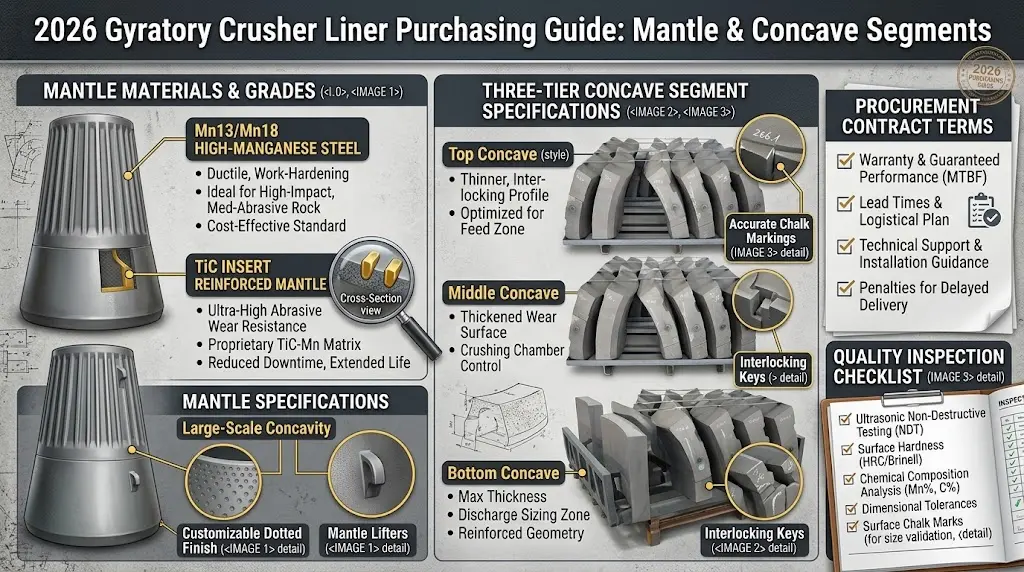
The two main options are manganese cone liners and TIC insert cone liners — and choosing the wrong one for your material can cost you significantly in downtime and replacement frequency.
If you’re running a mine, cement plant, or quarry — you’ve likely faced this question:
Should I stick with standard manganese cone liners, or upgrade to TIC insert cone liners?
This guide breaks it down clearly. No fluff. Just the technical facts, real-world performance data, and a straightforward comparison to help you decide.
What Are Manganese Cone Liners?
Manganese cone liners are the industry standard for cone crusher wear parts.
They’re cast from austenitic manganese steel — a material first developed by Sir Robert Hadfield in 1882. The key property that makes manganese steel ideal for crushing is work hardening: under repeated impact, the surface hardens while the interior stays tough.
Common Manganese Steel Grades
| Grade | Mn Content | Best For |
| M1 / 14% Mn | ~14% | Soft, low-abrasion materials |
| M2 / 18% Mn | ~18% | General-purpose; most common |
| M7 / 22% Mn | ~22% | Highly abrasive, hard rock |
(Source: Sandvik Rock Processing — Cone Crusher Wear Parts Technical Guide)
Most operations run 18% manganese as the default. For highly abrasive materials — granite, basalt, iron ore — 22% manganese hardens faster at the surface and extends liner life.
How Work Hardening Works
Fresh out of the foundry, manganese steel has a surface hardness of roughly 200–250 HB. Under crushing stress, the surface can harden to 500–550 HB — more than doubling its wear resistance. (Source: Metso Outotec, *Wear Parts Application Guide for Cone Crushers*)
This is why manganese liners actually improve during initial operation. But there’s a catch: work hardening requires impact. In low-impact or fine-crushing applications, the material never fully hardens — and wear accelerates.
What Are TIC Insert Cone Liners?
TIC insert cone liners take the same manganese steel foundation and embed tungsten carbide (WC) or titanium carbide (TiC) inserts directly into the casting.
These cylindrical rods — typically 10–20 mm in diameter — are metallurgically bonded into the manganese matrix during the casting process. They don’t sit on the surface. They’re part of the liner.
Why Carbide Inserts Change Everything
| Property | Manganese Steel | TIC Insert (Carbide) |
| Surface Hardness | 200–550 HB (work-hardened) | ~2,400–3,200 HV (WC and TiC typically ≥2,400 HV; varies by carbide type) |
| Abrasion Resistance | Moderate–High | Extreme |
| Impact Toughness | Excellent | Good (matrix absorbs impact) |
| Wear Mechanism | Gradual surface loss | Carbide pins protrude as matrix wears |
(Sources: Metso Outotec Wear Parts Application Guide; Sandvik Rock Processing Cone Liner Technical Data; TIC insert hardness data: supplier-reported, data on file)
The carbide pins stay harder than virtually any rock you’ll put through the crusher. As the surrounding manganese matrix wears away, the carbide inserts protrude slightly — creating a self-sharpening, high-grip crushing surface.
Available Configurations
TIC insert liners are available in the same manganese base grades:
- 14% Mn + TIC— for moderate impact, high abrasion
- 18% Mn + TIC— general high-wear applications
- 22% Mn + TIC— maximum wear resistance in extreme conditions
Manganese vs TIC Inserts: Direct Comparison
Here’s the head-to-head breakdown across the factors that matter most to your operation.
Performance Comparison Table
| Factor | Manganese Liners | TIC Insert Liners |
| Wear Life | Baseline | 2–4× longer (supplier field data; varies by material and application) |
| Abrasion Resistance | High | Extreme |
| Impact Resistance | Excellent | Good–Excellent |
| Work Hardening Benefit | Yes (requires impact) | Reduced dependency |
| Fine / Tertiary Crushing | Poor–Fair | Excellent |
| Hard Rock (granite, basalt) | Fair | Superior |
| Soft Rock (limestone, coal) | Good | Overkill |
| Initial Cost | Low | 2–5× higher |
| Cost Per Ton Crushed | Moderate–High | Lower (long-term) |
| Availability | Universal | Specialty (lead time) |
| Changeover Frequency | Higher | Lower |
Where Manganese Liners Still Win
Manganese isn’t obsolete. In the right conditions, it’s still the best choice.
Use standard manganese when:
- You’re crushing soft to medium-hard rock (limestone, sandstone, coal, river gravel)
- Your feed has high moisture or clay content that cushions impact
- You’re running a primary or secondary crusher with high throughput and consistent impact
- Budget constraints make upfront cost a hard limit
- Fast lead time is critical — replacement liners are needed immediately
In these scenarios, work hardening activates reliably, liner life is acceptable, and the economics make sense.
Where TIC Insert Liners Win — Clearly
TIC insert liners are engineered for conditions where standard manganese struggles.
Choose TIC inserts when:
- You’re crushing highly abrasive materials— granite, quartzite, iron ore, hard basalt, siliceous rock
- Your material has a Bond Abrasion Index (Ai) above 0.30or silica equivalent >65%
- You’re running a tertiary or fine-crushing circuit, where low impact prevents manganese from work-hardening
- Downtime is expensive— fewer liner changes mean more uptime
- You want to reduce cost per tonover a full production cycle
- Your crushing operation runs 24/7with high utilization rates
For cement plants processing clinker or raw limestone with silica bands, TIC inserts can dramatically cut the frequency of scheduled liner changes — often from monthly to quarterly.
Application-Specific Guidance
Mining Operations
In hard rock mining — gold, copper, iron ore, aggregates — abrasion is the primary wear mechanism.
Standard manganese liners in a tertiary cone crushing iron ore may last 200,000–400,000 tons before replacement (supplier field data; results vary by material and operating conditions). TIC insert liners in the same application have demonstrated 600,000–1,200,000+ tons of liner life in documented field cases (supplier field data; results vary by material and operating conditions).
Actual liner life varies significantly by material hardness (Mohs), feed size distribution, and crusher closed-side setting (CSS). The ranges above reflect hard rock applications at typical CSS settings for tertiary circuits.
(Reference: Metso Outotec Wear Parts & Service — Cone Crusher Liners; liner life improvement from THOR Technology: supplier-reported field data, data on file)
Bottom line for mines: In high-abrasion applications, TIC insert liners typically pay for themselves within 2–3 liner cycles.
Cement Plants
Cement operations crush two primary materials: limestone (relatively soft) and clinker (extremely hard and abrasive).
- Limestone crushing (primary/secondary):Standard 18% or 22% manganese performs well. Work hardening is consistent.
- Clinker crushing:Clinker’s hardness (~6–7 Mohs) and abrasive mineralogy cause rapid liner wear. TIC inserts are the preferred solution for clinker cone applications.
Fewer liner changes also mean reduced maintenance labor costs — a significant factor in cement plant economics, where planned maintenance windows are tightly scheduled.
Quarry and Stone Crushing Operations
Quarries process a wide range of materials — from soft limestone to hard granite and basalt.
For limestone quarries: Standard manganese is typically sufficient and cost-effective.
For granite, basalt, or hard stone quarries: TIC insert liners provide measurably better wear life and are increasingly becoming the standard recommendation from major OEMs.
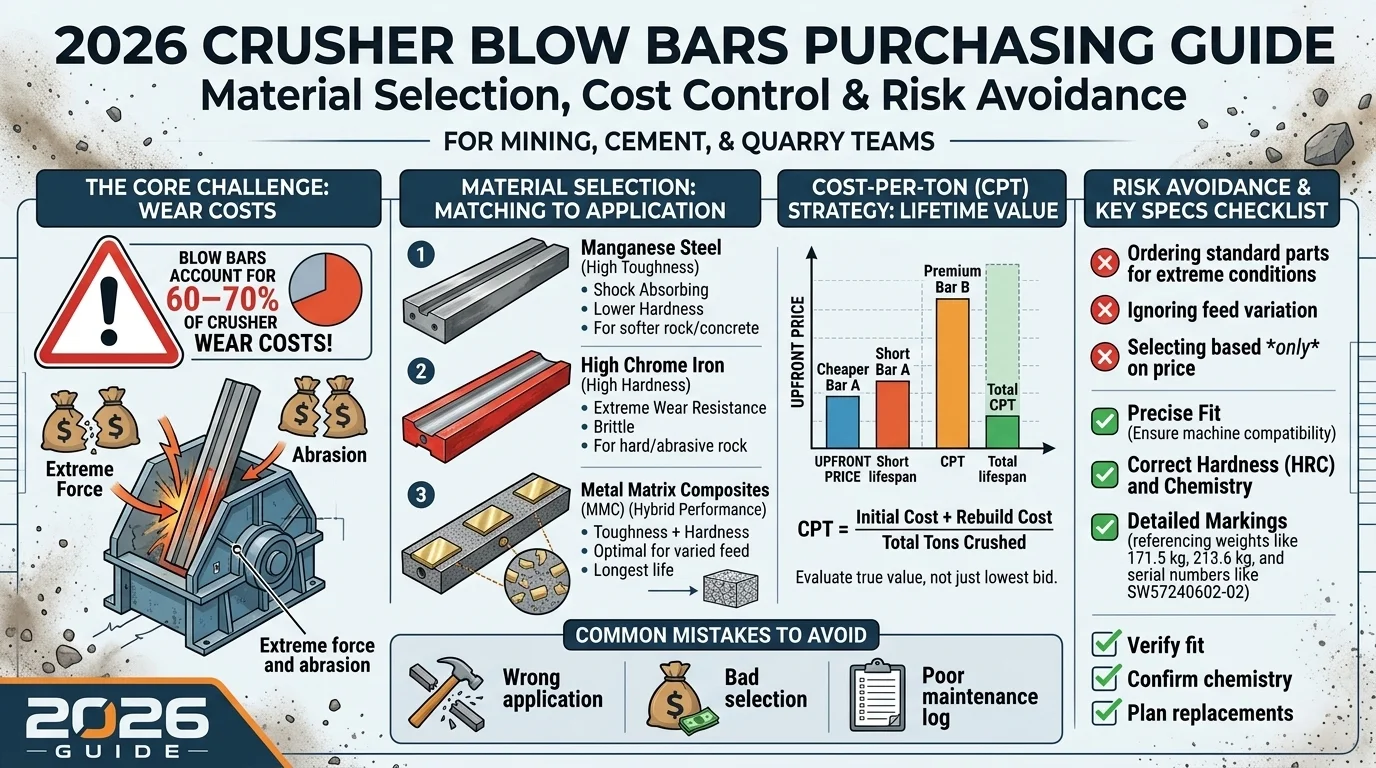
A key metric for quarry operators is cost per ton crushed. Even though TIC insert liners cost 2–5× more upfront, when spread across 2–4× the liner life, the per-ton cost often comes out equal or lower — while also reducing labor, crane time, and unplanned downtime costs.
Cost Analysis: Which Is Cheaper Over Time?
Let’s run a simplified scenario.
Assumptions:
- Operation: Hard rock quarry, tertiary cone crusher
- Production: 500,000 tons/year
- Manganese liner cost: $3,000/set
- TIC insert liner cost: $12,000/set
- Manganese liner life: 400,000 tons
- TIC liner life: 1,200,000 tons (3× longer)
| Manganese | TIC Insert | |
| Liner sets per year | 1.25 | 0.42 |
| Annual liner cost | ~$3,750 | ~$5,040 |
| Liner changes per year | 1.25 | 0.42 |
| Downtime cost (est. $2,000/change) | ~$2,500 | ~$840 |
| Total annual cost | ~$6,250 | ~$5,880 |
| Cost per 1,000 tons | ~$12.50 | ~$11.76 |
Note: Liner cost estimates based on industry-average pricing for mid-size cone crushers (500–800mm CSS). Downtime cost estimate based on typical quarry labor and equipment idle cost (~$2,000/event). Actual results vary by material hardness, feed gradation, and crusher utilization rate. This model is for illustrative comparison only.
In this scenario, TIC insert liners are slightly cheaper annually even at 4× the upfront price — because liner life more than compensates.
In real-world operations with higher abrasion or more frequent liner changes, the cost advantage of TIC inserts grows significantly.
Frequently Asked Questions
Can TIC insert liners handle high impact loads?
Yes — with caveats. The manganese matrix absorbs impact, protecting the carbide inserts. However, in applications with extreme intermittent impact (e.g., oversized feed, tramp metal risk), standard manganese or a hybrid approach may be safer. TIC inserts are optimized for abrasion-dominant wear, not pure impact.
Do TIC insert liners fit standard cone crushers?
Yes. TIC insert liners are available for most major crusher models — including Metso/Nordberg, Sandvik, Terex, and others. The insert technology is applied within the same casting geometry. No crusher modification is required.
How long does it take to get TIC insert liners?
Lead times are typically longer than standard manganese — 4–12 weeks depending on the supplier and crusher model. This is important for inventory planning. Many operations keep one spare set on hand.
Are TIC inserts the same as ceramic inserts?
No. TIC inserts (tungsten carbide or titanium carbide) are significantly harder than ceramic inserts:
- Ceramic: ~1,200–1,800 HV
- TIC (tungsten/titanium carbide): ~2,400–3,200 HV(varies by carbide type)
Carbide inserts also have better toughness and bonding integrity under crushing stress.
At what abrasion index should I consider switching to TIC?
A general guideline: if your material has a Bond Abrasion Index (Ai) above 0.30 (based on common industry practice; consult your wear parts supplier for material-specific evaluation), or if you’re crushing material with >65% silica equivalent (supplier-recommended guideline; verify with your material’s silica equivalent analysis), TIC insert liners should be evaluated.
Summary: Quick Decision Guide
| Your Situation | Recommended Liner |
| Soft rock, primary/secondary crushing | Manganese (18% or 22%) |
| Hard rock, abrasive material | TIC Insert |
| Tertiary / fine crushing circuit | TIC Insert |
| Cement clinker application | TIC Insert |
| Limestone quarry, budget-sensitive | Manganese |
| Granite / basalt quarry | TIC Insert |
| High silica content material (>65% SiO₂) | TIC Insert |
| High utilization, uptime-critical | TIC Insert |
| Infrequent operation, flexible schedule | Manganese |
The Bottom Line
Manganese cone liners are a proven, cost-effective solution for the right applications. They’ve been the backbone of crushing operations for over 140 years — and they’re not going anywhere.
But if you’re crushing hard, abrasive rock — or if your tertiary circuit is chewing through liners faster than expected — TIC insert cone liners offer a clear, measurable advantage.
The real question isn’t “which liner is better?”
It’s: “Which liner is right for your material, your circuit, and your cost model?”
If you’re unsure, the data-driven approach is simple: request a liner audit from your wear parts supplier. Share your material type, Mohs hardness, crusher model, and current liner life. A good technical rep will run the numbers and give you a clear recommendation.
Sources referenced in this article:
- Sandvik Rock Processing — Wear & Spare Parts for Cone Crushers
- Metso Outotec — Cone Crusher Wear Parts & Service
- Metso Outotec — Nordberg HP Series Cone Crushers, Liner Selection Guide
- EvoQuip / Terex — Crushing & Screening Wear Parts Catalog (supplier-reported, data on file)
- ESCO Corporation — Alloy Selection Guide for Crushing Applications (supplier-reported, data on file)
- TIC insert performance data: supplier-reported field results, data on file