2026 Procurement Guide for Scrap Metal Shredder Parts: What Every Purchasing Manager Needs to Know
If you manage equipment procurement for a scrap recycling or metal processing facility, you already know the pain: a shredder goes down unexpectedly, production halts, and your team is scrambling to source replacement parts overnight.
The right procurement strategy for metal shredder spare parts doesn’t just cut costs — it keeps your line running. This guide walks you through the 8 essential component categories, how to match materials to your specific application, what to ask suppliers before you commit, and how to build an inventory strategy that prevents emergency shutdowns.
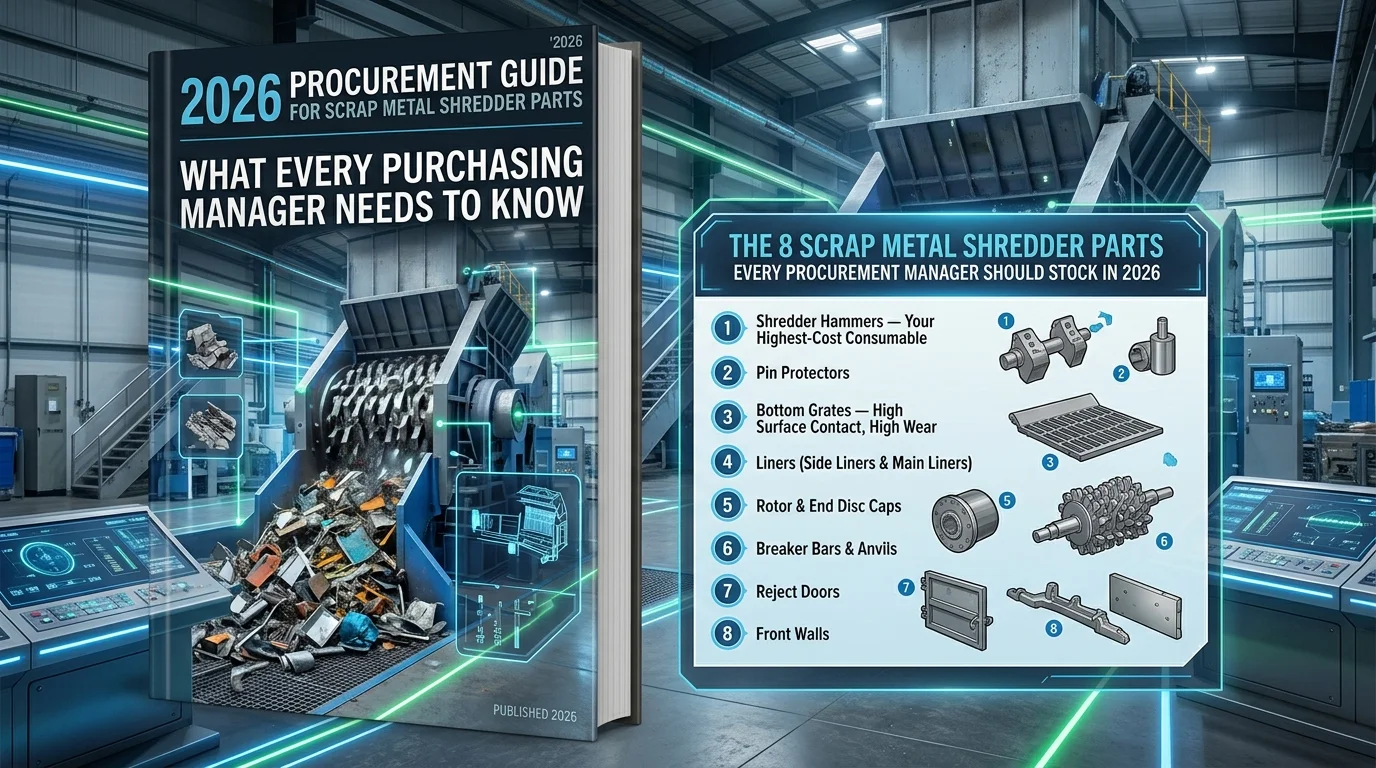
1. The 8 Scrap Metal Shredder Parts Every Procurement Manager Should Stock in 2026
Knowing what each part does — and how quickly it wears out — is the starting point for any budget-conscious procurement plan.
Shredder Hammers — Your Highest-Cost Consumable
Hammers are the core impact element of the shredder, transferring rotor kinetic energy directly to scrap metal. They wear faster than any other component, and getting the material selection wrong is one of the most common — and most expensive — procurement mistakes.
Four standard hammer configurations are available:
- Bell-Shaped Hammer — General-purpose, suitable for mixed scrap
- Standard Hammer — Ideal for mixed metal feedstock
- Light Iron Hammer — Optimized for thin sheet metal and aluminum cans
- Weight-Efficient Hammer — Designed for heavy-duty, high-load applications
Material selection by hammer weight — this is the decision that matters most:
- Under 300 kg: Choose between Mn13Mo0.5 (high-manganese steel with molybdenum — good toughness and work-hardening performance) or DHT / 30CrNiMo alloy steel (higher initial hardness, better suited for hard or abrasive feedstock)
- 300 kg and above: Use Mn13Mo0.5 or Mn13Mo1 — the higher molybdenum content improves strength and wear resistance at larger cross-sections, where work-hardening penetration becomes a limiting factor
Surface hardness reaches 50–55 HRC after work hardening under operational conditions.
Early warning signs to watch for: visible tip rounding, uneven fragmentation output, or a measurable drop in throughput tonnage. Any of these signals it’s time to rotate hammers before the damage compounds into adjacent components.
Pin Protectors
These sleeve-shaped components protect the long pin shafts that secure hammers to the rotor, while adding rotational inertia to stabilize impact force. They’re frequently left out of procurement plans — until a rotor disc needs replacing. Budget for them proactively.
Bottom Grates — High Surface Contact, High Wear
Grates control output particle size and prevent off-spec material from exiting prematurely. Their large contact surface makes them a consistent wear item.
Material: Austenitic manganese steel, ASTM A128 Grade B; work-hardened to 50–55 HRC.
Procurement rule: Always replace grates in the same cycle as anvils and breaker bars. Replacing them independently creates uneven wear across the system and shortens the life of all three components.
Liners (Side Liners & Main Liners)
Liners protect the internal chamber walls from direct abrasion. Material grade selection depends on your operating conditions:
- Mn13Cr2 — Standard wear environments
- Mn18Cr2 — High-impact or extreme abrasion applications
Rotor & End Disc Caps
Caps shield rotor components from direct impact. Replacement frequency is approximately every 10–15 hammer change cycles — typically every 2–3 weeks under continuous operation, though this varies significantly by machine model, feedstock type, and operational intensity. Track your own data to establish a facility-specific baseline.
For high-tonnage machines, individual caps can weigh several hundred pounds. Factor lead time and logistics into your stocking plan.
Breaker Bars & Anvils
- Breaker Bars :Absorb and distribute hammer impact forces, reinforcing structural integrity inside the chamber
- Anvils : Serve as the initial impact surface, guiding scrap into the shredding zone
Replace both on the same schedule as bottom grates.
Reject Doors
Reject doors provide a safety-release mechanism for non-shreddable objects — large metal blocks, foreign materials — without requiring a full machine shutdown. A functioning reject door is your first line of defense against catastrophic rotor damage. Don’t defer maintenance on this component.
Front Walls
Front walls absorb the initial impact of incoming feedstock. Inspect regularly for stress fractures, especially in facilities processing heavy plate or dense castings.
2. Material Specifications for Shredder Wear Parts: What to Ask Your Supplier
When evaluating shredder wear parts suppliers, don’t accept a product brochure as proof of quality. Ask for material certifications with specific alloy designations and hardness test results.
| Component | Material | Hardness (HRC) | Primary Function |
|---|---|---|---|
| Shredder Hammers (< 300 kg) | Mn13Mo0.5 or DHT (30CrNiMo) | 50–55 (work-hardened) | High-impact fragmentation |
| Shredder Hammers (≥≥ 300 kg) | Mn13Mo0.5 or Mn13Mo1 | 50–55 (work-hardened) | Heavy-duty fragmentation |
| Rotor Shafts | Forged 42CrMo4 | 28–32 (quench-tempered) | High-torque power transmission |
| Liner Plates | Mn13Cr2 / Mn18Cr2 | 50–55 (surface) | Chamber abrasion protection |
| Gratings / Screens | Austenitic Mn steel (ASTM A128) | 50–55 (work-hardened) | Output size control |
| Rotor Disks | Forged 42CrMo4 | 28–32 (quench-tempered) | Hammer mounting and structural support |
| Wear Plates | High-chrome cast iron | Up to 60 | Extreme abrasion environments |
Procurement tip: Always request the specific alloy designation — ask for Mn13Mo0.5 or 30CrNiMo, not just high-manganese steel or alloy steel. Vague material descriptions are the most reliable indicator of a low-quality supplier. Note: 42CrMo4 hardness values above reflect standard quench-and-temper (Q+T) conditions; surface hardness after induction hardening may reach 42–44 HRC depending on application requirements.
3. Casting Process Comparison: Where to Spend and Where to Save
Knowing the right alloy is only half the equation. The other half is how that alloy is cast — and this is where procurement decisions can quietly make or break your parts budget.
The same part made with different casting processes can vary significantly in service life — sometimes dramatically so depending on the application. The table below gives you a practical decision framework:
| Process | Relative Cost | Dimensional Accuracy | Best Use Case |
|---|---|---|---|
| Lost Foam Casting | Lower cost | Medium | Complex-geometry non-critical parts (e.g., feed chutes) |
| Water Glass Sand Casting | Lowest cost at volume | Lower | High-volume simple wear parts (e.g., bulk hammer orders) |
| Resin Sand Casting | Higher | High (tighter tolerances vs. water glass sand) | Critical load-bearing components (e.g., main shaft bushings, large jaw plates) |
The practical rule: Use water glass sand casting for bulk hammer procurement to control costs. Use resin sand casting for rotor shafts, main shafts, and any component where dimensional tolerance directly affects machine alignment or operational safety. Don’t cut costs on load-bearing parts.
4. How to Qualify a Scrap Metal Shredder Parts Supplier: A Practical Checklist
If you’re researching how to buy shredder wear parts from a new supplier, the expanded third-party market is both an opportunity and a risk. A growing number of manufacturers now offer OEM-compatible parts for major brands — including Newell, Lindemann, and Texas Shredder— and the quality gap between top-tier aftermarket suppliers and original equipment has narrowed considerably. That said, it also means more low-quality options in the same channels.
Use this checklist before placing any significant order:
- Request material certificates — Ask for alloy-specific documentation (Mn13Mo0.5, 30CrNiMo, 42CrMo4) and hardness test reports. In practice, most low-quality suppliers cannot provide alloy-specific certifications beyond a generic spec sheet — this single step filters out a significant portion of unqualified vendors.
- ✅Verify work-hardening performance — Confirm that surface hardness reaches 50–55 HRC under operational conditions for wear parts:insert{.}
- ✅ Confirm brand and model compatibility — Match part numbers to your specific machine model (Newell, Lindemann, Texas Shredder, Metso, etc.). A mismatch wastes money and causes downtime.
- ✅ Ask about casting process — A credible supplier will clearly state which casting method is used for each component and why:insert{.}
- ✅ Check lead time and shipping reliability — For international buyers, logistics performance is as critical as part quality. One delayed shipment can cost more than any price difference.
- ✅ Request synchronized replacement packages — Suppliers who understand operational workflow will offer bundled grate + anvil + breaker bar sets, saving you coordination time and reducing the risk of mismatched wear cycles.
5. Procurement Strategy: How to Reduce Downtime and Control Parts Budget
Build a Replacement Frequency Matrix
If you’re managing procurement reactively — ordering parts after something breaks — you’re already losing money. Build a simple replacement frequency log for your facility. A typical baseline for continuous operations:
| Component | Approximate Replacement Interval | Stocking Recommendation |
|---|---|---|
| Shredder Hammers | Highest frequency (facility-dependent) | Maintain minimum 1 full set on-site at all times |
| Rotor & End Disc Caps | Every 10–15 hammer cycles (~2–3 weeks) | Keep at least 2 sets in inventory |
| Bottom Grates | Synchronized with anvils and breaker bars | Order as a bundled set |
| Liners | Lower frequency; inspect monthly | 1 backup set per liner type |
| Reject Doors / Front Walls | Annual inspection; replace on damage | On-demand; prioritize supplier lead time |
Stock Strategically, Not Reactively
Working with a reliable shredder hammer tips supplier means you can negotiate volume pricing on your highest-turnover item. Hammers are your highest-volume consumable — bulk ordering via water glass sand casting offers meaningful cost savings at scale. Maintain a minimum on-site buffer of at least one full hammer set to avoid emergency sourcing situations.
For rotor caps, given the 2–3 week replacement cycle under continuous operation, carry at least two sets in inventory at all times. The cost of holding an extra set is negligible compared to the cost of an unplanned shutdown.
Never Mix Wear Grades Mid-Cycle
Mixing Mn13Mo0.5 and DHT hammers in the same rotor row — or combining different wear grades in a single replacement cycle — isn’t just a quality compromise. It creates uneven stress distribution across the rotor, accelerates disc wear, and will generate a repair bill that far exceeds whatever was saved on parts. Replace the full set, every time, with consistent material grade throughout.
Final Thoughts
Sourcing scrap metal shredder spare parts in 2026 is less about finding the cheapest supplier and more about building a reliable supply chain that keeps your machine running at specification. The decisions that matter most — alloy grade matched to hammer weight, casting process matched to component criticality, supplier qualification before the first order — are all within your control as a procurement manager.
Start with material certifications, build your replacement frequency data, and qualify at least two suppliers per critical component category. That’s the foundation of a procurement strategy that protects both your equipment and your production schedule.
The shredder doesn’t care about your budget cycle — but with the right parts strategy in place, you’ll be the one in control.