OEM vs Aftermarket Crusher Wear Parts: Which Is Better?
If you manage a quarry, mining operation, or recycling facility, you’ve faced this decision more than once: stick with OEM crusher wear parts, or go aftermarket?
Maybe you’ve gotten a parts quote that made you do a double-take. OEM pricing for jaw plates or cone liners can be steep — and when you’re replacing them every few months, that adds up to a number that’s hard to justify. But then you start looking at aftermarket options, and the doubt creeps in: will these actually hold up, or am I just buying a headache at a discount?
It’s a fair concern. And the honest answer is: it depends — not on whether the part is OEM or aftermarket, but on who made it and how well it was specified for your application.
This guide breaks down both options across five critical factors — quality, fit, price, lead time, and warranty — so you can make a confident, informed decision for your operation.
What Are OEM Crusher Wear Parts?
OEM (Original Equipment Manufacturer) wear parts are produced by — or under direct license from — the company that built your crusher. When you buy a Metso jaw plate, a Sandvik cone liner, or a Kleemann blow bar directly from the brand, that’s OEM.
The case for OEM:
- Engineered and tested specifically for your machine model
- Backed by the manufacturer’s full warranty
- Consistent metallurgical specs across every order
- Long-term parts availability commitments — major OEM brands typically commit to multi-year parts availability for current product lines
The limitations:
- Premium pricing — typically 20–40% higher than comparable aftermarket alternatives, though the gap varies by brand, part type, and region
- Longer lead times when parts aren’t stocked locally
- Single-source dependency; if the OEM faces supply disruptions, you feel it immediately
- Limited customization options for specific material conditions
What Are Aftermarket Crusher Wear Parts?
Aftermarket wear parts are manufactured by third-party companies that are independent of the original crusher brand. They are designed to be dimensionally and functionally compatible with specific crusher models — without carrying the OEM label.
A common misconception: aftermarket always means lower quality. That’s no longer accurate.
Today’s leading aftermarket manufacturers invest heavily in metallurgical R&D, dimensional reverse-engineering, and quality control systems that meet or exceed OEM specifications. Across the industry, suppliers with serious manufacturing capabilities can achieve wear life improvements of up to 20–30% over standard OEM parts in certain applications — depending on application conditions and alloy selection — achieved through tailored alloy formulations rather than off-the-shelf casting.
The real variable isn’t OEM vs. aftermarket — it’s which supplier you choose.
OEM vs Aftermarket: Head-to-Head Comparison
1. Quality & Wear Life
| OEM | Aftermarket (Quality Supplier) | |
| Material consistency | High — controlled by the OEM | Varies — depends on supplier’s QC |
| Wear life | Baseline reference | Can match or exceed OEM |
| Testing & validation | Factory-tested against equipment | Reputable suppliers run independent testing |
| Risk of damage to machine | Very low | Low (with vetted supplier); higher (with unknown supplier) |
Takeaway: A reputable aftermarket supplier using verified alloy grades and strict dimensional tolerances can deliver wear parts that perform on par with OEM — sometimes better, particularly in abrasive or high-impact applications where custom metallurgy is an advantage.
2. Fit & Compatibility
OEM parts are designed for exact fit. No surprises.
Aftermarket parts that are properly reverse-engineered to OEM specs should fit without modification. However, quality varies across the aftermarket landscape. A poorly made aftermarket part that doesn’t seat correctly can accelerate wear on adjacent components — and that’s a cost no one budgets for.
What to look for: Dimensional drawings, material certifications, and a supplier willing to stand behind fit guarantees.
3. Price
This is where aftermarket parts win — clearly and consistently.
| Typical Cost vs. OEM | |
| OEM | Baseline (100%) |
| Aftermarket (budget, unknown origin) | 40–60% of OEM |
| Aftermarket (quality supplier) | 60–75% of OEM |
For high-consumption wear parts like jaw plates, mantles, and blow bars, the cost difference adds up fast. An operation running multiple crushers can save tens of thousands of dollars annually by sourcing from a quality aftermarket supplier — without sacrificing performance.
4. Lead Time & Availability
OEM parts are subject to the manufacturer’s own production and distribution schedules. For standard parts, this is usually fine. For less common configurations or during peak demand periods, lead times can stretch to weeks.
Aftermarket suppliers — especially those with dedicated stock and global logistics — often offer:
- Faster turnaround on common wear parts. A quality supplier maintaining stock of standard jaw plates for Metso C-series or Sandvik CH/CS-series cones can typically ship within 3–7 business days. Compare that to OEM lead times that can run 3–6 weeks for non-stocked configurations.
- Flexible order quantities without minimum order requirements that tie up capital
- Willingness to produce custom profiles — alternative alloy grades, modified tooth patterns — that OEM channels simply won’t offer
For operations where unplanned downtime carries significant cost — and in large-scale mining or aggregate production, that can easily run into thousands of dollars per hour — faster parts availability is not a minor point. It’s a business-critical advantage.
5. Warranty & After-Sales Support
OEM manufacturers offer structured warranty coverage — but typically only when genuine parts are used. Using aftermarket parts can, in some cases, affect OEM warranty coverage on the machine itself. This is worth reviewing in your equipment service agreement.
Established aftermarket suppliers carry their own product warranty. What matters:
- Is the warranty clearly stated in writing?
- Does the supplier have the technical capacity to assess and honor claims?
- Is there local or regional support available?
A small or unknown supplier offering vague “satisfaction guaranteed” language is not the same as a supplier with documented warranty procedures and international support infrastructure.
When Should You Choose OEM vs. Aftermarket?
Consider OEM when:
- Your machine is under active manufacturer warranty and the agreement restricts third-party parts
- You’re running a less common or highly specialized crusher where aftermarket options are limited
- Precise OEM spec compliance is required for regulatory or insurance reasons
Consider a quality aftermarket supplier when:
- Your equipment is out of warranty and you have purchasing flexibility
- Budget pressure is real and you’re buying wear parts in volume
- You’ve done due diligence on the supplier’s quality controls
- You need faster delivery or custom material grades for specific applications
For most operations, a quality aftermarket supplier is the smarter long-term choice once the machine is past its warranty period — provided you’ve done the supplier vetting outlined above.
How to Evaluate an Aftermarket Crusher Wear Parts Supplier
Not all aftermarket suppliers are equal. Here’s what separates the reliable ones from the rest:
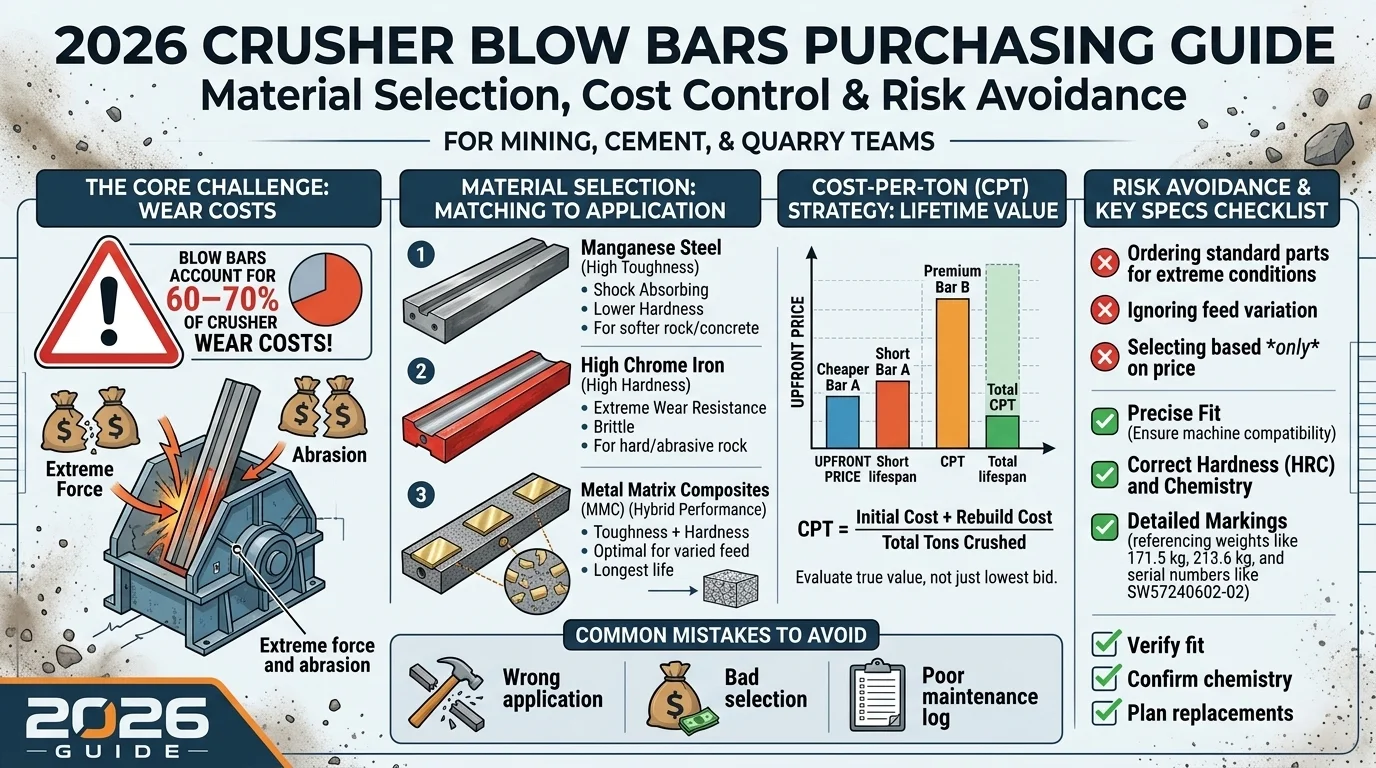
- Metallurgical Transparency: Can they provide material certifications? Do they document the alloy composition of their manganese steel, chrome iron, or other wear materials? A credible supplier answers this clearly. Red flag: If a supplier can’t produce a material cert on request, walk away.
- Dimensional Accuracy: Do they have verified drawings for your specific crusher model and serial number range? Will they guarantee dimensional fit?
- Quality System: Are they ISO certified? Do they have in-house testing facilities — spectral analysis, hardness testing, impact testing? Red flag: “We’ve supplied this model for years” is not a substitute for documented QC.
- Track Record: How long have they been supplying parts for your crusher brand? Can they provide references from customers running similar applications?
- Warranty & Support: Is there a written warranty? Can they provide technical support if installation or performance issues arise?
- Delivery Capability: Do they maintain stock or manufacture to order? What are realistic lead times for your region?
Why Qiming Casting Is One of the Best Aftermarket Crusher Wear Parts Suppliers
If you’re looking for an aftermarket supplier that checks every box above, Qiming Casting belongs at the top of your shortlist.
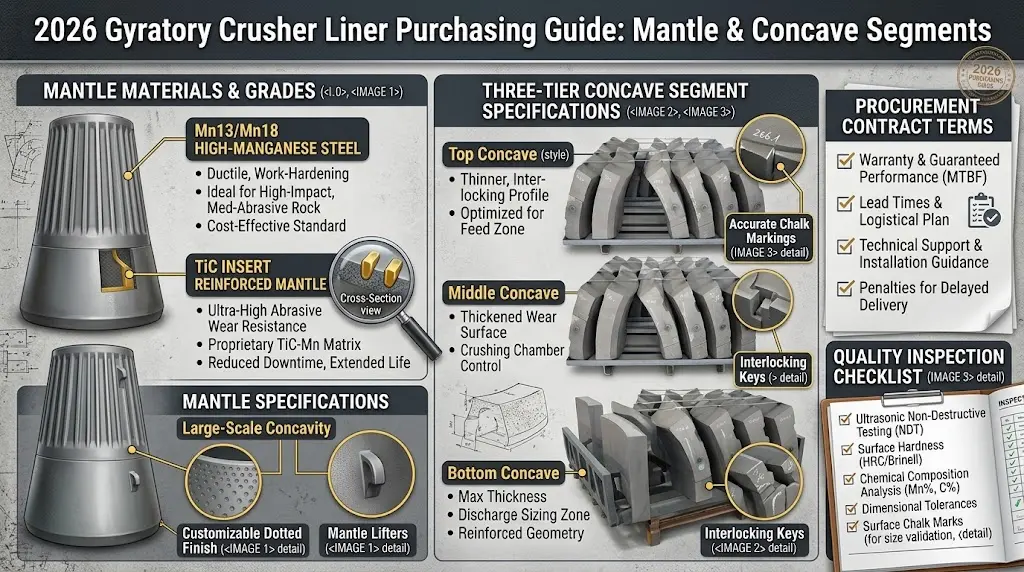
Qiming Casting is a China-based manufacturer specializing in high manganese steel, chrome iron, and alloy steel wear parts for jaw crushers, cone crushers, impact crushers, and gyratory crushers. Their parts catalog covers virtually all major crusher brands — Metso/Nordberg, Sandvik, Terex, Kleemann, Trio, and more — and every part is produced to match OEM dimensional specifications, with full material traceability from raw material sourcing through final inspection.
On the metallurgy side, Qiming doesn’t use a one-size-fits-all approach. Parts are cast using premium raw materials with controlled chemical composition, multi-stage heat treatment, and hardness verification tailored to the application. For a hard-rock quarry in Southern Africa running a Sandvik CH440, that means a different alloy selection than a recycling operation in Germany processing mixed demolition material — and Qiming’s technical team understands that distinction.
What that translates to in practice: customers across North America, Europe, and Southeast Asia report wear life that is comparable to — and in abrasive applications, often longer than — OEM-supplied parts, at a cost that’s typically 25–40% lower. For operations sourcing jaw plates or mantles in volume, that delta is substantial.
Delivery is predictable. Standard wear parts for common crusher models ship within 7–15 business days internationally, and the team is responsive on part identification, drawing verification, and post-delivery technical questions — not something you can always say about a large OEM distribution channel.
- ISO 9001:2015-certified quality systemwith documented material certifications available on request
- Proven global deliverywith customers across North America, Europe, Africa, and Southeast Asia, with a track record in mining, aggregate, and recycling applications
When price, quality, fit, delivery, and support all need to work together — Qiming Casting delivers.
Conclusion
The OEM vs. aftermarket debate doesn’t have a single universal answer. What it does have is a framework:
- If you’re under active warranty or have specific contractual obligations, OEM is the safe default.
- If you’re past warranty and buying wear parts in volume, a quality aftermarket supplier can save you significant money without sacrificing performance— as long as you’ve done the vetting.
The key word is quality. Not all aftermarket parts are created equal, and the supplier you choose matters as much as the choice between OEM and aftermarket itself.
Qiming Casting has built its reputation on exactly this standard — professional-grade aftermarket crusher wear parts that hold up in demanding applications, delivered reliably, backed by real support.
If you want to see what this looks like for your specific equipment, reach out to Qiming Casting with your crusher model, serial number range, and application details. Their team will recommend the right alloy grade, confirm current stock or lead time, and get back to you within 24 hours.