Notice
This document outlines the core guidelines and quality control standards for high manganese steel liner casting, focusing on the key processes, composition control, and defect prevention measures. All content is based on professional casting practices and industry standards, intended to provide technical guidance for relevant practitioners. For specific customization needs and professional support, please contact Qiming Casting for professional solutions.
-
What Makes High Manganese Steel Liners Special?
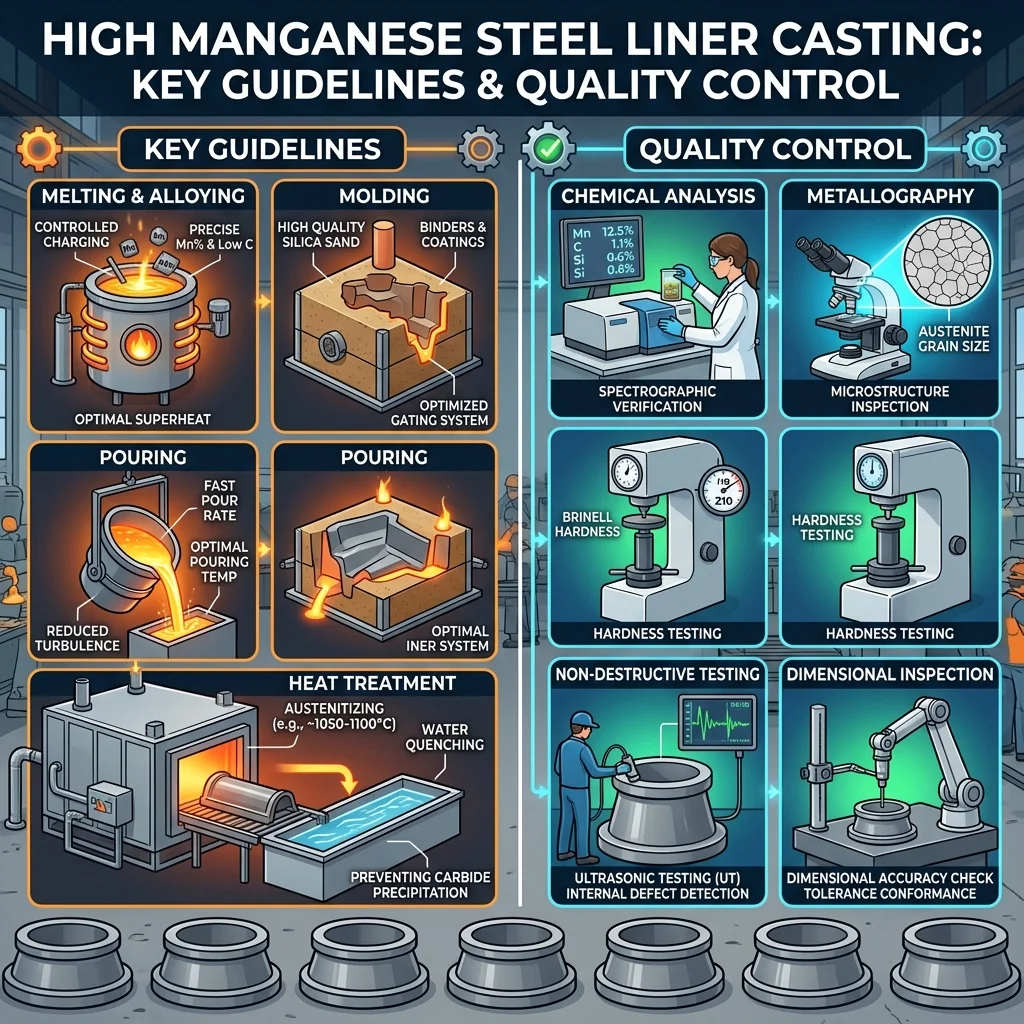
High manganese steel, particularly Mn13, is renowned for its work hardening capability—under impact loading, it exhibits increased hardness and wear resistance. However, this performance advantage can only be realized through rigorous control of the casting process. The core principles of successful high manganese steel liner casting include precise composition control, effective sand sticking prevention, proper pouring and feeding system design, and strict water toughening heat treatment.
-
Composition Control: The Foundation of Wear Resistance
Incorrect chemical composition in high manganese steel liner casting will directly affect the wear resistance and service life of the liners. The following composition range is recommended for optimal performance, consistently utilized by Qiming Casting for high-quality liner production:
| Element | Target Range (Mass Fraction) | Significance for Casting Quality |
| Carbon (C) | 1.0% – 1.4% | Enhances wear resistance for Mn13 liner casting; insufficient carbon results in low hardness, while excessive carbon leads to brittleness. |
| Manganese (Mn) | 11% – 14% (≥13% recommended) | Critical for inducing work hardening in high manganese steel liner casting; excessive manganese may cause carbide precipitation. |
| Silicon (Si) | ≤0.5% | Lower silicon content improves toughness for Mn13Cr2 liner casting; elevated levels reduce impact resistance. |
| Phosphorus (P) | ≤0.09% | Low phosphorus content minimizes brittleness in high manganese steel liner casting; excessive phosphorus may lead to cracking. |
| Sulfur (S) | ≤0.04% | Minimizes internal defects and brittleness in Mn18 liner casting; excessive sulfur causes casting defects. |
Professional Tip: Maintain a carbon-manganese ratio between 1.0–1.4 for high manganese steel liner casting. This ratio ensures the formation of a single austenite structure, which is essential for the work hardening performance of Mn13 liners.
-
Molding & Sand Control: Preventing Sand Sticking Defects
Sand sticking is a common defect in high manganese steel liner casting, which impairs the surface quality and wear resistance of the liners. The following measures are recommended to eliminate sand sticking and ensure casting quality:
- Sand Selection: Magnesium olivine sand is the preferred material for high manganese steel liner casting, as it is resistant to MnO erosion and prevents chemical sand sticking. For small-to-medium Mn13Cr2 liners, limestone sand or CO₂-hardened water glass sand can also be used.
- Molding Standards: Sand compactness should be maintained at ≥50 (measured using an A-type hardness tester) to avoid loose sand and sand drops. The mold cavity must be smooth, and multiple through air channels should be installed to ensure proper gas discharge during casting.
- Coating Protection: A high-refractory magnesia coating (0.5–1.0mm thick) must be applied to the working surface of the mold. Quartz sand is strictly prohibited, as it reacts with MnO to form low-melting point compounds, resulting in severe sand sticking in Mn18 liner casting.
-
Pouring & Feeding: Preventing Shrinkage Defects
Shrinkage defects (such as holes and looseness) reduce the structural integrity of high manganese steel liners and increase the risk of fracture. The following parameters and requirements must be strictly followed in high manganese steel liner casting:
| Parameter | Recommended Setting | Quality Impact |
| Linear Shrinkage | 2.5% – 2.7% | Ensures proper liner size and fit with equipment; deviations cause mismatch issues. |
| Pouring Temperature | 1380–1420℃ | Temperatures below 1350℃ increase shrinkage rate and reduce wear resistance. |
| Pouring Speed | 20–30kg/s (medium-large liners) | Excessive speed causes sand washing; insufficient speed leads to cold shut defects. |
| Feeding System | Bottom/step side pouring + insulated risers | Ensures uniform filling and prevents shrinkage holes in high manganese steel liner casting. |
Additional Note: Insulated risers with easy-cut discs should be used to ensure that risers solidify after the liner, providing continuous feeding during solidification. External chills are recommended to control hot spots, while internal chills are strictly prohibited to avoid inclusions in Mn13Cr2 liner casting.
-
Heat Treatment: Water Toughening for Optimal Performance
Heat treatment is a critical step in high manganese steel liner casting, directly determining the work hardening performance and service life of the liners. The water toughening process must be strictly implemented as follows:
- Heating Stage:
- Room temperature to 600℃: Heat at a rate of 30–50℃/h to prevent thermal stress and cracking.
- 600℃ to target temperature (1050–1100℃): Heat at an accelerated rate of 100–150℃/h to improve efficiency.
- Insulation Stage: Maintain the target temperature for a duration calculated as (liner thickness in mm) ÷ 25 (hours). For example, a 50mm Mn13 liner requires 2 hours of insulation.
- Quenching Stage: Submerge the liner in water immediately after removing it from the furnace (steel temperature ≥950℃). The water temperature should be 10–30℃, and the water volume should be ≥8–10 times the liner weight. Stir or circulate the water to break the vapor film and ensure uniform cooling.
- Final Cooling: Cool the liner to ≤60℃ in water; air cooling is prohibited, as it causes carbide precipitation and brittleness in high manganese steel liner casting.
- Common Defects: Diagnosis & Remedial Measures
Strict quality control during high manganese steel liner casting can effectively reduce defects. The following table outlines common defects, their root causes, and corresponding remedial measures:
| Defect Type | Root Cause | Remedial Measures |
| Sand Sticking | MnO reaction with sand; insufficient coating; low sand compactness | Use magnesium olivine sand + magnesia coating; increase sand compactness. |
| Shrinkage Holes | Inadequate feeding; uneven pouring; low pouring temperature | Optimize feeding system; adjust pouring speed and temperature; add external chills. |
| Air Pores | High sand gas emission; turbulent pouring; poor mold ventilation | Use low-gas sand; add air channels; ensure smooth pouring. |
| Cracking | Thermal stress; uneven cooling; improper heat treatment | Follow heating/cooling curves; optimize water toughening process. |
| Carbide Precipitation | Inadequate water toughening; slow cooling; excessive manganese content | Strictly control heat treatment parameters; ensure rapid quenching. |
-
Professional Selection Guidelines for High Manganese Steel Liners
High manganese steel liners (Mn13, Mn13Cr2, Mn18) should be selected based on operating conditions to maximize service life and performance. The following guidelines are recommended for liner selection in high manganese steel liner casting:
- High Impact Environments (Mining/Crushing): Mn13Cr2 or Mn18 liners are recommended, as they exhibit enhanced toughness and crack resistance, optimized through professional high manganese steel liner casting.
- High Wear Environments (Cement/Grinding): Standard Mn13 liners are preferred for their stable wear resistance and cost-effectiveness, suitable for continuous grinding operations.
- Corrosive/Fatigue Environments (Power Plants): Mo/Ni micro-alloyed high manganese steel liners are suitable, as they provide superior corrosion resistance and fatigue performance for long-term operation.
-
Quality Inspection Requirements
To ensure the quality of high manganese steel liner casting, the following mandatory inspections must be conducted after casting and heat treatment:
- Metallographic Testing: Confirm the formation of a single austenite structure, free of excessive carbides or inclusions.
- Hardness Testing: Ensure the liner hardness reaches HB 180–220, which is the optimal range for work hardening performance.
- Impact Toughness Testing: The impact toughness should be ≥15 J/cm² to ensure resistance to impact loading in high manganese steel liner casting.
- Surface Inspection: The liner surface should be smooth, free of sand sticking, cracks, or other defects that may affect wear resistance.
-
About Qiming Casting – Your High Manganese Steel Liner Casting Expert
Qiming Casting is a global leader in the design and manufacturing of high manganese steel liners, specializing in professional high manganese steel liner casting services. The company strictly controls every stage of the casting process—from composition testing and molding to pouring, heat treatment, and quality inspection—to deliver high-quality liners that meet industry standards and customer requirements.
Whether you require Mn13, Mn13Cr2, or Mn18 liners, Qiming Casting provides customized casting solutions and professional technical support.