This guide is written for engineers and procurement managers at mining operations, cement plants, and stone quarries running cone crushers in secondary, tertiary, or quaternary crushing stages.
Quick Answer:
- Limestone→ Grade C or D manganese steel, standard/medium profile
- River Pebble→ Grade D + Gripper Slot bowl liner
- Granite→ Grade D2 or enhanced alloy (THOR, MnCr 20.3)
- Basalt / Hard Rock→ D2 / MnCr 20.3 minimum; fix feed distribution first
Wrong liner. Wrong material. Wrong grade.
That’s how most unplanned shutdowns begin.
If you’re running a cone crusher in a mine, cement plant, or stone quarry, you already know: liner selection is one of the highest-impact decisions you make. Get it right, and you’re looking at longer wear life, higher throughput, and lower cost per ton. Get it wrong, and you’re changing liners every few weeks — burning budget and losing production hours.
This guide breaks down exactly how to choose cone crusher liners based on your rock type, crushing stage, and operational goals.
No fluff. Just the framework.
What Are Cone Crusher Liners — and Why They Matter
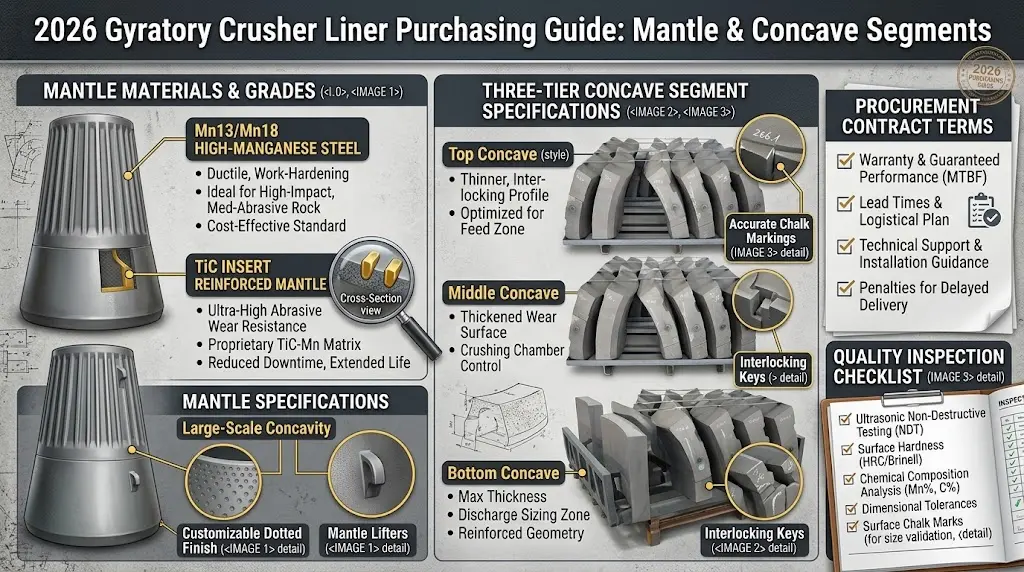
Cone crusher liners are the two main wear parts inside a cone crusher:
- Mantle(the inner, moving part — also called the crusher cone)
- Bowl liner(the outer, fixed part — also called the concave)
Together, they form the crushing chamber. Material is crushed between them as the mantle gyrates.
Because they’re in direct contact with rock — thousands of tons of it every day — they wear down over time. When they’re worn out, productivity drops, product size becomes inconsistent, and your operating cost spikes.
The goal is simple: choose liners that last as long as possible for your specific material, without sacrificing throughput or product quality.
4 Key Factors That Determine Liner Selection
Before picking a liner grade or profile, you need to understand your material and application. Four factors matter most:
1. Rock Hardness (Compressive Strength)
Measured in MPa (megapascals). Cone crushers are typically designed for materials with compressive strength below 300 MPa (Kleemann Technical Guide). Beyond that, impact crushers or jaw crushers may be more appropriate.
| Rock Type | Typical Compressive Strength |
| Limestone | 30–150 MPa |
| River Pebble / Gravel | 80–200 MPa (varies significantly by rock composition) |
| Granite | 100–250 MPa |
| Basalt | 100–300 MPa |
| Quartzite | 200–300 MPa |
(Compressive strength ranges: Sandvik Rock Processing Technical Reference — https://www.sandvik.com. Basalt strength varies significantly by formation; harder varieties typically 200–300 MPa.)
2. Abrasion Index (AI)
The abrasion index tells you how quickly a material will grind down your liner. Higher AI = faster wear = more aggressive alloy needed.
Granite and quartzite are highly abrasive. Limestone is generally low to moderate. River pebble sits in the middle — but its rounded shape creates unique challenges (more on that below).
3. Work Index (Wi)
The Bond Work Index indicates how much energy it takes to crush a material to a given size. High Wi materials (like granite) demand more from your liner, accelerating wear. Low Wi materials (like soft limestone) are much gentler.
4. Crushing Stage
Are you doing secondary crushing (product size > 25mm) or tertiary/quaternary crushing (product size < 25mm)?
- Secondary stage: Larger feed opening, higher throughput, coarser output → Standard cone configuration (S-Cone)
- Tertiary/quaternary stage: Smaller CSS, tighter calibration zone, finer output → Short Head cone configuration (SH-Cone) (Kleemann Cone Crusher Application Guide)
Knowing your stage matters because it determines the liner profile, not just the material grade.
Cone Crusher Liner Materials: Grades Explained
Almost all cone crusher liners are made from austenitic manganese steel (Hadfield steel). The core material work-hardens under impact — meaning the surface actually gets harder as it crushes rock.
But not all manganese steel is the same.
Standard Manganese Steel Grades
| Grade | Composition | Best For |
| C (Mn 13% Cr 2%) | Standard manganese-chrome | Low-abrasion rock, soft to medium strength (e.g., soft limestone, coal) |
| D (Mn 18% Cr 2%) | High-manganese, general purpose | Medium to hard rock, most quarry applications |
| D2 (Mn 22% Cr 2%) | Ultra-high manganese | Highly abrasive rock, tertiary/quaternary stages with dense feed |
(Source: Element Wear Solutions (https://www.elmc.com); D2 grade cross-referenced with Metso Crushing Handbook (https://www.metso.com))
Enhanced / Proprietary Alloys
Several manufacturers offer proprietary upgrades:
- THOR Technology(by Element): A metallurgical enhancement applied to C, D, or D2 grades. Average liner life improvement: up to 30% (Element Wear Solutions)
- 14G Alloy(by ESCO): An aluminum-bearing proprietary grade engineered for high-impact, heavy-duty applications — particularly effective where standard manganese fatigues quickly (ESCO Wear Solutions — Weir Group)
- MnCr 20.3: Higher chrome-manganese ratio for enhanced hardness in demanding secondary crushing roles (Kleemann Technical Reference)
Bottom line: For most standard quarry applications, Grade D (Mn 18% Cr 2%) is the right starting point. Move to D2 for high-abrasion materials. Consider proprietary alloys when standard grades aren’t delivering acceptable wear life.
Liner Selection by Rock Type
This is the section most engineers actually need. Here’s a practical breakdown by material:
Limestone
Profile: Low to medium hardness (50–150 MPa), generally low abrasion index, moderate work index.
Liner recommendation:
- Grade C or Dmanganese steel for most applications
- Standard or medium bowl liner profile
- Short Head cone for tertiary cement plant applications where tight product sizing matters
Key challenge: Limestone in cement plants often requires very consistent product gradation. Focus less on wear life and more on profile stability — you need the liner to maintain its shape through the full wear cycle.
Tip for cement plants: Monitor CSS (closed side setting) closely. As liners wear, CSS opens up — which changes your product size distribution. Many cement operations set a conservative liner replacement schedule rather than running to full wear.
River Pebble / Gravel
Profile: Medium hardness, moderate abrasion, but highly rounded feed material.
Liner recommendation:
- Grade D (Mn 18% Cr 2%)as baseline
- Gripper Slot Bowl Linerdesign: The ribbed geometry helps grip smooth, rounded pebbles and initiates crushing higher up in the chamber, improving efficiency and reducing liner slippage (ESCO Wear Solutions — Weir Group)
- Standard head configuration for secondary crushing
Key challenge: Smooth pebbles are notoriously difficult to “catch” in a standard crushing chamber. Without the right liner profile, rounded material tends to slip through the chamber without being properly nipped — reducing your crushing ratio and accelerating uneven wear.
Tip: Always confirm your bowl liner profile is designed for rounded feed. A standard liner designed for angular rock will underperform significantly on pebble and river gravel.
Granite
Profile: High hardness (150–250 MPa), high abrasion index, high work index.
Liner recommendation:
- Grade D2 (Mn 22% Cr 2%)as standard
- Consider THOR-enhanced D2or proprietary alloys (14G, MnCr 20.3) for maximum wear life
- Short Head configuration for tertiary crushing of granite aggregates
Key challenge: Granite is one of the most demanding materials for cone crusher liners. High silica content drives abrasion hard. You’ll see much shorter wear cycles compared to limestone operations.
Tip: Track tons-per-liner rather than hours-per-liner. In granite applications, liner wear correlates more closely with tonnage processed than with calendar time.
Basalt and Other Hard, Abrasive Rock
Profile: Very high hardness (200–300 MPa), high to very high abrasion index.
Liner recommendation:
- Grade D2or MnCr 20.3 as minimum
- High-impact proprietary alloys (14G, THOR D2) strongly recommended
- Evaluate crushing stage carefully — basalt at 300 MPa is approaching the upper limit for cone crushers
Key challenge: In typical operations, liner life on basalt can be approximately 30–50% of what you’d see on comparable limestone applications. Cost per ton of liner wear becomes a major factor in total operating cost.
Tip: If you’re seeing liner life below expectations on basalt, don’t just upgrade the alloy grade — also check feed distribution. Uneven feed creates localized wear hot spots. A feed distribution plate or rock box can dramatically improve liner wear uniformity (Sandvik Rock Processing / Quarry Academy).
How to Match Bowl Liner and Mantle Profiles for Your Crushing Stage
The liner profile (coarse / medium / fine) determines how material flows through the crushing chamber.
| Profile | Feed Size | Product Size | Best Application |
| Coarse | Large | Large | Primary-secondary, oversized feed |
| Medium | Medium | Medium | General quarry, secondary crushing |
| Fine | Small | Small | Tertiary, tight product spec |
Critical rule: The mantle and bowl liner must be matched to the same profile. Mismatching — e.g., pairing a coarse mantle with a fine bowl liner — causes:
- Uneven wear distribution
- Reduced throughput
- Premature liner failure
For Hydrocone-style crushers, also consider mantle type:
- A-Mantle: For smaller CSS settings and smaller feed
- B-Mantle: For larger settings with wider feed opening
- Heavy Choke (HC) Mantle: Smaller CSS capability, but lower throughput
These configurations remain industry-standard and are referenced in current Sandvik documentation (https://www.sandvik.com).
Common Wear Problems — and How to Fix Them
| Problem | Likely Cause | Solution |
| Excessive bottom wear | Crushing load concentrated at discharge | Switch to a finer chamber profile; move work higher up the cavity |
| Uneven wear around circumference | Non-uniform feed distribution | Install a feed distribution plate; avoid segregated feed |
| Very short liner life | Wrong alloy grade; material harder than expected | Upgrade to D2 or proprietary alloy; audit feed material AI |
| Chamber plugging / packing | High fines in feed; wet/sticky material | Reduce reduction ratio; pre-screen fines; improve drainage |
| Liner cracking | Thermal stress or metallurgical issue | Check water quench quality; review liner casting specifications |
(Adapted from Sandvik Quarry Academy Technical Reference, 2005)
Cone Crusher Liner Lifespan by Rock Type: Benchmarks & Cost
Liner life varies enormously — from a few hundred hours on hard granite to several thousand hours on soft limestone.
General benchmarks (highly variable by operation):
| Material | Typical Liner Life (hours) | Relative Liner Cost per Ton |
| Soft limestone | 1,500–4,000 hrs | Low |
| River pebble | 800–2,000 hrs | Medium |
| Granite | 400–1,000 hrs | High |
| Basalt | 300–800 hrs | Very High |
(Data ranges compiled from Sandvik Quarry Academy Technical Reference and Metso Crushing Handbook — https://www.metso.com)
How to reduce liner cost per ton:
Match alloy to material — the right grade for your rock, not the cheapest or most expensive
Optimize feed distribution — consistent, centered feed is the single biggest lever outside of alloy selection
Monitor CSS and replace at the right time — running worn liners hurts both product quality and the crusher itself
Use liner life data — track tons-per-liner across campaigns to build a real baseline for your operation
Frequently Asked Questions
Q: Can I use the same liner for limestone and granite?
Technically yes, but it’s not recommended. Granite will wear a limestone-spec liner approximately 3–5x faster in typical quarry conditions. You’ll pay significantly more in liner cost and downtime. Always spec your liner to the hardest, most abrasive material in your feed.
Q: What’s the difference between Mn 18% and Mn 22% steel?
Higher manganese content means faster and deeper work-hardening under impact — which makes the liner surface harder in service. Mn 22% (Grade D2) is designed specifically for highly abrasive applications like granite, quartzite, and river pebble where Mn 18% would wear out too quickly.
Q: How often should I replace cone crusher liners?
There’s no universal answer — it depends on material, CSS, throughput, and liner grade. Best practice: set a replacement threshold based on CSS drift (the liner has worn enough that your setting has opened beyond spec) rather than a fixed calendar interval.
Q: What is a Gripper Slot bowl liner?
It’s a bowl liner with a ribbed/grooved profile designed for smooth, rounded materials like river pebble and cobblestone. The ribs help grip the material so crushing begins higher in the chamber, improving efficiency and reducing the “rolling” effect that standard liners suffer on rounded feed.
Q: Do I need different liners for secondary vs. tertiary crushing?
Yes. Secondary crushing uses a standard head (S-Cone) with a coarser profile and larger feed opening. Tertiary crushing uses a short head (SH-Cone) with a tighter profile for finer, more precise output. Using the wrong configuration for the stage reduces both efficiency and liner life.
Final Takeaway
Choosing cone crusher liners isn’t a one-size-fits-all decision.
Here’s the short version:
- Limestone (soft, cement plant): Grade C or D, standard/medium profile, focus on shape stability
- River pebble: Grade D with a Gripper Slot bowl liner to handle rounded feed
- Granite: Grade D2 or enhanced alloy, monitor tons-per-liner closely
- Basalt / hard abrasive rock: D2 or MnCr 20.3 minimum, fix feed distribution first
And if your current liners aren’t lasting as long as they should — before you blame the alloy, check your feed distribution. Uneven feed is one of the most significant — and most overlooked — drivers of premature liner wear in quarry and mining operations.
Get the selection right, and you’ll see it in your cost-per-ton numbers within the first liner campaign.
Get a Liner Recommendation for Your Operation
Every crusher setup is different. If you want a liner spec matched to your exact material, crusher model, and CSS target — send us your:
- Rock type and compressive strength (MPa)
- Abrasion Index (if available)
- Crusher model and crushing stage
- Current liner grade and average wear life
[Request a Free Liner Consultation →]