10 Signs It’s Time to Replace Your Crusher Wear Parts
OEM documentation warns of a failure mode that’s hard to forget: a blow bar worn past its wear limit, not rotated in time, can destabilize in the rotor — and the machine ends up needing a full rotor replacement. That’s what changing too late looks like at the extreme end.
But change parts too early and you’re discarding usable liner life on every changeout — a cost that compounds quietly over thousands of operating hours. Neither mistake is acceptable when margins are tight.
The good news: worn crusher wear parts give you clear, measurable signals before they fail. This guide covers 10 of them — with OEM-sourced thresholds for jaw crushers, cone crushers, and impact crushers — so you can make replacement decisions based on evidence, not instinct.
This guide covers jaw crushers, cone crushers, and impact crushers — with OEM-sourced thresholds for each.
Sign #1: Your Throughput Has Dropped — and Adjustments Aren’t Helping
A gradual decline in tons per hour is one of the earliest and most reliable indicators that crusher wear parts need attention. As jaw plates wear smooth, or cone mantles and concaves lose their profile, the crusher works harder to move the same volume of material — and delivers less of it.
According to Curt Theisen, Crushing Technical Support Engineer at Superior Industries: “Properly timed changeouts lead to greater crushing efficiency and liner performance.” When throughput loss exceeds 10% from baseline, the calculus changes: the production you’ve already lost cannot be recovered after a changeout. At that point, every additional shift you run on worn liners compounds the loss.
What to do: Establish a baseline throughput figure when liners are new. Track it weekly. A steady downward trend — especially one that persists after CSS adjustments — flag it for inspection before the next shift, not at the next scheduled maintenance.
Sign #2: Abnormal Vibration You Can Feel (and Hear)
Unusual vibration in a crusher is rarely a minor inconvenience. In impact crushers, it is frequently a direct result of wear-related imbalance: blow bars that have worn unevenly, or that differ in weight by more than 0.5 kg between paired positions, will create rotational imbalance significant enough to be felt across the structure and heard as a low-frequency rumble.
Uneven feed distribution accelerates this pattern — material channeling to one side causes asymmetric wear, which feeds back into more vibration, which accelerates wear further. Vibration can also signal that a blow bar has worn past its safe limit and is beginning to shift in its rotor seat.
What to do: If vibration levels are increasing, inspect blow bars immediately for uneven wear patterns. When replacing blow bars, always weigh matched pairs — the weight difference between any two paired bars must not exceed 0.5 kg.
Sign #3: Product Size Is Inconsistent or Running Oversized
When crusher wear parts are in good condition, output gradation is predictable and consistent. When they’re not, you’ll see product size drift — more oversized material, higher recirculation loads, or particle shape that no longer meets spec.
In jaw crushers, worn tooth profiles shift from crushing-and-fracturing material to simply compressing it. In cone crushers, a worn mantle/concave combination causes the effective CSS to open beyond your set point, allowing larger particles to pass through. In impact crushers, blow bar wear reduces penetration depth, and the result is coarser, less consistent product.
What to do: Monitor your screening reject rates and recirculation load. If the recirculating load is climbing without a corresponding increase in feed, pull the wear parts for inspection before the next production run.
Sign #4: Jaw Plate Tooth Profile Has Gone Flat
Jaw plates are designed with corrugated tooth profiles that grip, fracture, and advance material through the crushing chamber. As the teeth wear, that grip disappears — material slides rather than breaks, energy goes into heat rather than fracture, and capacity drops.
The threshold is precise: the peak-to-valley difference on any jaw face must be at least 10 mm. Below that minimum, the plate must be replaced immediately (EvoQuip/Terex OEM standard). As a practical rule, a jaw plate that has lost more than 90% of its original tooth profile height (EvoQuip/Terex OEM standard) — or where corrugations are visibly flat to the eye — has reached end of service life.
What to do: Use a depth gauge or caliper to measure tooth profile height at multiple points across the jaw face. Don’t rely on visual inspection alone, especially in worn-profile conditions where the difference between 12 mm and 8 mm is difficult to see.
Sign #5: Jaw Plate Thickness Has Reached the Minimum Safe Limit
Beyond tooth profile, jaw plate thickness is an independent replacement criterion. Operating a jaw plate below minimum thickness risks the plate cracking or fracturing under load — damage that can propagate to the crusher frame, pitman, or toggle components.
OEM minimum thickness thresholds vary by design:
- Lock-wedge-at-rear designs(Metso Nordberg C Series): replace at 60–65 mm remaining thickness
- Wedge-hold designs: replace at 20–25 mmremaining thickness
These are hard limits, not guidelines. Continuing past them is where “changing too late” stops being a financial question and becomes a structural one.
What to do: Measure jaw plate thickness at the thinnest point — typically the bottom third of the fixed jaw — at every scheduled inspection. Log the measurements to track wear rate and predict the next changeout window.
Sign #6: Blow Bar Wear Is Approaching the “Z” Limit
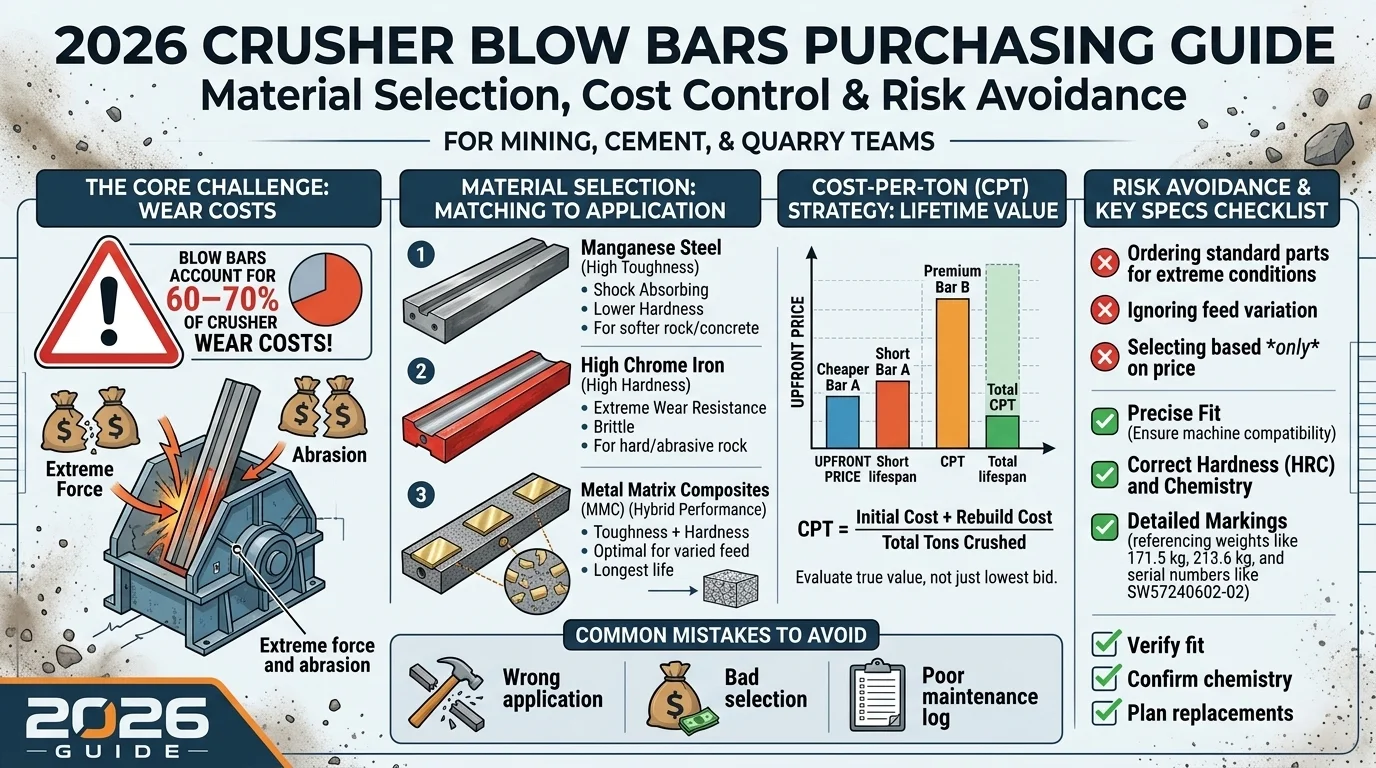
In impact crushers, blow bars carry a manufacturer-specified wear limit marked as dimension “Z.” This limit exists for a reason: a blow bar that wears past “Z” cannot be safely flipped — the seating geometry has changed, the bar is no longer stable in the rotor, and the risk of it detaching under load becomes real.
The failure mode is documented. EvoQuip/Terex official documentation warns directly: blow bars run past the “Z” limit without being rotated caused rotor seat damage so severe that the entire rotor required replacement.
One deferred blow bar rotation became a full rotor changeout.
A single blow bar costs a fraction of what a rotor costs. The math on that trade-off is not complicated — but only if you catch it in time.
What to do: Measure blow bar wear at every maintenance interval and compare against the “Z” dimension in your OEM documentation. Rotate or replace before the limit — not at it. If your OEM documentation doesn’t clearly mark the “Z” dimension, contact your dealer before the next maintenance window — not after.
Sign #7: Cone Liner Feed Opening Has Narrowed
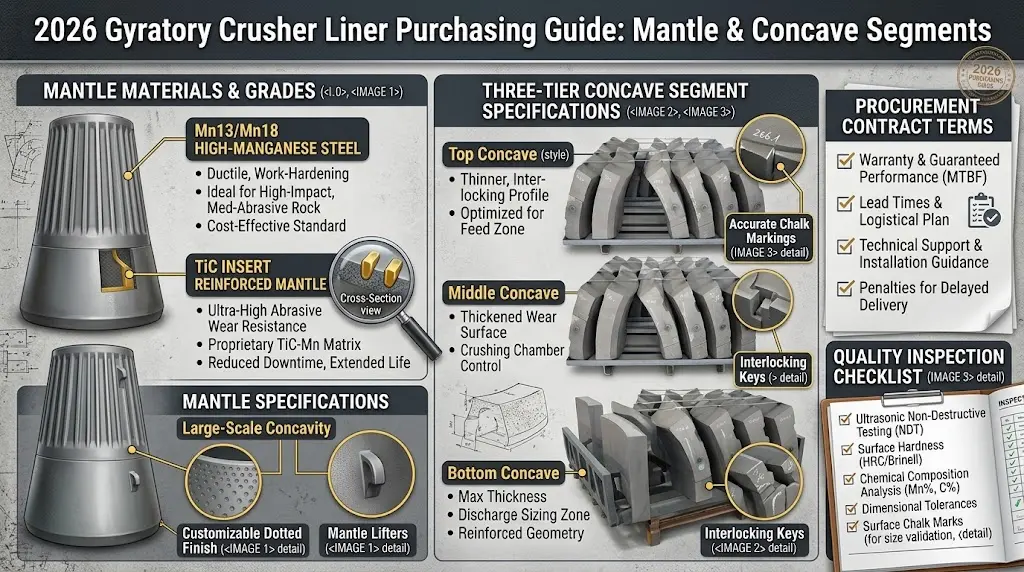
In cone and gyratory crushers, the feed opening between mantle and concave defines how large a piece of material can enter the crushing chamber. As the mantle and concave wear, the chamber geometry changes: the feed opening closes off, feed rate decreases, and the crusher can begin to pack — material builds up faster than it can be crushed and discharged.
Packing is both a symptom and a cause: it accelerates wear on the remaining liner surface, creates abnormal loads on the eccentric and bearing systems, and can lead to the material backing up into the feed arrangement.
What to do: Check the feed opening measurement at each inspection against your reference dimension. If feed-end wear is consuming the opening faster than expected, review your feed size distribution — oversized feed accelerates this pattern disproportionately.
Sign #8: Power Draw Is Climbing Without a Change in Feed
A crusher in good mechanical condition, processing consistent feed material, consumes a predictable amount of power. When wear parts degrade — particularly in jaw crushers with flat tooth profiles, or cone crushers running low on liner — the machine must exert more force to achieve the same result. Motor amperage climbs. Power consumption increases.
As Jarrod Adcock, Crushing Product Manager at Superior Industries, explains: “Higher vibration, rising temperatures, unstable settings, reduced throughput and product gradation that drifts out of spec” are all connected indicators of wear-related deterioration. Energy consumption doesn’t lie.
What to do: Log motor amperage or kilowatt-hours per ton of production. A rising kWh/ton trend — holding feed material and crusher settings constant — schedule a wear inspection before the next planned maintenance window. Don’t wait for the trend to reverse on its own.
Sign #9: Maintenance Frequency Is Increasing
Crusher wear parts don’t just degrade in isolation. Worn jaw plates, mantles, or blow bars change load distribution across the entire machine: bearings absorb forces they weren’t designed for, fasteners work loose more frequently, and secondary components experience accelerated wear as a consequence.
If you’re finding yourself responding to minor issues — loose bolts, leaking seals, bearings running hotter than normal, increased oil contamination — with increasing regularity, worn primary wear parts are often the root cause. Magnus Skörvald, Product Manager for Crushers at Weir, describes it clearly: “Scheduled maintenance can be carried out during an allotted time period and is budgeted for, whereas unplanned failures often lead to extended downtime and higher costs.”
What to do: Review your maintenance log for frequency of reactive interventions. A rising trend in minor repairs is a lagging indicator of wear-part condition. Before drawing that conclusion, rule out lubrication system issues and feed-size anomalies — but if those check out clean, worn primary wear parts are the next place to look, and a leading indicator of an unplanned major failure if the root cause isn’t addressed.
Sign #10: Your Last Liner Change Was More Than 6–12 Months Ago
Some wear is invisible until it isn’t. In high-abrasion applications — hard granite, basalt, recycled concrete — internal wear progression can outpace what visual inspection catches. Per OEM maintenance schedules for high-abrasion applications, inspect every 200–300 operating hours; as a general industry planning horizon, schedule a full changeout review every 6–12 months regardless of apparent condition.
This is not arbitrary. Work-hardened manganese steel can maintain its surface appearance well past the point where it’s providing full crushing efficiency. Time-based and hours-based review cycles exist to catch what looks-fine-but-isn’t.
What to do: Maintain a wear parts log that tracks installation date, operating hours, and tonnage processed for each liner set. If you can’t answer “when was this liner installed and how many hours has it run?” — start there: build the log, then set your inspection intervals from it.
The Real Cost of Waiting Too Long
The financial logic of proactive replacement is not complicated, but it is frequently underestimated. As Dustin Broadbent, Services Manager for Crushing & Grinding NA at FLS, notes: “A primary crusher down is frequently an immediate production limiter.” Unlike secondary or tertiary equipment, primary crushers typically lack redundancy — when they stop, the line stops.
Running wear parts to failure compounds costs in multiple directions simultaneously:
- Emergency freight: for replacement parts (vs. planned procurement)
- Unplanned labor: at premium rates vs. scheduled changeout time
- Secondary damage: to crusher frame, bearings, or drive components
- Lost production: during extended unplanned downtime
The industry consensus, confirmed by Metso’s crushing product team: “Downtime erodes profitability, reactive repairs consume labor and parts at a premium, and equipment life shortens.”
The 10 signs above exist to prevent exactly this outcome.
Frequently Asked Questions
How do I know when to replace jaw crusher plates? Measure tooth profile depth (minimum 10 mm peak-to-valley) and plate thickness (check OEM minimum for your model). Also monitor throughput — a steady decline that doesn’t respond to CSS adjustment is a reliable indicator.
What happens if you don’t replace crusher wear parts in time? Consequences range from reduced throughput and increased energy consumption to catastrophic component failure. In impact crushers, running blow bars past the wear limit can result in rotor damage requiring full rotor replacement. In jaw crushers, operating below minimum plate thickness risks fracture damage to the crusher frame.
How long do crusher wear parts typically last? It depends heavily on material hardness, feed size distribution, and operating practice. In high-abrasion applications, inspect every 200–300 hours. As a general planning horizon, schedule a full review every 6–12 months regardless of apparent condition. In high-tonnage operations, liner life is often tracked in millions of tons processed rather than hours alone — a useful metric to add to your wear parts log alongside operating hours, and a better basis for planning future changeouts.
What causes excessive vibration in a crusher? In impact crushers, uneven blow bar wear or mismatched blow bar weights (>0.5 kg difference) are common causes. In jaw or cone crushers, uneven feed distribution causes asymmetric liner wear, which can create off-center loading and vibration.
When should cone crusher liners be replaced? Replace cone mantles and concaves when: (1) throughput has declined more than 10% from baseline, (2) the feed opening has closed off measurably, or (3) product gradation is drifting out of spec despite correct CSS settings.
Sources
- Metso, Nordberg C Series Jaw Crushers — Wear Parts Guide(OEM technical documentation)
- EvoQuip / Terex, Impact Crusher Wear Parts Guide(OEM technical documentation)
- Pit & Quarry, “Tips for replacing cone liners”— featuring Curt Theisen, Superior Industries
- Engineering & Mining Journal (E&MJ), Industry expert roundtable on crusher maintenance and wear parts(2026) — featuring Jarrod Adcock (Superior Industries), Magnus Skörvald (Weir), Dustin Broadbent (FLS), Metso Crushing Product Group
Note: Inspection interval recommendations (200–300 hours; 6–12 months) reflect general industry practice. Consult your specific OEM maintenance manual for model-specific schedules.