If your cone crusher liners are wearing out too fast — or failing before you expect — you’re not alone.
Liner failure is one of the most expensive problems in crushing operations. It triggers unplanned downtime, inflated spare parts costs, and reduced throughput that compounds every single shift.
This guide breaks down the 5 most common cone crusher liner failures, what causes them, and exactly how to fix them. Built for mining, cement, and aggregate professionals who need practical answers — not sales brochures.
What Are Cone Crusher Liners (And Why Do They Fail)?
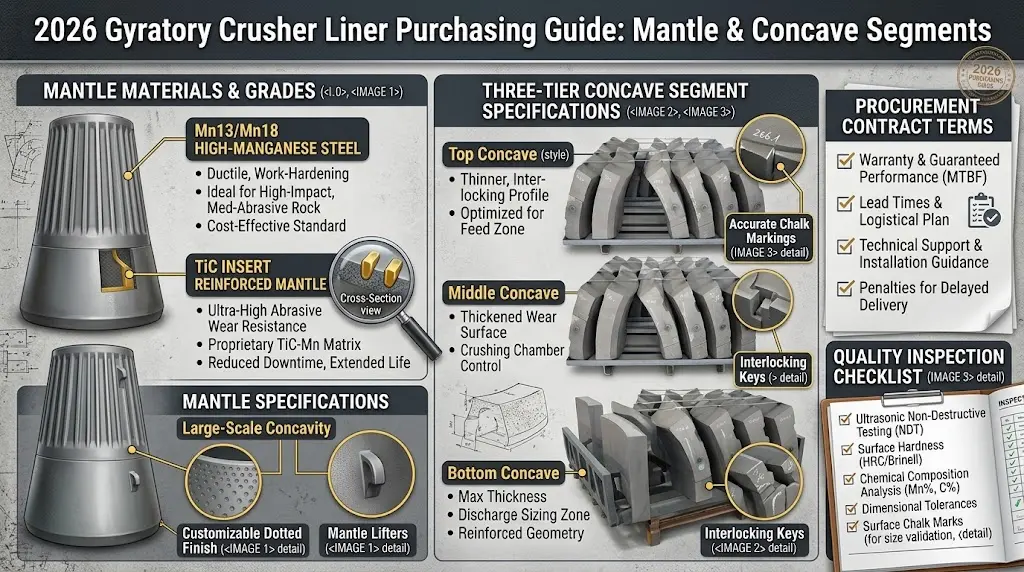
Cone crusher liners — the mantle and the bowl liner (concave) — are the two primary wear parts inside every cone crusher. They take the full brunt of crushing force, cycle after cycle, against some of the hardest materials on earth.
Most liners are made from manganese steel, a work-hardening alloy that gets harder as it’s compressed. That sounds ideal. But several things can go wrong — with material selection, feed conditions, and operating practices — that lead liners to fail prematurely.
The result? Replacement cycles that should last 700–1,000 hours are cut to half that. Or worse.
The 5 Most Common Cone Crusher Liner Failures
1. Premature Wear (Liner Life Too Short)
What it looks like: You’re replacing liners far more frequently than the OEM’s estimated service life. Throughput drops. Cost-per-ton climbs.
Root causes:
- Wrong alloy grade for the material being crushed
- Incorrect closed side setting (CSS) — too tight puts excess stress on the liner
- Running the crusher at suboptimal speed
- Fine-particle-heavy feed causing abrasive grinding instead of impact crushing
The numbers: According to Element Mining and Construction Oy (ELMC)’s internal case study data, generic replacement liners from an alternative supplier at a gravel quarry in Romania averaged just 350 hours of service life — half the 700 hours achieved with properly specified liners. (Source: ELMC, Element Parts for Crushing Equipment)
Fix: Start with alloy selection. Match the manganese grade to your material’s abrasion index (AI) and work index (WI):
| Material Condition | Recommended Alloy |
| Low-abrasion, soft rock | Mn13Cr2 (C-grade) |
| General-purpose applications | Mn18Cr2 (D-grade) |
| Highly abrasive rock | Mn22Cr2 (D2-grade) |
Also review your feed gradation. Excessive fines in the feed increase sliding abrasion and dramatically shorten liner life.
2. Excessive Wear at the Bottom of the Crushing Chamber
What it looks like: The lower section of your bowl liner wears out much faster than the upper portion. You’re throwing away metal with plenty of service life left on top.
Root causes:
- All the crushing work is concentrated at the bottom of the chamber
- CSS is too small, forcing material through a narrow choke point
- Liner profile is too coarse for a secondary or tertiary crushing stage
Fix: Select a finer crushing chamber profile. Moving the crushing zone higher up shifts the work distribution and prevents localized bottom wear.
This single change — matching chamber geometry to the application stage — can significantly extend liner life without changing any other operating parameters.
3. Uneven Wear Around the Concave Ring
What it looks like: One side of the bowl liner wears faster than the other. The liner develops an asymmetric profile, reducing product consistency and accelerating failure on the worn side.
Root causes:
- Uneven feed distribution— material is loading the crusher on one side only
- Feed segregation— coarse and fine particles are separating before entering the chamber, creating uneven load patterns
This is one of the most overlooked causes of liner failure. Many operations spend money on premium liners, then install them in a crusher that’s being fed improperly.
Fix:
- Audit your feed system. For Hydrocone-type crushers, center feeding is essential.
- Install a feed distributor (especially for medium-fine and fine chambers)
- Rebuild the feed arrangement if necessary — the payback is significant
Pro tip: Uneven wear is often misdiagnosed as a material or alloy problem. Before spending money on a premium liner grade, check your feed distribution first. It’s the most common fix — and the cheapest one.
4. Support Ring Wear
What it looks like: Wear on the support ring, particularly when the crusher is operating at a large CSS (open setting).
Root causes:
- Insufficient clearance between the support ring and the bowl liner at larger settings
- Operating outside the crusher’s designed parameter range
Fix: Machining the bottom of the support ring to increase available clearance resolves this issue in most cases. This is a relatively low-cost mechanical fix that prevents recurring liner wear driven by metal-on-metal contact.
5. Mantle “Ski Slope” Effect
What it looks like: A concave, ski-slope-shaped wear profile develops on the mantle. This leads to:
- High operating pressure
- Increased CSS (the crusher “opens up”)
- Reduced throughput and fines generation
- Accelerated wear cycle
Root causes:
- Feed material consistently contacting the same zone of the mantle
- Incorrect chamber selection for the feed size and reduction ratio
Fix: The mantle can be machined to optimize the crushing point geometry. This adjustment has been documented to significantly extend liner life on affected crushers — in some reported cases by 50% or more — though results depend on the specific wear pattern and operating conditions. (Source: Sandvik Crushing & Screening Technical Bulletin)
The Hidden Cost of Liner Failures
Most operations calculate liner cost as: price per set × number of sets per year.
That’s incomplete.
The real cost of liner failure includes four compounding layers.
It starts with the liner change itself — each unplanned replacement at a primary crusher takes 4–8 hours, plus mobilization time. But that’s just the beginning. Every hour offline at a 500 TPH operation is 500 tonnes you’re not producing. And when the primary stops, so does everything downstream: screens, conveyors, and secondary circuits all stall together. Then, as the liner wears toward failure, it starts producing oversized product — material that recirculates through the circuit, consuming capacity without adding output. By the time you pull the liner, you’ve been operating at degraded efficiency for days.
The gap between top-quartile and average crushing operations can reach 10–20% in annual plant efficiency, according to Metso’s Crushing and Screening Handbook, 7th Edition (2023). (Source: Metso, Crushing and Screening Handbook, 7th Edition)
The bottom line: Cheap liners that fail early almost always cost more than premium liners that last.
How to Choose the Right Liner — And Avoid the Most Expensive Mistakes
Getting liner selection right from the start prevents most of the failures above. Here’s the framework used by leading crushing engineers:
Step 1: Define Your Rock Characteristics
- Abrasion Index (AI):Measures the scratch abrasiveness of the rock
- Work Index (WI):Measures the energy required to crush the rock
- Feed size and gradation
- Risk of high-impact loading(e.g., tramp metal, oversized boulders)
Step 2: Match Alloy to Application
| Application | Alloy Choice | Notes |
| Soft, low-abrasion rock | M1 / Mn14 | Higher risk of cracking if misapplied |
| Standard aggregate | M2 / Mn18Cr2 | Most versatile choice |
| Hard, high-abrasion ore | M7 / Mn22Cr2 | Best wear resistance; higher cost |
Note: Higher manganese content improves wear resistance marginally — but significantly increases cracking risk if the application doesn’t justify it. More is not always better.
Step 3: Match Chamber Profile to Crushing Stage
Alloy selection and chamber profile are closely linked — getting one right while ignoring the other is one of the most common mistakes in liner management.
| Crushing Stage | Recommended Profile | Target CSS |
| Secondary (>25mm product) | Coarse / Medium | Wider setting |
| Tertiary (<25mm product) | Medium Fine / Fine | Tighter setting |
| Quaternary (spec product) | Extra Fine | Minimum CSS |
Step 4: Audit Feed Conditions
Even the best liner will fail prematurely if feed distribution is poor. Confirm:
- ✅ Feed is entering the chamber centrally
- ✅ No significant feed segregation
- ✅ Fines content in feed is within acceptable range
- ✅ Feed is choke-fed (not trickle-fed)
What to Look for in Advanced Liner Technology
Standard manganese steel liners are well understood. But over the past decade, wear parts manufacturers have developed casting and alloy refinements that can meaningfully extend service life in the right applications.
Here’s what the engineering actually looks like — and what to ask about when evaluating suppliers.
Enhanced Casting Processes (Reduced Inclusions)
Some manufacturers have refined their casting methods to reduce non-metallic inclusions and gas porosity in the manganese steel. These inclusions — small voids and impurity pockets in the metal — act as crack initiation points under repeated impact loading.
A denser, more consistent microstructure means the liner can absorb more crushing cycles before fatigue sets in. According to case study data from one wear parts supplier, liners produced with enhanced casting processes averaged 30% longer service life than standard-specification liners in comparable applications — though results vary significantly by rock type and operating conditions. Always request site-specific trial data before committing to a premium liner program. (Source: ELMC, THOR Technology Overview)
Optimized Liner Profiles (Application Engineering)
Some suppliers offer wear profile analysis — using crusher dimensions, feed characteristics, and historical wear data to engineer mantle and bowl liner geometries that distribute wear more evenly across the chamber height.
The practical outcome: less bottom-heavy wear, reduced recirculating load, and more consistent product shape over the liner’s service life. For high-tonnage operations, even a 10–15% improvement in liner life translates to measurable reductions in cost-per-tonne.
What to ask your supplier: Can you provide wear profile data from a comparable application — same rock type, similar reduction ratio? Generic claims about liner life improvements are not useful. Site-relevant data is.
A Systematic Approach to Solving Liner Problems
If you’re experiencing liner issues right now, here’s the step-by-step diagnostic process recommended by crushing engineers:
Step 1: Start with Chamber Selection Choose the correct standard chamber — mantle and concave as a matched pair for your application stage and reduction ratio.
Step 2: Fix the Feed First Optimize feed distribution before anything else. This is where most operations have the most room for improvement, and it costs far less than a liner upgrade.
Don’t skip Step 2. Feed system issues are systematically underdiagnosed and account for a disproportionate share of liner failures in real-world operations.
Step 3: Escalate to a Specialist If wear problems persist after Steps 1 and 2, bring in a technical specialist — OEM or an independent wear parts engineer — with site-specific data in hand.
Step 4: Trial Alternative Alloys Only at this stage does it make sense to experiment with different manganese grades. Base the decision on your rock’s Abrasion Index (AI) and Work Index (WI) data.
Liner Failure Quick Reference Table
| Failure Type | Primary Cause | First Fix to Try |
| Short overall liner life | Wrong alloy / poor feed | Upgrade alloy grade; audit feed fines |
| Excessive bottom wear | Work concentrated at bottom | Switch to finer chamber profile |
| Uneven wear (concave) | Feed maldistribution | Retrofit feed distributor; center feed |
| Support ring wear | Insufficient clearance at large CSS | Machine support ring bottom |
| Mantle ski-slope | Wrong chamber for feed size | Machine mantle to optimize crush point |
Key Takeaways
- The majority of premature liner failures are preventable— wrong alloy selection, poor feed distribution, and mismatched chamber profiles cause the majority of problems
- Feed distribution is the most underestimated variable— audit it before upgrading to premium liners
- Match alloy to application— more manganese is not always better; cracking risk increases with higher Mn content
- Advanced liner technologies deliver measurable ROI— documented cases show 30–50%+ improvements in liner life with the right engineering approach
- Calculate total cost, not unit cost— the cheapest liner per set is rarely the cheapest liner per tonne produced
Frequently Asked Questions
How long should cone crusher liners last?
Liner life varies significantly by application. Typical range is 700–1,500 operating hours, or 500,000–3,000,000+ tonnes depending on rock hardness, abrasivity, and operating conditions. Any liner consistently falling below this range warrants a systematic review.
What is the most common cause of cone crusher liner failure?
In practice, uneven feed distribution and incorrect alloy selection account for the majority of premature liner failures. Feed-related issues are especially common and often misattributed to liner quality.
When should I replace cone crusher liners?
Replace when the liner has worn to the minimum safe thickness (typically when worn to 30–40% of original thickness, or per the OEM’s minimum thickness specification for your specific model), when product size can no longer be controlled within spec, or when power draw increases significantly without a corresponding increase in throughput.
Is Mn18 or Mn22 better for hard rock?
Mn22Cr2 (22% manganese) offers the best wear resistance for highly abrasive applications. However, in less demanding applications, Mn22 increases cracking risk without proportional benefit. Always base the decision on your rock’s Abrasion Index.
The Bottom Line
For operations running cone crushers in mining, cement production, or aggregate processing, liner management is one of the highest-leverage maintenance activities available. Get it right, and you’re adding productive capacity without adding equipment.