Crusher wear parts don’t come cheap.
A single set of jaw plates for a large primary crusher can run anywhere from $3,000 to over $20,000. Cone liners? Add another $5,000 to $30,000 per change-out. And that’s before you factor in the downtime, labor, and the production losses that stack up every hour your crusher sits idle.
Here’s the uncomfortable truth: most wear parts fail prematurely — not because of bad materials, but because of bad practices.
Wrong alloy selection. Running half-empty chambers. Skipping pre-screening. Setting CSS too tight. These mistakes are costing quarry operators, mine managers, and cement plant engineers millions of dollars every year — and most of them are completely preventable.
This guide gives you a clear, no-fluff breakdown of the 10 most effective strategies to extend crusher wear parts life in 2026. Whether you’re running jaw crushers, cone crushers, or impact crushers — and whether your material is hard granite, abrasive quartzite, or recycled construction waste — these principles apply.
1. Choose the Right Alloy and Tooth Profile (This Is the Big One)
If there’s one decision that determines wear part life above everything else, it’s material selection.
Get it right, and your liners outlast the competition’s by 2–5x. Get it wrong, and no amount of operational fine-tuning will save you.
Here’s a practical framework:
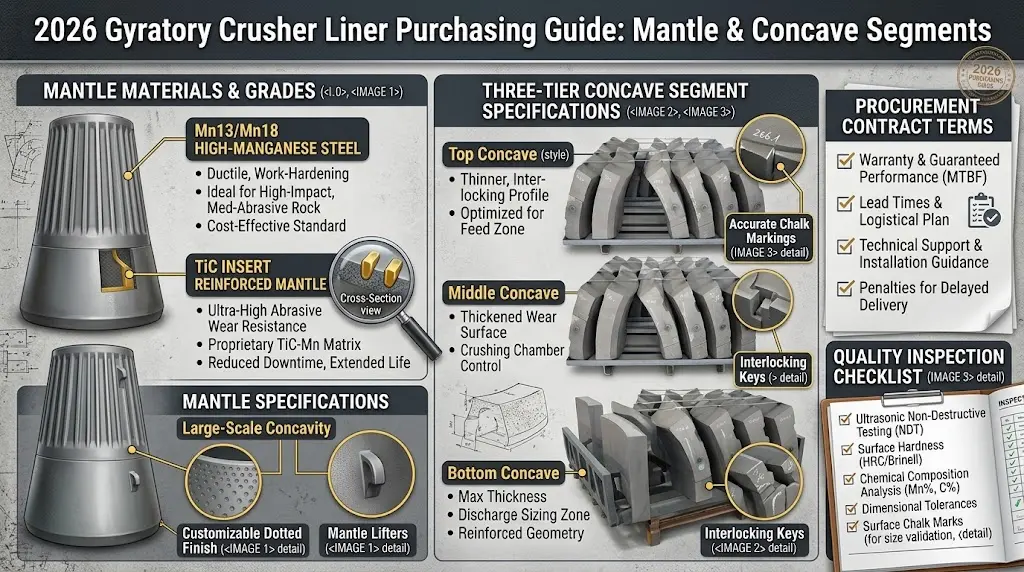
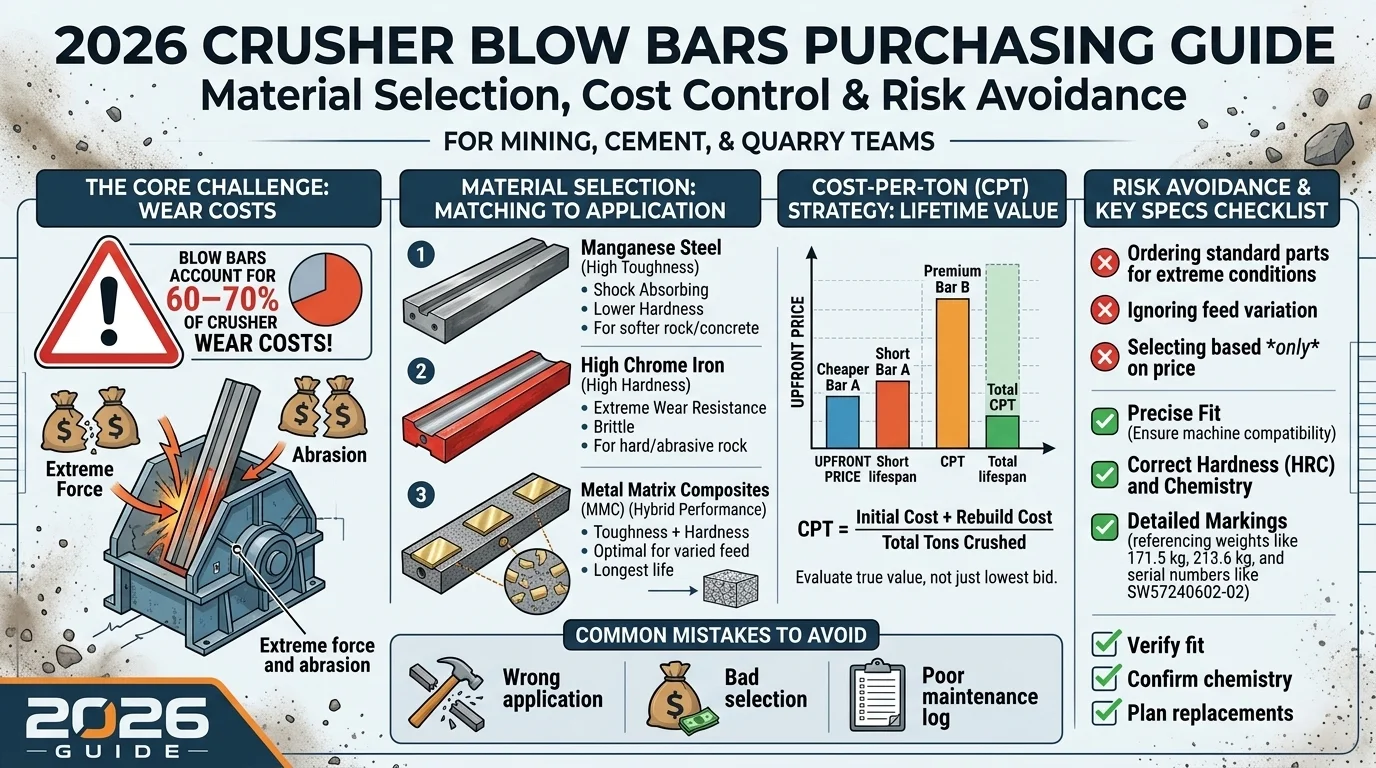
Hard rock, high abrasion (granite, basalt, quartzite, silica-rich ores): Go with Mn18Cr2 or Mn22Cr2 (18–22% manganese, 2% chromium). The higher chromium and manganese content dramatically increases work-hardening capacity and abrasion resistance. For the most severe applications — think secondary or tertiary crushing of highly abrasive rock — TiC (titanium carbide) composite liners are worth the premium. TiC inserts embedded in a manganese steel matrix deliver 2–3x the wear life of standard alloys, with better crack resistance under high impact loads.
High-impact applications, reinforced concrete, demolition waste: Standard Mn13 (13% manganese) remains the go-to. Its superior toughness absorbs impact without fracturing — critical when tramp metal or rebar enters the chamber. Don’t chase abrasion resistance at the cost of toughness here.
Wet, clay-heavy, or fine-rich feed: Tooth profile matters as much as alloy. Use Coarse Corrugated profiles to improve material flow and reduce packing. Smooth or fine-tooth profiles will clog, increase specific wear, and accelerate manganese steel wear part degradation faster than you’d expect.
Flaky, slab-heavy feed (slate, shale, recycled concrete panels): Sharp Teeth or Slab Breaker profiles give you the aggressive bite needed to break plate-shaped material efficiently. Running standard corrugated profiles on this feed type results in uneven wear, poor throughput, and premature liner failure.
Bottom line: Alloy mismatch is the single biggest cause of underperformance in crusher wear parts. Always match the alloy to the actual crushing application — not just the crusher model.
2. Use Choke Feeding to Cut Crusher Liner Wear by Up to 70%
This is one of the most overlooked crusher maintenance best practices in the industry, and the cost of ignoring it is enormous.
Choke feeding means keeping the crushing chamber consistently 80–100% full. When the chamber is full, rock breaks against rock — the material itself absorbs most of the energy. Liners act as containment, not as the primary breaking surface.
When you run half-full or empty:
- Liners absorb direct impact from feed material
- Sliding abrasion against the liner surface increases dramatically
- Wear life can drop by 30–70%compared to properly choke-fed operation
Field data backs this up. One quarry operation documented that switching from intermittent (40–60% full) to continuous choke feeding increased jaw plate lifespan from 180 operating hours to over 290 hours — a 60% improvement with zero capital investment.
How to maintain choke feed:
- Use a surge bin or buffer hopper upstream of the crusher
- Install a level sensor or camera to monitor fill level in real time
- Set your feeder rate to consistently maintain 80%+ chamber fill
- Minimize idle running — every minute the crusher spins empty, liner life is being wasted
If your plant layout makes continuous choke feeding difficult, this is worth solving at the process design level. The return on investment is that significant.
3. Pre-Screen Feed Fines to Extend Jaw Plate and Cone Liner Life
Fines are silent killers of wear parts.
Material smaller than the CSS (closed side setting) has already been crushed to the target size. It cannot be broken further — it can only slide through the chamber. And as it slides, it acts like sandpaper against your jaw plates and cone liners.
The effect is real: pre-screening fines can extend cone liner replacement intervals by 20–50%, depending on the material and the percentage of fines in the feed.
The solution is straightforward: install a vibrating grizzly feeder or a pre-screen ahead of your primary crusher. Any material smaller than the CSS gets bypassed directly to the product conveyor — never entering the crushing chamber.
Additional benefits:
- Reduced power consumption (you’re not wasting energy “crushing” already-crushed material)
- Higher throughput (chamber capacity is freed up for material that actually needs crushing)
- More uniform wear pattern across the liner surface, which directly supports crusher downtime reduction
For operations processing recycled concrete, mixed aggregates, or heavily blasted ore with significant fines generation, pre-screening is non-negotiable. The capital cost of a grizzly feeder pays back in liner savings within months.
4. Set and Maintain the Correct CSS
The closed side setting (CSS) is the minimum gap between the fixed and moving wear surfaces at the narrowest point of the crushing chamber. It controls product size, throughput, and — critically — liner stress.
Running CSS too tight is one of the fastest ways to destroy wear parts.
When CSS is set below the manufacturer’s recommended minimum:
- Crushing forces increase exponentially
- Liners cannot work-harden properly in the early run-in period
- Risk of liner cracking and catastrophic failure increases significantly
- Throughput often drops because the chamber packs with fines
Running CSS too tight doesn’t make you more productive. It makes your next liner change-out arrive sooner.
Running CSS too large:
- Underutilizes the crusher’s capacity
- Produces oversized product requiring additional crushing passes
- Increases recirculating load in closed-circuit operations
Best practices for CSS management:
- Always follow the OEM-specified minimum CSS for your liner profile and application
- During liner break-in (first 1–2 operating days), run at a slightly larger CSS to allow the liner surface to work-harden before being subjected to peak loads
- Measure CSS regularly — wear gradually opens the setting, and if you don’t compensate, product size drifts out of spec and chamber geometry degrades
- Never force the CSS smaller than the mechanical minimum to chase production targets. The liner will pay the price. So will your production schedule.
For jaw crushers: CSS = OSS (open side setting) minus stroke. For cone crushers: measure at the bottom of the chamber when the head is at closest approach. Use a lead ball or calibrated measurement tool — visual estimates are not reliable.
5. Rotate and Flip Crusher Wear Parts to Double Their Usable Life
This is one of the most cost-effective crusher maintenance best practices available — and it’s dramatically underutilized across aggregate plants worldwide.
Crusher liners don’t wear uniformly. Jaw plates wear faster at the bottom (the discharge end) than at the top. Cone liners wear unevenly between the upper and lower sections. Impact crusher blow bars wear more heavily on one end if feed distribution is off.
The solution is systematic rotation and flipping.
For jaw plates:
- Flip (rotate 180°) when wear reaches approximately 30% of tooth height
- For two-piece jaw plate designs: remove the heavily worn bottom section, move the work-hardened upper section to the bottom position, and install a new plate at the top
- Done correctly, this procedure can extend total jaw plate wear life by 30–60%compared to running plates to failure without rotation
For cone liners:
- The lower section of the concave (bowl liner) typically wears faster than the upper section
- When the lower section is worn, replace it while retaining and reusing the upper section
- Reducing cone liner replacement interval costs doesn’t require better alloys — it often just requires better rotation discipline
For impact crusher blow bars:
- Rotate bars when one end shows significantly more wear than the other
- Weight-match pairs within 0.5 kg to maintain rotor balance
Build rotation schedules into your preventive maintenance program. Set clear wear thresholds, not just “when it looks worn.” Consistency is what delivers the savings.
6. Stop Tramp Metal and Oversized Material at the Source
One piece of tramp metal — a drill bit, a section of rebar, a piece of bucket tooth — can crack or shatter a jaw plate or cone liner in a single pass. The repair cost easily runs 5–20x the cost of the prevention measure.
Install a magnetic separator (overband magnet or drum magnet) on the feed conveyor ahead of the crusher. This is standard practice in quarrying and aggregate operations, and non-negotiable in recycling and demolition waste applications. Modern electromagnetic systems can remove ferrous objects up to 100mm diameter reliably.
Feed size discipline matters equally:
- Maximum feed size should not exceed 80–90% of the crusher feed opening
- Enforce this at the blast design level (primary crusher applications) or at the secondary screen (downstream crushers)
- Oversized blocks that wedge in the chamber don’t just damage liners — they can bend cheek plates, crack side liners, and damage the crusher frame itself
A crusher protection system is your last line of defense, not your first. Don’t rely on it as a substitute for proper feed control.
7. Ensure Even Feed Distribution Across the Full Chamber Width
Single-side feeding is a guaranteed recipe for uneven wear — and uneven wear means you’re discarding 30–50% of the liner’s useful service life before it’s exhausted.
When feed material consistently enters the crushing chamber from one side:
- That side experiences 2–3x higher contact stress
- The liner on that side wears out in half the time of a properly fed machine
- Chamber geometry becomes asymmetric, producing a wider product size distribution
- Power draw increases as the crusher works harder to compensate for the imbalance
For jaw crushers: Feed should cascade evenly across the full width of the jaw opening. Use a rock box, feed chute deflectors, or a vibrating pan feeder to spread material. Avoid point-dumping from a conveyor that’s offset to one side.
For cone crushers: A distribution plate or feed cone directly above the mantle is essential. Material must fall vertically and spread radially before entering the crushing chamber. Off-center feed is one of the most common causes of premature cone liner failure — and one of the most frequently missed in crusher maintenance audits.
For impact crushers: Ensure feed is spread across the full rotor width. Concentrated feed in the center or at one end creates localized blow bar wear and rotor imbalance.
If you’re seeing asymmetric wear patterns on your liners, the solution usually isn’t a different alloy — it’s fixing your feed arrangement.
8. Manage Feed Moisture and Sticky Material
High moisture content in feed material creates problems that go beyond simple wear.
Wet, clay-rich material tends to:
- Pack and accumulate in the crushing chamber (packing/caking)
- Create a grinding paste between the material and liner surface — dramatically increasing abrasive wear on manganese steel wear parts
- Block discharge openings, causing backpressure and increased liner stress
- Reduce throughput as the chamber struggles to clear
Operational responses:
- Install a dry fog dust suppression system rather than water sprays directly on the feed — you still control dust without adding moisture to the material
- For operations that cannot avoid wet feed (rainy season, wet quarry faces): increase cleaning frequency of the chamber, monitor CSS more frequently as packed fines can give false readings, and consider switching to a Coarse Corrugated profile that resists packing
- In extreme cases, covered stockpiles and feed bins can allow surface moisture to drain before crushing
The relationship is direct: every 5–10% increase in feed moisture content above threshold corresponds to a measurable increase in specific wear (wear per ton of material processed). Controlling moisture is controlling wear cost.
9. Install Wear Parts Correctly — Torque, Backing Compound, and Fit
Correct installation is the foundation everything else builds on. Get this wrong, and the best alloy in the world will still fail early.
Locking wedges and bolts:
- All jaw plate locking wedges must be torqued to the manufacturer’s specified values — not “tight enough”
- A jaw plate that moves even 0.1mm under load will fretting-wear its contact surfaces, generate heat, and eventually crack
- Check torque after the first 4–8 hours of operation following a new liner installation — plates settle and torque can drop significantly in this period
- Retighten to spec before returning to full production. Skipping this check is one of the most common causes of early jaw plate lifespan failure in the field.
Backing compound (epoxy backing):
- For cone crushers and gyratory crushers: backing compound fills the gap between the liner and the crusher head/bowl frame
- Use the correct backing material for your operating conditions — standard epoxy for normal applications, high-impact formulations for severe impact conditions
- Pour at the correct temperature range (typically 15–35°C) — outside this range, curing is compromised and the backing won’t achieve design strength. Wrong temperature, wrong cure. Wrong cure, wrong support. It’s that simple.
- Ensure complete fill with no voids — voids allow movement, which leads to cracking
Clearances and contact surfaces:
- All mating surfaces must be clean and free of debris before assembly
- For blow bars in impact crushers: weight differential within matched pairs must not exceed 0.5 kg. Install matched pairs on opposite sides of the rotor. Imbalance causes vibration that shortens bearing life and accelerates all wear in the machine.
Correct installation takes more time upfront. It pays back in significantly longer liner life and fewer catastrophic failures — and that’s true for every crusher type, every alloy, every application.
10. Source Wear Parts from Reliable Suppliers — OEM or Verified High-Quality Aftermarket
This one seems obvious. But it’s worth saying clearly, because the cost of getting it wrong is severe.
The wear parts market in 2026 includes a wide spectrum of quality. At one end: OEM parts and a handful of reputable aftermarket manufacturers with genuine metallurgical expertise. At the other end: low-cost castings with inconsistent manganese content, poor heat treatment, and dimensional tolerances that mean the part doesn’t fit correctly even on day one.
What to look for in a wear parts supplier:
Metallurgical transparency: Can they provide material certifications with actual chemical composition data? Reputable suppliers will show you Mn%, Cr%, C%, and other alloying elements, plus hardness values and impact test results. If a supplier can’t or won’t provide this data, that’s a serious red flag for aggregate plant wear cost management.
Dimensional accuracy: Aftermarket parts must meet OEM dimensional specifications. Even small deviations in liner thickness or contact surface geometry can cause uneven load distribution, premature wear, and installation problems.
Application engineering support: The best suppliers don’t just sell you a liner — they help you select the right alloy and profile for your specific application and material. This kind of support is worth paying for, because the right liner in the right application consistently outperforms a generic “standard” liner.
Track record: Ask for references from operations running similar material and similar equipment. Real-world wear life data from comparable applications is the most reliable predictor of what you’ll experience.
Cheap wear parts that fail at 60% of expected life aren’t cheaper. They’re more expensive, when you factor in the additional change-outs, downtime, and secondary damage they cause.
Putting It All Together: A Practical Wear Management Framework
These ten strategies don’t operate in isolation. The operations that achieve the best wear part economics implement them as a system.
Weekly checks:
- Monitor chamber fill level and feeding consistency
- Inspect wear profiles on jaw plates, cone liners, and blow bars
- Verify CSS against specification and compensate for wear drift
- Check locking wedge torque on recently installed liners
Monthly actions:
- Execute scheduled rotation/flipping based on wear measurement, not calendar interval
- Review wear rate data by material type and crusher — identify outliers and investigate root cause
- Inspect and clean feed chutes and distribution equipment
Per-campaign or seasonal:
- Conduct a full feed arrangement audit — are you actually achieving uniform distribution?
- Review alloy selection relative to current material characteristics (quarry faces change, material hardness varies)
- Audit your supplier’s material certifications against what you’re actually receiving
The best crusher wear part program isn’t a single upgrade. It’s a continuously improving system of operational discipline, correct material selection, and data-driven maintenance.
Frequently Asked Questions
How often should jaw plates be flipped? Flip when wear on the lower teeth reaches approximately 30% of original tooth height. For a typical primary crushing application in hard rock, this might be every 200–400 operating hours, depending on material abrasiveness and throughput. Measure — don’t guess.
What’s the single highest-ROI change most operations can make? For most operations: implementing consistent choke feeding. It costs nothing to change, and the jaw plate wear life improvement is typically 30–60%. Start there.
Is Mn18Cr2 always better than Mn13? No. Mn18Cr2 has superior abrasion resistance, but lower toughness. In high-impact applications — demolition waste, material with embedded rebar, or feed with frequent oversize — Mn13’s toughness is more valuable than Mn18Cr2’s hardness. Fracture resistance matters more than abrasion resistance when impact loads are extreme.
How do I know if my wear parts supplier is trustworthy? Ask for a material certificate (mill certificate or foundry certificate) for the last batch delivered. It should show chemical composition, heat treatment parameters, and hardness test results. If they can’t provide it, consider that a serious red flag.
Are TiC composite liners worth the higher upfront cost? For highly abrasive applications — quartzite, silica-rich ores, secondary/tertiary crushing — yes. TiC liners typically deliver 2–3x the wear life of standard Mn18Cr2, which more than offsets the 40–80% price premium when you factor in reduced change-out frequency and crusher downtime reduction. For softer or more impact-dominated applications, standard manganese steel wear parts remain the better value.
Final Thoughts
Crusher wear parts are a significant and unavoidable cost in any crushing operation. But “unavoidable” doesn’t mean “uncontrollable.”
The difference between an operation that changes jaw plates every 200 hours and one that gets 450 hours from the same application comes down to the disciplines covered in this guide: right alloy, right profile, choke feeding, pre-screening, correct CSS, systematic rotation, feed control, moisture management, correct installation, and quality sourcing.
None of these require major capital investment. Most are operational decisions — practices and disciplines that cost nothing to implement beyond the time and attention to get them right.
Consider the numbers. A 500 t/h quarry running 6,000 hours per year with annual wear parts costs of $800,000 — a 30% improvement in liner life puts $240,000 back in your pocket. Every year. That’s not a rounding error. For a cement plant or mine running multiple crushers at higher throughput, multiply accordingly.
The question isn’t whether these practices work. Start with choke feeding and alloy selection — the two changes that cost nothing and deliver the most. Then build from there.