Introduction
Your crusher is running. The rock is feeding.
And somewhere inside that machine, a standard liner is wearing down faster than it should.
For most mining, cement, and quarry operations, wear is an expected cost of doing business. But when liners fail weeks ahead of schedule — when downtime climbs and replacement costs spiral — the problem is rarely the rock itself.
More often, it is a mismatch between the liner and the job it is being asked to do.
Standard crusher liners are designed for average conditions. They perform adequately when feed material, moisture, impact load, and equipment geometry all sit within a predictable range. But in the real world, crushing conditions are rarely average.
You might be processing high-silica iron ore at 300 MPa. You might be running a non-standard crusher that no catalog was ever written for. You might be dealing with wet, corrosive material that eats through manganese steel at twice the expected rate.
In these situations, an off-the-shelf liner is not a solution — it is a compromise.
That is where custom crusher liners come in. Engineered to match your specific material, equipment, and operating conditions, custom wear liners eliminate the guesswork and address crushing wear issues at the source.
The result: longer service life, less downtime, and lower cost per ton.
1. Common Specialized Wear Problems in Crushing Operations
Before you can solve a wear problem, you need to name it accurately.
Here are the four challenges we hear most often from mine operators, quarry managers, and cement plant maintenance teams — and the ones that standard wear liners consistently fail to address.
Severe Impact and Abrasion from Hard, High-Silica Materials
Not all rock is equal.
When your feed contains high-silica granite, basalt, quartzite, or iron ore with compressive strength exceeding 200–300 MPa, standard manganese steel liners face a fundamental limitation: they do not have enough hardness or toughness to resist combined impact and abrasion over an acceptable service interval.
Liner thickness drops rapidly. Crushing geometry shifts. Product gradation changes. And before you reach the planned replacement window, the liner is already compromised — or fractured under impact.
Continuing to install generic Mn13 liners in high-abrasion environments is not a cost-saving measure. It is a slow drain on your maintenance budget.
Corrosive Material Crushing
Wet processing environments, sulfide ore bodies, and high-chloride materials introduce a wear mechanism that most liner specifications ignore entirely: corrosion.
In these conditions, the liner surface does not just abrade — it reacts chemically with the feed material. The protective work-hardening layer that makes austenitic manganese steel effective is compromised by electrochemical attack.
The practical consequence is accelerated surface degradation. Liner profiles lose their geometry faster. And conventional hardness specifications, designed for dry abrasion, give you no reliable prediction of service life in corrosive conditions.
Non-Standard Crusher Equipment: The Fit Problem
The global crusher fleet is far more diverse than the major OEM catalogs suggest.
Older machines, regional brands, heavily modified platforms, and custom-built equipment are operating every day at mines and quarries around the world — and none of them appear in a standard wear parts catalog.
When you try to fit an off-the-shelf liner onto a non-standard machine, even a small dimensional deviation in profile radius, seat angle, or thickness distribution creates installation gaps and stress concentration points. These are not minor inconveniences. They cause premature liner cracking, inconsistent wear patterns, and in some cases, liner movement during operation — which is a safety issue.
The answer is not to find a liner that is “close enough.”
The answer is a liner that fits exactly.
Uneven Wear and Declining Crushing Efficiency
Even on standard equipment, uneven wear is one of the most common complaints in crushing operations.
One side of the mantle wears faster than the other. The upper or lower section of the concave degrades while the middle stays intact. The liner profile drifts, crushing chamber geometry changes, and product consistency deteriorates.
Standard liners offer no answer to this problem. They are designed with uniform geometry for average conditions — they cannot account for the specific way your material interacts with your specific machine.
Custom liner design can.
2. How Custom Crusher Liners Solve Your Wear Issues
Custom liner engineering is not about picking a different alloy from a dropdown menu.
It is a systematic process that examines your material, your machine, and your operating goals — then builds a liner to meet all three. There are three core dimensions where customization delivers the most measurable impact.
Material Customization: Matching Metallurgy to Your Conditions
The single most consequential decision in liner design is the choice of alloy. Different wear mechanisms demand fundamentally different metallurgical responses.
Here is how the main options compare:
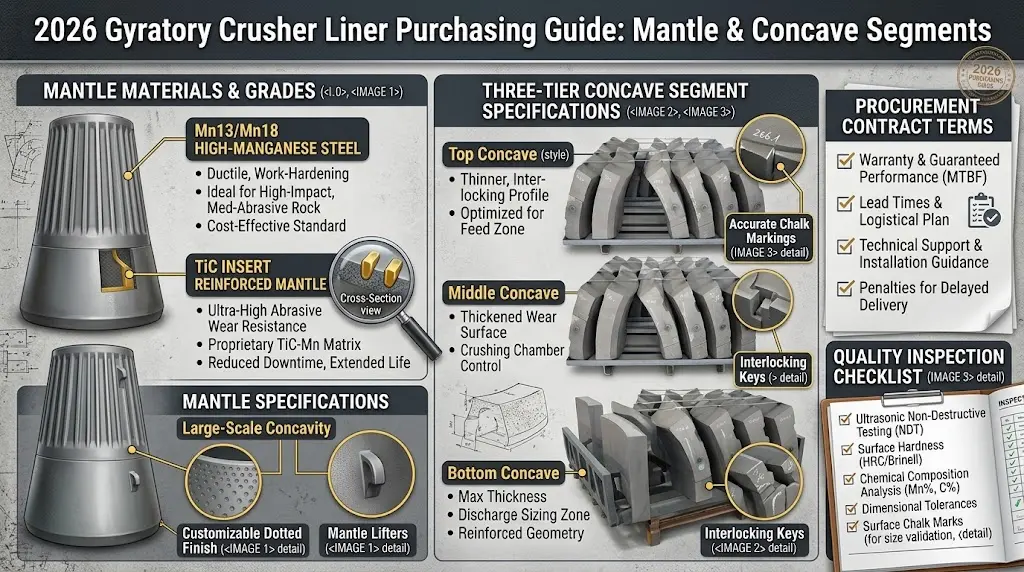
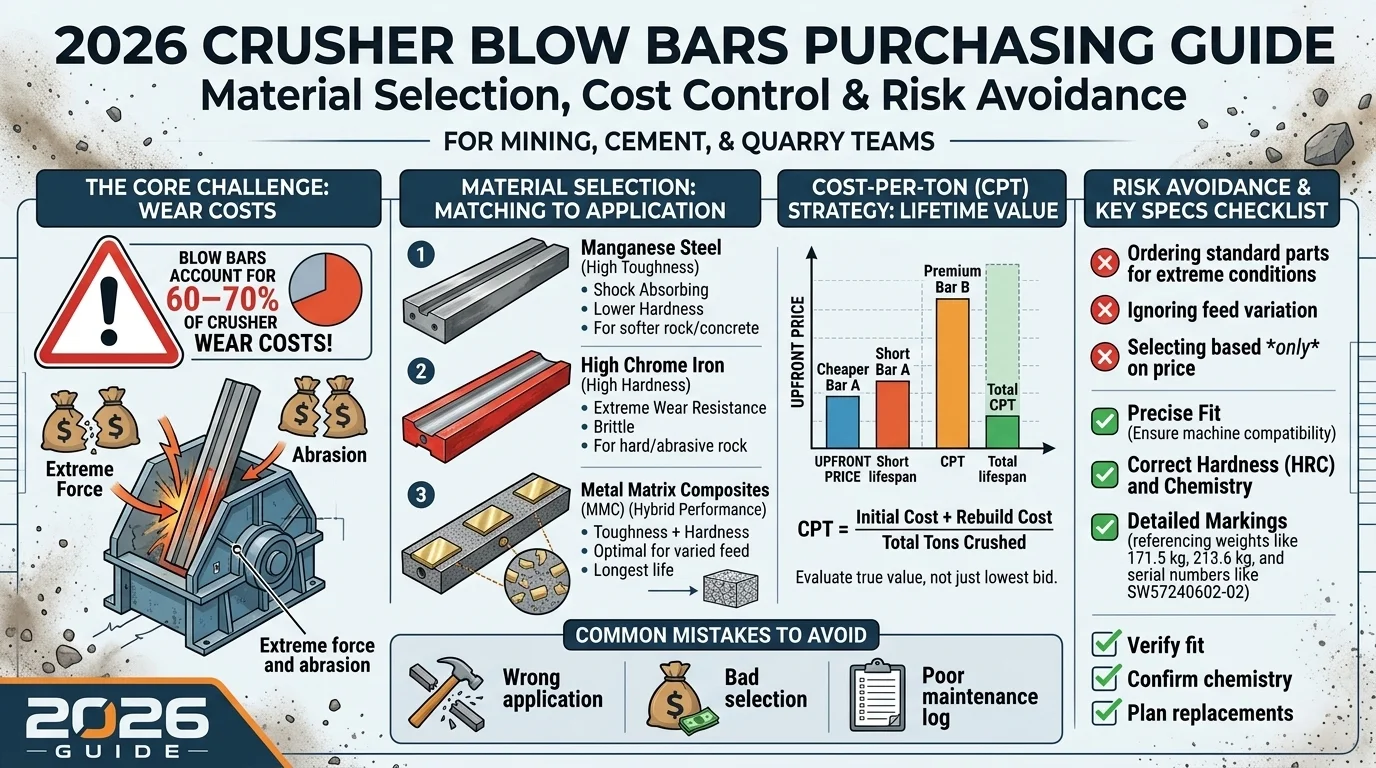
Austenitic Manganese Steel (Mn13 / Mn18 / Mn22Cr2) Under repeated impact, the surface layer work-hardens while the core retains toughness. Mn18Cr2 and Mn22Cr2 offer a significant step up from standard Mn13 in primary crushing of hard rock, where impact energy is high. Best for: high-impact primary crushing applications.
High-Chrome White Iron (15–28% Cr) With surface hardness reaching 58–65 HRC, high-chrome iron resists fine particle grinding wear far more effectively than manganese steel. Best for: secondary and tertiary cone crushing of abrasive, low-impact materials.
Martensitic Alloy Steel (400–550 HB) Through-hardened and effective without requiring impact to activate hardness. Performs well where feed size is inconsistent or impact loading is intermittent. Best for: medium-impact, medium-abrasion environments.
Titanium Carbide (TiC) Composite Inserts TiC particles (hardness >3,000 HV) are embedded in a tough steel matrix — combining extreme surface hardness with sufficient toughness to resist cracking. This is the solution for ultra-hard, ultra-abrasive materials where all other options fall short. Best for: extreme abrasion conditions where conventional alloys cannot deliver acceptable service life.
Corrosion-Resistant Alloy Additions Chromium, molybdenum, and rare earth element additions stabilize the microstructure, improve corrosion resistance, and refine grain size for a tougher, more uniform casting. Best for: wet processing, sulfide ores, and high-chloride environments.
The right material is never generic. It is the one matched precisely to your abrasion index, impact energy, compressive strength, and chemical environment.
Structure and Profile Customization: Engineering the Crushing Chamber
Material selection addresses what the liner is made of. Profile design addresses how it performs as a system.
The geometry of a crusher liner — its arc radius, tooth profile, thickness distribution, and chamber angle — directly controls how material flows through the crushing zone, where contact pressure peaks, and how uniformly the liner wears over its service life.
A poorly optimized profile creates localized stress concentrations and uneven wear — even if the metallurgy is correct.
Custom profile engineering starts with your feed material: particle size distribution, shape, compressive strength, and moisture. The crushing chamber geometry is then modeled to distribute wear load across the full liner surface rather than concentrating it in one zone.
For operations experiencing chronic uneven wear, profile redesign alone can extend liner life by 20–40%. Combined with the right metallurgy, the improvement compounds further.
Size and Fit Customization: Precision Dimensional Engineering
A liner that does not fit perfectly does not perform perfectly.
When a liner seats correctly, contact pressure is distributed evenly. Stress is managed. The liner behaves as designed. When there are gaps or dimensional deviations, the liner rocks under load, stress concentrates at contact edges, and fatigue cracking begins — often long before the wear surface itself is depleted.
For non-standard and legacy equipment, we reverse-engineer the mounting geometry from your machine — using physical measurements, 3D scanning, or existing drawings — and manufacture to ±0.3mm dimensional accuracy. The fit is exact. The installation is clean.
For standard OEM platforms — Metso HP/GP series, Sandvik CH/CS series, Terex MVP series, and others — we match OEM dimensional specifications precisely while applying upgraded metallurgy and optimized profiles. Better performance, zero compromise on installation compatibility.
3. Key Benefits of Custom Wear Liners
The engineering arguments above translate directly into operational and financial outcomes.
Here is what custom crusher liners deliver in practice.
Extended Service Life
Up to 80% longer liner life. Fewer shutdowns. Lower cost per ton.
In standard hard-rock applications, upgrading from generic Mn13 to an application-optimized Mn18Cr2 or high-chrome liner typically yields 30–50% longer service life. In extreme conditions, TiC insert liners have demonstrated improvements exceeding 200% compared to OEM standard parts.
Longer liner life means fewer change-outs, lower parts consumption, and less labor — all of which reduce your total cost of ownership in ways that a unit price comparison will never capture.
Reduced Downtime and Maintenance Costs
Cut planned shutdowns in half. Eliminate unplanned failures.
Every liner change-out is a planned shutdown. In continuous mining operations, even a four-hour replacement window carries significant opportunity cost. When liner life doubles, shutdown frequency is halved. When the liner is engineered for your conditions, premature failures are eliminated entirely.
Operations that track total maintenance cost per ton consistently report 20–40% reductions after switching to custom-engineered wear liners.
Improved Crushing Capacity and Product Consistency
Consistent output from day one to the last hour of liner life.
A liner that maintains its designed profile throughout its service life delivers consistent crushing performance start to finish — correct engagement angle, maintained crushing ratio, on-spec product gradation.
Standard liners that wear unevenly deliver declining performance across their service life. You meet your production targets in week one and fall short by week six, with no change in feed or operating parameters. Custom-profiled liners eliminate that drift.
One-Stop Solution for All Crushing Applications
One technical team. One quality system. One point of contact.
From primary jaw crushing of 400 MPa quartzite to secondary cone crushing of iron ore, tertiary VSI processing for manufactured sand, and impact crushing of recycled concrete — custom crusher liner solutions cover every application in a single supply relationship. No need to manage multiple vendors for different machines or material types.
4. Real-World Results: Custom Crusher Liner Case Studies
The claims above are not theoretical. Here are two examples from active operations.
Custom Mn22Cr2 Liners for Metso MP1000 — Chilean Copper Mine
The challenge: A large copper mining operation in Chile was running standard OEM cone crusher liners in their Metso MP1000 primary cone. Hard, abrasive copper porphyry ore was producing liner life results well below benchmark — more planned shutdowns than budgeted, and rising cost per ton.
The solution: Our metallurgical team developed a custom liner using Mn22Cr2 + 1% Mo + rare earth element (REE) additions:
- Mn22Cr2 base:Higher manganese (22%) combined with chromium delivers a superior work-hardening response under high-impact primary cone crushing, while chromium improves abrasion resistance
- 1% Mo addition:Refines carbide distribution and significantly improves toughness — reducing impact fracture risk in high-energy primary crushing
- REE addition:Refines grain structure for a more homogeneous microstructure, improving both toughness and wear resistance
The result: 30% longer service life vs. OEM standard liners under identical operating conditions. Fewer annual change-outs, recovered production time, measurable reduction in cost per ton.
TiC Insert Cone Liners for Terex MVP450 — Australian Iron Ore Operation
The challenge: An iron ore operation in Australia was running a Terex MVP450 on exceptionally hard, ultra-abrasive feed. OEM manganese steel liners were lasting just 7 days before requiring replacement — creating unacceptable operational disruption and cost.
The solution: Standard alloy upgrades — including high-chrome iron — were evaluated and ruled out based on the impact load profile of the MVP450 in this application. The only viable path was TiC insert composite liners: TiC particles (hardness >3,000 HV) embedded in a tough alloy steel matrix, with insert distribution optimized for the specific wear zone geometry of the MVP450 crushing chamber.
The result: TiC insert liners ran for 20 days before the first hairline cracks appeared. The operation replaced them at that point as a precautionary measure — not because wear had reached a critical level. That is a service life improvement in excess of 200% compared to the 7-day OEM benchmark. Annual liner change-outs dropped from over 50 to fewer than 20.
5. Applications
Custom crusher liner solutions are relevant across the full range of heavy crushing industries:
- Mining— Copper, iron ore, gold, coal, phosphate. High compressive strength feed and continuous high-volume operation consistently push standard liners beyond their design limits.
- Cement and Limestone Plants— Consistent feed gradation is critical to downstream grinding efficiency. Custom liners maintain chamber geometry longer and deliver more stable throughput.
- Aggregate and Quarry Operations— Granite, basalt, sandstone, gravel. Custom metallurgy and profile design are tailored to your dominant material type and seasonal moisture variation.
- Construction Waste Recycling— Variable feed, embedded rebar, high moisture. Custom recycling liners prioritize toughness and impact resistance over pure abrasion hardness, matching the actual damage mode.
- Metallurgical Processing— Slag, ferro-alloys, and other extreme-hardness materials with chemical reactivity and temperature sensitivity. Off-the-shelf solutions simply do not apply here.
6. Frequently Asked Questions
Can you customize liners for non-standard or legacy crushers?
Yes — and this is one of the most common requests we receive.
Many operations run equipment that is no longer supported by OEM wear part programs: older machines, regional brands, or heavily modified platforms. For these applications, we work from your equipment measurements, field drawings, or 3D scan data to engineer a liner with exact dimensional fit.
If you can measure it, we can manufacture it.
What materials are available for custom crusher liners?
We manufacture custom crusher liners in the full range of engineering alloys:
- Austenitic manganese steel:Mn13Cr2, Mn18Cr2, Mn22Cr2 — with optional Mo, Ti, V, and REE additions
- High-chrome white iron:15–28% Cr, in hypoeutectic, eutectic, and hypereutectic grades
- Martensitic alloy steel:through-hardened at 400–550 HB
- TiC composite insert liners:for extreme-abrasion applications
- Bi-metallic and compound castings:hard wear face combined with a tough backing
Material selection is an engineering recommendation based on your ore, your crusher, and your targets — not a catalog choice.
How long is the service life of your custom wear liners?
Typically 30% to 200%+ longer than the standard liners you are replacing now — depending on your material, crusher type, and operating parameters.
In every application where we have replaced a standard liner with a custom-engineered solution, service life has improved. The two case studies above are representative examples, not outliers.
Contact us with your crusher model, material type, and current liner performance. We will provide an estimated improvement range based on comparable applications — and in many cases, support a trial installation to validate performance before full commitment.
Conclusion
Standard crusher liners were designed for standard conditions.
If your operation faces anything beyond average — hard and abrasive feed, corrosive environments, non-standard equipment, or chronic uneven wear — standard liners will keep underperforming, no matter how many times you replace them.
Every week your operation runs on the wrong liner is a week of avoidable cost. Let’s fix that.
Custom crusher liners solve the problem at the source: right metallurgy, right profile, right fit — for your specific material, machine, and operating conditions. The result is longer service life, fewer shutdowns, lower maintenance cost per ton, and more consistent crushing performance across every application.
The Chilean copper mine and Australian iron ore operation in this article are not exceptions. They are what engineered solutions look like when liner design is treated as an engineering problem — not a procurement decision.
Ready to solve your crushing wear problem?
Contact us today for a customized crusher liner solution and a free wear analysis.
Share your crusher model, material type, and current liner performance — and our technical team will respond with a material recommendation, design approach, lead time, and quotation.
[Get Your Free Wear Analysis — Tell Us Your Crusher Model →]