1.Executive Summary
The global mining wear parts market is entering 2026 from a position of structural strength. Three forces are converging at once: the energy transition is pulling copper, lithium, and nickel out of the ground at record rates; mining capex is recovering sharply after a decade of underinvestment; and the world’s ore bodies are getting harder and deeper, shortening replacement cycles across every wear part category.
The numbers tell a clear story. Crusher wear parts alone represent a roughly USD 5 billion market in 2024, heading toward USD 7 billion by 2029. Ground engaging tools (GETs) — the bucket teeth, cutting edges, and ripper shanks that take the first hit in any excavation — constitute a USD 9.8 billion market, projected to reach USD 13.7 billion by 2030. Mill liners, the less glamorous but equally critical armor plating inside grinding mills, are tracking a steady 5.87% CAGR through 2031.
The competitive landscape, meanwhile, is getting more interesting. Metso, Weir Group, and FLSmidth continue to hold commanding positions in mill liners — but each segment has its own competitive logic. In crusher wear parts, the top-three structure is Metso, Magotteaux, and Weir. In GETs, OEM brands (Caterpillar, Komatsu) compete alongside pure-play specialists like ESCO and Hensley. And in the aftermarket across all categories, Chinese manufacturers are no longer simply offering cheaper versions of Western products — they are building real technical capability.
The bottom line: in 2026, mining wear parts is increasingly not a commodity business — at least not at the performance tier where margins are made. It is a technology and service competition, where advanced materials (TiC inserts, ceramic composites, bimetallic systems) and digital wear monitoring platforms are the real differentiators. Companies that understand this distinction will capture premium margins. Those that don’t will face accelerating margin compression from every direction.
2. Scope of This Report: What Counts as a Mining Wear Part?
The term “mining wear parts” is used loosely — and the scope definition matters enormously when comparing market size figures across sources.
For this report, mining wear parts are defined as replaceable components designed to absorb abrasion, impact, and erosion during ore extraction, crushing, grinding, and materials handling. They are intentionally engineered to wear out and be replaced, protecting the higher-cost structural equipment around them.
The product families covered:
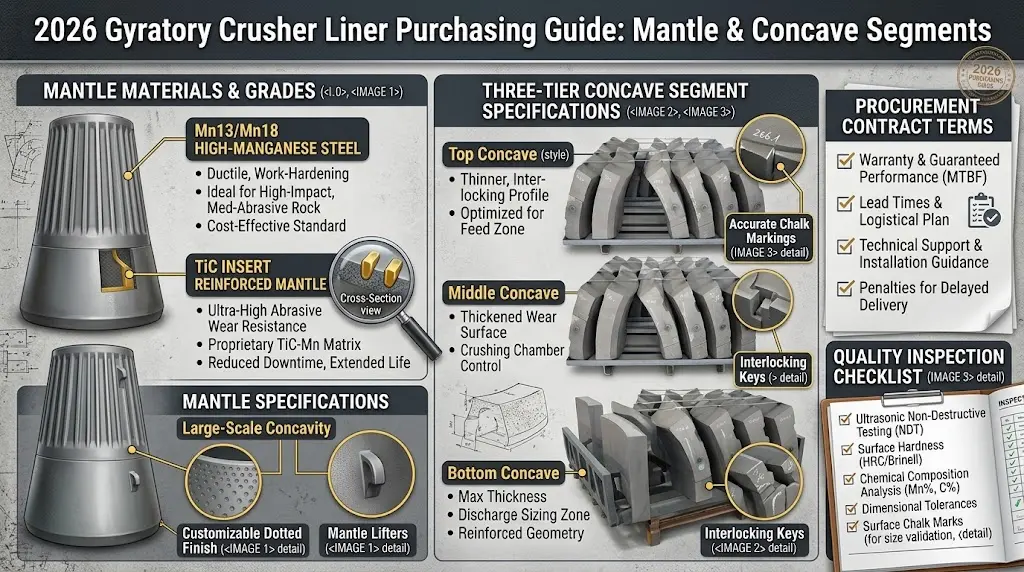
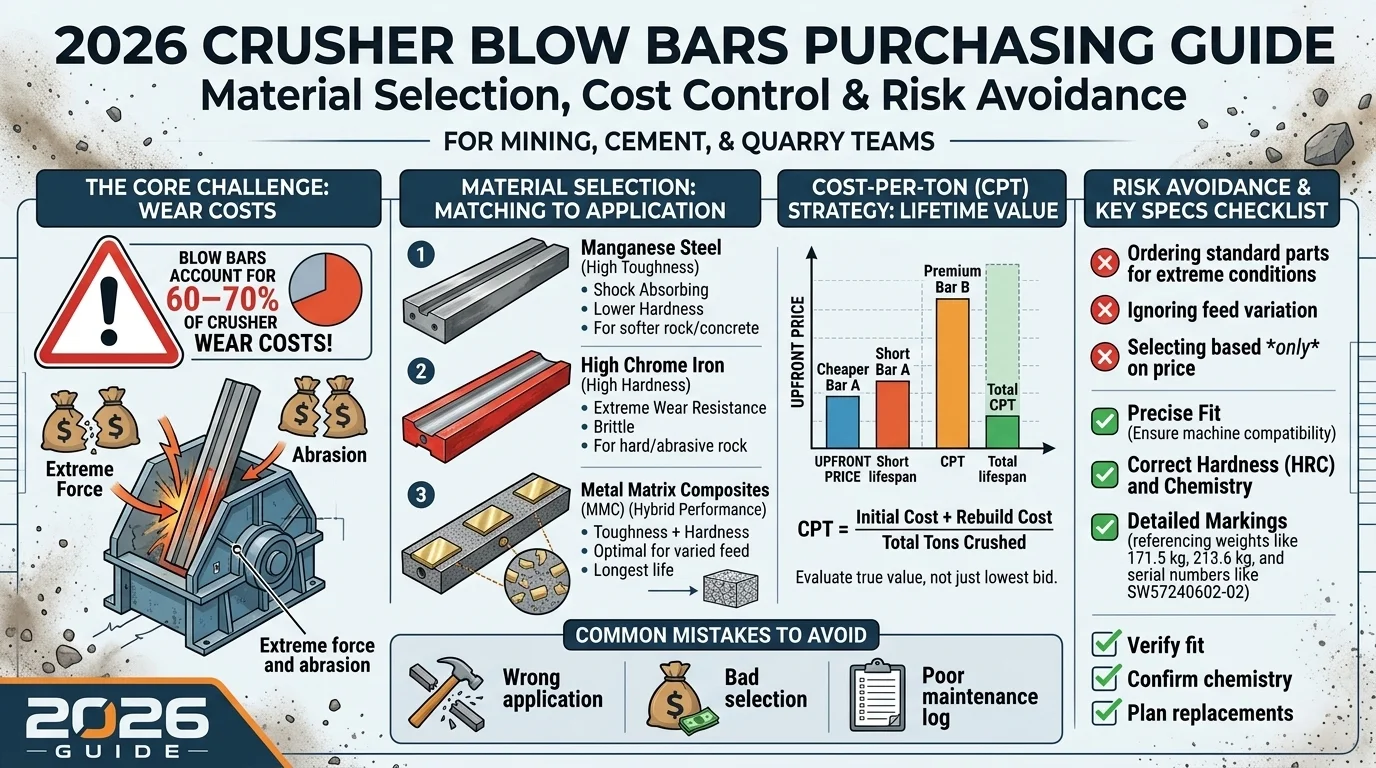
- Crusher wear parts: jaw plates, mantles, concaves, blow bars, impact plates
- Mill liners: rubber, steel, and composite liner systems for SAG, AG, ball, and rod mills
- Ground engaging tools (GETs): bucket teeth, cutting edges, adapters, ripper shanks
- Pump and slurry wear parts: impellers, liners, throatbushes
- Screen media and panel liners: polyurethane/rubber screening surfaces, chute liners
This scope excludes grinding media (steel balls, cylpebs) and purely structural equipment components. Where broader industry figures are cited for context, the scope difference is clearly noted.
3. Global Market Size & Growth Forecasts
3.1 The Broad Industrial Wear Parts Market
For scale context: the global wear parts market across all industries — mining, construction, cement, manufacturing, energy — was valued at USD 722 billion in 2025, projected to reach approximately USD 1.21 trillion by 2035 at a CAGR of 5.29% (Precedence Research, January 2026). Mining represents a significant but minority share.
3.2 Crusher Wear Parts
The crusher wear parts market is estimated at USD 5.0 billion in 2024 and is projected to reach approximately USD 7.0 billion by 2029, reflecting a CAGR in the 6–7% range (Market Report Analytics, January 2026).
This is a market concentrated at the top — Metso, Magotteaux, and Weir Group command the leading positions — but with a long, fragmented tail of regional foundries and aftermarket suppliers. China is the single largest national market and a major export hub for aftermarket components. Worth noting: the 6–7% CAGR estimate for crusher wear parts runs slightly above the mill liner figure, reflecting the direct exposure of this segment to primary mining activity and the faster adoption of higher-priced ceramic and composite parts.
3.3 Mill Liners
| Year | Market Size | CAGR | Source |
| 2024 | USD 1.28 billion | — | Report Prime, Sep 2025 |
| 2025 | USD 1.36 billion | — | Report Prime, Sep 2025 |
| 2031 (forecast) | USD 1.91 billion | 5.87% | Report Prime, Sep 2025 |
The mill liner market — scoped to standalone liner systems (rubber, steel, composite) — reached USD 1.28 billion in 2024 and is growing at a steady 5.87% CAGR through 2031 (Report Prime Research Team, September 2025). This is the primary figure used throughout this report.
⚠️ Data Note — Why You May See a Much Larger Number Elsewhere: Some sources cite mill liner market figures as high as USD 9.9 billion. These estimates use a substantially broader scope that includes grinding media (steel balls, cylpebs), classification equipment, and related mill internals — categories often sold and managed separately from liner systems. The two figures are not comparable. Always verify scope before comparing across reports.
3.4 Ground Engaging Tools (GETs)
| Year | Market Size | CAGR | Source |
| 2024 | USD 9.8 billion | — | Strategic Market Research, Dec 2025 |
| 2030 (forecast) | USD 13.7 billion | 5.8% | Strategic Market Research, Dec 2025 |
The GET market is projected to grow from USD 9.8 billion (2024) to USD 13.7 billion by 2030 at a CAGR of 5.8% (Strategic Market Research, December 2025). This is the primary figure used in this report.
⚠️ Data Note: A separate estimate cited USD 8.38 billion for 2025 with a different trajectory. The divergence likely reflects differences in geographic scope and whether OEM-bundled GET systems are included. Strategic Market Research figures are used as primary references here due to more explicit methodology disclosure.
The GET market sits at the intersection of mining and construction demand — which makes it somewhat more resilient to mining-specific cycles than crusher or mill liner segments.
3.5 Flotation Wear Parts & Steel Wear Liners
Two smaller but significant sub-segments:
- Flotation wear parts:estimated at USD 1.45 billion in 2024, serving froth flotation circuits used in copper, gold, and nickel concentration (Industry Report, July 2025)
- Steel wear liners:growing at a CAGR of 83% from 2025 to 2035, driven by mining and construction demand (Market Research Future, December 2025)
Market Size Summary
| Segment | 2024 Size | CAGR | Forecast Year | Forecast Size |
| Crusher Wear Parts | ~USD 5.0B | 6–7% | 2029 | ~USD 7.0B |
| Mill Liners | USD 1.28B | 5.87% | 2031 | USD 1.91B |
| Ground Engaging Tools | USD 9.8B | 5.8% | 2030 | USD 13.7B |
| Flotation Wear Parts | ~USD 1.45B | N/A | — | — |
| Steel Wear Liners | N/A | 2.83% | 2035 | — |
4. Market Segmentation
4.1 By Product Type
The mining wear parts market is not monolithic. Each product family has its own demand rhythm, competitive dynamics, and technology curve.
Crusher wear parts break down into three material categories: metallic (the incumbent — jaw plates, mantles, concaves in high-manganese steel or chrome iron), ceramic (fastest-growing, with documented wear-life improvements of 40%+), and composite bimetallic systems combining hard surface layers with tough backing structures.
GETs are dominated by bucket teeth and cutting edges by revenue. Adapter systems and wear plate packages are growing faster, as mining companies move from ad hoc replacement toward systematic GET lifecycle management programs.
Mill liners are bifurcating by application. Large-diameter SAG and AG mills increasingly favor rubber or Poly-Met (rubber-steel hybrid) systems for faster reline times and better safety outcomes. Smaller ball mills continue to use steel liners where impact conditions demand higher hardness.
4.2 By Application and Mining Type
| Application | Est. Revenue Share | Key Products Consumed |
| Surface mining (iron ore, coal, copper) | ~45% | GETs, crusher wear parts |
| Underground mining | ~30% | Drill bits, conveyor liners, compact GET |
| Mineral processing (all ore types) | ~20% | Mill liners, flotation wear parts, pump liners |
| Construction & quarrying | ~5% | GETs, jaw plates |
Surface mining operations — primarily bulk commodity extraction — remain the largest single consumer by both volume and value. Underground mining’s share is growing, however, as high-grade copper and gold deposits increasingly require going deeper (IndexBox, April 2026).
4.3 By Region
| Region | Est. Share | Key Mining Activities | Growth Outlook |
| Asia-Pacific | ~43–44% | Iron ore (AUS), coal (AUS/ID), copper (CN/PH) | Stable, high-volume base |
| North America | ~20% | Copper (US/CAN), gold, potash | Moderate; critical minerals upside |
| Europe | ~15% | Aggregate quarrying; aftermarket services | Slow growth; ESG-driven investment |
| Latin America | ~10% | Copper (CL/PE), lithium (CL/AR), silver | Fastest growing |
| Middle East & Africa | ~10% | Gold (ZA/GH), platinum (ZA), iron ore | Emerging; high long-term potential |
Asia-Pacific leads with approximately 43.56% of wear-resistant materials market share in 2025 (SNS Insider, April 2026). Australia’s Pilbara, Indonesian coal mines, and China’s domestic processing circuits collectively represent an enormous installed base.
Latin America is the region to watch. Chile and Peru together account for roughly 33–36% of global copper production — and both are expanding capacity to meet electrification demand. Lithium projects in Chile’s Atacama Desert and Argentina’s “Lithium Triangle” are adding entirely new wear part consumption streams. The region’s share of global mining capex is growing faster than any other geography (IndexBox, April 2026).
5. Key Market Drivers in 2026
5.1 The Energy Transition: A Structural Demand Engine
The most consequential driver in the 2026 mining wear parts market is structural and multi-decade in nature: the global energy transition requires mining an extraordinary volume of copper, lithium, nickel, cobalt, and rare earth elements.
The scale is hard to overstate. Under IEA’s Sustainable Development Scenario, lithium demand for batteries was projected to increase roughly 40 times by 2040 (IEA, The Role of Critical Minerals in Clean Energy Transitions, 2021). IEA’s 2024 update revised this to approximately 9x under the Net Zero Emissions scenario, reflecting battery technology improvements and higher recycling rates — either figure represents an extraordinary structural demand shift. Copper demand from EV manufacturing and grid infrastructure is surging; offshore wind installations require multiple tonnes of copper per MW of capacity (IEA Critical Minerals Market Review, 2023) — and estimates vary by scenario and technology pathway.
Every tonne of these metals that comes out of the ground passes through crushers, mills, and loading equipment — all consuming wear parts at predictable rates. This is not a cyclical tailwind that disappears when commodity prices dip. It is a structural reorientation of the global mining industry toward a new set of metals, in new geographies, at new ore grades.
5.2 Rising Mining Capital Expenditure
After a prolonged period of capital discipline following the commodity downturn of 2015–2020, mining companies are re-opening their wallets:
- The Mobile Mining Equipment Marketwas valued at USD 71.4 billion in 2025, forecast to reach USD 123.1 billion by 2035 (CAGR 5.6%) (Future Market Insights, July 2025). Every new machine enters a multi-year wear parts consumption cycle from day one
- The Mineral Processing Equipment Marketwas worth USD 22.9 billion in 2025, forecast to grow to USD 35.6 billion by 2035 (CAGR 4.5%) (Future Market Insights, September 2025)
- Greenfield projects in the Pilbara, the South American copper belt, and West Africa’s iron ore corridor are generating fresh waves of demand that will run for years
5.3 Deeper, Harder Ore Bodies: The Physics of Scarcity
Here is the driver that most generic market reports miss entirely: the world’s easily accessible, high-grade ore is increasingly depleted.
Grades at major copper mines have been declining for five decades. Gold miners are going deeper. Iron ore operators in Australia are processing increasingly fine-grained, complex ore. As deposits deplete at surface, extraction moves deeper and into harder rock.
The implication for wear parts is direct: harder, more abrasive ore generally accelerates wear rates and shortens replacement intervals — all else being equal. Combined with growing production volumes, this secular trend structurally supports wear part demand per unit of output over the long term, though actual wear rates vary significantly by equipment type, operating parameters, and ore mineralogy.
5.4 The Aftermarket Service Transformation
Aftermarket revenue now represents over 65% of total revenue for players like Weir Group — and the leading suppliers are actively deepening that dependency through digital services.
The new model: sell wear parts, but also sell the monitoring platform, the maintenance contract, and the performance guarantee. Customers pay not for a jaw plate but for a guaranteed cost-per-tonne target. TCO-based contracts make switching costs prohibitively high and create recurring revenue streams that transactional part sales never could.
5.5 Construction and Infrastructure Activity
Beyond mining, the GET market benefits from a global infrastructure investment cycle showing no sign of abating. Road construction across India and Southeast Asia, renewable energy site preparation worldwide, and the ongoing U.S. infrastructure program are all driving excavator and loader utilization — and therefore GET consumption (Strategic Market Research, December 2025).
6. Competitive Landscape
6.1 Market Structure: Three Different Games in One Industry
It is tempting to describe the mining wear parts competitive landscape as a single market. It isn’t. Crusher wear parts, mill liners, and GETs each have distinct competitive structures — different leaders, different dynamics, different sources of advantage. Understanding the differences matters.
In all three segments, a handful of well-resourced global players dominate the OEM and premium aftermarket tiers. Below them: a large, fragmented ecosystem of regional foundries, specialist manufacturers, and Chinese exporters competing aggressively on price. The tension between these tiers is constant, and the leading OEMs are investing heavily in digital tools to make the price gap feel less compelling to customers.
6.2 Mill Liner Market — Leading Players (2024)
Note: The market share data below applies specifically to the mill liner sub-segment. Crusher wear parts and GET markets have distinct competitive structures — see Sections 6.3 and 6.4.
| Rank | Company | Est. Revenue (USD M) | Market Share | HQ |
| 1 | Metso (formerly Metso Outotec, renamed May 2023) | 430 | 14.2% | Espoo, Finland |
| 2 | FLSmidth | 390 | 12.9% | Copenhagen, Denmark |
| 3 | Weir Group | 320 | 10.5% | Glasgow, UK |
| 4 | Trelleborg | 190 | 6.2% | Trelleborg, Sweden |
| 5 | Bradken | 175 | 5.7% | Newcastle, Australia |
| 6 | Magotteaux | 160 | 5.2% | Vaux-sous-Chèvremont, Belgium |
| 7 | Multotec | 120 | 3.9% | Johannesburg, South Africa |
| 8 | Polycorp | 95 | 3.1% | Ontario, Canada |
| 9 | GIW Industries | 85 | 2.8% | Georgia, USA |
| 10 | H-E Parts International | 70 | 2.3% | Atlanta, Georgia, USA |
Source: Report Prime Research Team, September 2025
6.3 Crusher Wear Parts: A Different Competitive Map
The crusher wear parts market is also led by Metso, Magotteaux, and Weir Group — but the dynamics differ from mill liners in important ways. Here, the aftermarket is more fragmented and price competition is more intense. Chinese manufacturers (Qiming Casting, HUBEI JYS) have made the deepest inroads into crusher wear parts, particularly in Asia-Pacific and Latin America, precisely because crusher liners are easier to reverse-engineer than the precision-engineered composite systems used in large mills.
For Western OEMs in this segment, the battleground is increasingly technical: ceramic insert and TiC composite parts represent a performance tier that Chinese producers have not yet fully replicated. That window will not stay open indefinitely.
6.4 GET Market — Key Players
| Tier | Company | Notes |
| OEM Systems | Caterpillar, Komatsu, Hitachi | Integrated GET systems for proprietary equipment fleets |
| Pure-Play Leaders | ESCO (Weir Group), Hensley Industries | Largest independent GET brands globally |
| European Specialists | MTG (Metalogenia) | Strong in European and Latin American markets |
| Regional Players | Various | Fragmented; competing on availability and price |
ESCO — now part of Weir Group — remains the dominant independent GET brand globally. The GET market’s OEM-versus-aftermarket tension mirrors the crusher parts dynamic: OEMs argue for compatibility and performance guarantees; aftermarket suppliers compete on price and local availability.
6.5 Key Player Strategies
Metso (formerly Metso Outotec) is playing a long game built on R&D depth and digital lock-in. Expanding its Chile service center targets the copper sector directly; launching an AI-assisted wear-life monitoring platform embeds software into every customer relationship. Once your mill’s wear history lives inside Metso’s platform, switching to Bradken or Polycorp means starting that institutional knowledge base from zero.
Weir Group is betting on speed. The rapid manufacturing hub opened in Arizona in 2024 can compress liner delivery from weeks to days — which is worth an extraordinary premium when unplanned downtime costs USD 100,000+ per hour. 3D-printed liner trials are still early, but the directional intent is clear: own the emergency replacement market.
FLSmidth is diversifying its manufacturing base and technology portfolio simultaneously. Acquiring TEi Wear Solutions added wear engineering capability; investing in an Indian rubber molding plant positions it for Asian growth; the SmartEar acoustic monitoring system — which listens to the mill and detects liner wear in real time — is a genuinely differentiated piece of technology.
CMS Cepcor made a notable commercial move in April 2026, announcing a strategic partnership with Superior Industries for crusher parts distribution in North America (Supply Post, April 2026). For an aftermarket specialist, securing a major distribution partner in the world’s most lucrative market is a significant step.
Chinese manufacturers — particularly Qiming Casting, HUBEI JYS, and Xinhai Mining — deserve candid acknowledgment. They have moved beyond simple price competition into genuine technical capability: improved alloy formulations, faster delivery, and increasingly professional after-sales service. Any analysis that frames them as a purely “low-end” competitive threat is misreading the market.
6.6 OEM vs. Aftermarket: The Perennial Tension
OEMs argue — correctly — that their parts are optimized for specific crusher or mill designs, and that off-spec aftermarket parts can void warranties, reduce performance, and increase accident risk. Aftermarket suppliers argue — also correctly — that genuine parts are frequently overpriced by 30–50%, and that quality alternatives are commercially rational for most operating conditions.
In 2026, OEMs are trying to win this argument digitally: if your monitoring platform only works with your liners, the aftermarket option becomes much less attractive. Whether this strategy succeeds long-term is one of the more interesting competitive questions in the sector.
7. Material Technology Trends
7.1 High Manganese Steel — Still the Foundation
High manganese steel (Hadfield steel) has been the dominant wear part material for over a century. It is not going anywhere. Its defining property is work hardening under impact: surface hardness climbs from roughly 200 HB as-cast to 500+ HB under repeated impact loading, making it uniquely self-reinforcing in primary crushing applications.
Standard grades:
- Mn13(13% Mn): general-purpose crusher liners, jaw plates
- Mn18(18% Mn): higher manganese for more impact-intensive conditions
- Mn22(22% Mn): extreme-impact primary crushing environments
The materials frontier, though, is pushing beyond standard HMS. A 2025 study in ScienceDirect investigated HMS/WC (tungsten carbide) composite coatings applied via laser cladding, finding significant wear resistance improvements by adjusting WC content from 0–40 wt% in the HMS matrix (ScienceDirect, October 2025). Surface engineering like this could extend manganese steel into applications that currently require chrome iron or ceramic components.
7.2 High Chrome White Iron — The High-Abrasion Specialist
Where impact loads are lower but abrasion is severe — ball mill liners in fine-grinding circuits, slurry pump impellers, hydrocyclone components — high chrome white iron (HCWI) is the material of choice. Chrome content typically runs 15–30%, producing a microstructure rich in hard carbides embedded in a martensitic matrix. Hardness of 600–800 HV is achievable.
Its weakness — relative brittleness under sudden impact — is precisely why it is not used in primary jaw or gyratory crushers.
7.3 Ceramic Insert Technology — The Fastest-Growing Material Innovation
Ceramic-metal composites are the wear parts industry’s most commercially consequential material development right now. The performance data from field conditions is no longer theoretical.
A field trial at a major copper mine in Chile (Metso HP500 cone crusher, copper ore at Bond Work Index 15.2), published by ATF Crusher Parts in December 2025:
| Metric | Standard High Chrome | Ceramic Insert |
| Wear Life | 2,800 hours | 4,100 hours (+46%) |
| Part Cost | USD 12,500 | USD 17,800 |
| Cost Per Hour | USD 4.46 | USD 4.34 |
| Annual Change-Outs | 6 | 4 |
Source: ATF Crusher Parts, December 2025
The premium part costs more. It also costs less to run — because the economics of wear parts are not about unit price; they are about cost per tonne of ore processed. That distinction is what drives ceramic adoption in high-abrasion applications.
The technology: alumina (Al₂O₃) ceramic tiles (~1,800 HV hardness) embedded in a high-chrome white iron matrix. Ceramics provide extreme surface hardness at wear contact points; the metal matrix absorbs impact forces that would shatter ceramic used alone.
The clearest ROI case: operations processing highly abrasive ores (silica content above 60%) and remote sites where each change-out carries significant logistics and downtime cost.
7.4 TiC Insert Technology — Documented Gains in Roll Crushing
Titanium carbide (TiC) inserts in manganese steel matrices are showing compelling performance gains in roll crusher applications:
- Sunwill Machinery documented over 70% wear life extensionfor TiC-inserted toothed roll crusher segments in hard-rock mining (Sunwill Machinery, March 2026)
- Qiming Casting reported, based on a case study from a Russian mining operation, a reportedly up to 178% improvementin wear life for TiC-inserted roll crusher tooth segments versus standard manganese steel — tested on a specific ore type at a specific site (Qiming Casting, November 2025). This figure is manufacturer-reported from a single operation and should be treated as a directional reference, not a guaranteed baseline. Independent verification is recommended before procurement decisions.
The directional finding is consistent across multiple sources: TiC inserts in roll crusher applications deliver a meaningful and repeatable performance advantage. The magnitude varies by ore type, crusher model, and operating conditions.
7.5 Rubber and Polymer Liners — The Operational Convenience Play
Rubber and rubber-metal hybrid liners have been steadily taking share from steel liners in specific mill applications, and the trend accelerated in 2025–2026. The advantages are operational:
- 30–50% weight reductionequivalent steel liners, improving reline safety
- Faster reline times, reducing planned downtime windows
- Lower noise levels, simplifying regulatory compliance
- Competitive wear life in fine grinding and lower-impact applications
Trelleborg leads in polymer liner systems; Polycorp specializes in rubber-metal hybrid designs (Mining.com, October 2025). The constraint on adoption: temperature and chemical compatibility limit rubber performance in high-temperature mills and aggressive chemical environments.
7.6 Digital Wear Monitoring — Where Materials Science Meets Business Model
The materials technology story and the service model story are converging. The key platform developments in 2025–2026:
- AI-assisted wear-life monitoring(Metso, 2025): continuous liner condition assessment with AI-predicted remaining life
- SmartEar acoustic monitoring(FLSmidth): real-time wear detection through acoustic signal analysis — the mill tells you when its liner needs changing
- Digital twin platformsfor liner design: virtual mill models generate liner profiles optimized for each site’s specific ore characteristics
- IoT condition monitoring(Trelleborg/ABB): liner wear data integrated into broader equipment health management systems
The strategic significance goes beyond operational efficiency. These platforms create data lock-in. Once a mining operation’s wear patterns, replacement histories, and optimization models are embedded in a supplier’s system, switching vendors means losing institutional knowledge that took years to build.
8. Key Challenges & Risk Factors
Raw material cost volatility is structural and not going away. High manganese steel requires manganese (South Africa, Australia); chrome iron requires chromium (South Africa, Kazakhstan, India); advanced composites need tungsten and titanium. Geopolitical disruption in any of these supply chains creates immediate margin pressure.
It is worth anchoring this with a recent example. In 2023–2024, tightening Chinese export controls on tungsten and gallium sent shock waves through the advanced materials supply chain. Wear parts manufacturers that had not diversified sourcing scrambled. Those that had — through long-term contracts and multi-region supply — absorbed the shock more cleanly.
Chinese manufacturer competition deserves a direct assessment: it is intensifying faster than most Western industry observers acknowledge. Producers like Qiming Casting and HUBEI JYS have moved beyond simple price competition into genuine alloy R&D and manufacturing quality improvement. In developing markets across Africa, Southeast Asia, and Latin America, they are winning contracts that were previously assumed to belong to Western OEMs and their aftermarket partners.
Mining industry consolidation is concentrating buyer power. As BHP, Rio Tinto, Glencore, and Vale grow through M&A, their collective leverage over wear part suppliers increases. The trend toward TCO contracts partly reflects mining companies’ desire to consolidate spend with fewer suppliers at predictable per-tonne rates — which suits major OEMs (who can offer integrated service packages) but squeezes both mid-tier suppliers and pure-price competitors.
ESG and sustainability requirements are moving from voluntary to mandatory across multiple mining jurisdictions. For wear parts suppliers, this means growing demand for components that reduce energy consumption (lighter liners lower mill motor load), support recycling programs, and carry verified environmental credentials. First movers in sustainable wear parts manufacturing have a window to differentiate that will not stay open indefinitely.
Supply chain geopolitics remains a chronic risk. Tungsten carbide supply depends heavily on Chinese production. Rare earth elements used in advanced composite materials face export restriction risk. Regional manufacturing diversification is no longer a strategic option for major suppliers — it is a requirement.
9. Market Outlook: 2026–2030
| Dimension | 2026–2030 Outlook |
| Overall market growth | Positive; CAGR 5–7% across key sub-segments |
| Fastest-growing product | Ceramic and TiC composite wear parts |
| Fastest-growing region | Latin America (copper/lithium expansion) |
| Key technology shift | Digital wear monitoring + advanced material systems |
| Competitive pressure | Increasing from Chinese manufacturers in aftermarket |
| Business model shift | TCO contracts replacing transactional sales |
| M&A activity | Continued consolidation among top-tier and mid-tier players |
| Material innovation pace | Accelerating; ceramic/composite adoption at inflection point |
The next four years will separate wear parts companies that sell components from those that sell outcomes — and the distance between them will grow faster than most incumbents currently expect.
Three structural shifts are running simultaneously:
First, the energy transition sustains demand growth at a rate the mining wear parts industry has not seen since the early 2000s commodity boom — but with more geographic diversification. Latin America, Africa, and Central Asia are growing faster than the traditional Australia-China axis. The companies best positioned are those that already have service infrastructure in Santiago, Lima, and Johannesburg, not just Melbourne and Beijing.
Second, materials technology is reaching a commercial inflection point. Ceramic insert and TiC technologies have moved from lab curiosity to field-proven commercial reality. As production scales and price premiums compress, these materials will take meaningful share from conventional high-manganese steel and chrome iron in high-abrasion applications. The cost-per-tonne economics are no longer marginal — in the right applications, they are decisive.
Third — and this is the most under-appreciated shift — the middle of the market is being hollowed out. The middle ground — good quality, moderate technology, regional service, no digital offering — is the most exposed competitive position. Companies in that tier face pricing pressure from Chinese manufacturers from below and switching-cost pressure from digitally-integrated OEMs from above. The strategic response is not incremental improvement. It requires a choice: invest seriously in digital service capabilities, or compete explicitly on cost with supply chain efficiency as the only differentiator.
10. Frequently Asked Questions
What are mining wear parts? Mining wear parts are replaceable components — jaw plates, mill liners, bucket teeth, pump impellers — designed to absorb abrasion and impact in mining operations, protecting the more expensive structural equipment around them. They are intentionally engineered to wear out and be replaced. → See Section 2 for full product scope.
How large is the mining wear parts market in 2026? Key sub-segments: crusher wear parts ~USD 5B (2024); ground engaging tools ~USD 9.8B (2024); mill liners ~USD 1.28B (2024). Combined CAGRs range 5–7% through 2030–2031. Note that broader “wear parts” figures from some sources (USD 700B+) include all industries, not mining specifically. → See Section 3 for full data and scope notes.
What materials are used in mining wear parts? The five primary material systems are: high manganese steel (best for high-impact crushing), high chrome white iron (best for high-abrasion, lower-impact conditions), rubber/polymer (SAG and ball mill liners), tungsten carbide (drill bits, hard-rock tools), and ceramic/TiC composites (fastest-growing; documented wear-life extensions of 40–70%+). → See Section 7 for material-by-material analysis.
Who are the leading mining wear parts manufacturers? Mill liner leaders: Metso (14.2%; formerly Metso Outotec, renamed 2023), FLSmidth (12.9%), Weir Group (10.5%). Crusher wear parts: Metso, Magotteaux, and Weir hold leading positions. GET leaders: ESCO (Weir), Hensley Industries, MTG. Each sub-segment has a distinct competitive structure. → See Sections 6.2–6.4.
How often do crusher wear parts need to be replaced? Typically every 2,000–4,000 operating hours in hard-rock mining, depending on ore abrasivity and crusher type. Ceramic insert components have demonstrated 40%+ wear life extension versus standard high-chrome parts in copper ore applications, potentially cutting annual change-outs from 6 to 4. → See Section 7.3 for field trial data.
Which region is growing fastest for mining wear parts? Latin America — Chile, Peru, Argentina — is the fastest-growing region, driven by copper expansion and lithium mining. Asia-Pacific remains the largest market overall at ~43–44% global share. → See Section 4.3.
What is the difference between OEM and aftermarket crusher wear parts? OEM parts are manufactured by the original equipment maker (Metso, FLSmidth, etc.) and optimized for their specific machine designs. Aftermarket parts are produced by independent suppliers and typically priced 20–40% lower. OEMs argue their parts optimize performance and preserve warranties; aftermarket suppliers argue quality alternatives are commercially rational for most conditions. In 2026, leading OEMs are using digital monitoring platforms to make the OEM option stickier. → See Section 6.6.
How do ceramic insert wear parts compare to high manganese steel on cost per tonne? In documented field trials on copper ore, ceramic insert cone crusher liners showed a lower cost-per-operating-hour (USD 4.34 vs. USD 4.46) despite higher unit prices — because extended wear life (4,100 vs. 2,800 hours) more than offsets the premium. The case is strongest in highly abrasive ores (silica >60%) and remote operations with high change-out costs. → See Section 7.3 for the full trial breakdown.
Which mining wear parts manufacturer is best for copper mining operations? There is no single answer — it depends on the specific application (primary crushing vs. milling vs. loading) and the operation’s priorities (lowest unit cost vs. longest wear life vs. digital service integration). Metso and Weir Group are the most comprehensively capable suppliers across all equipment types in copper mining. For aftermarket crusher parts, Columbia Steel (North America) and CMS Cepcor (global) are respected specialists. Chinese manufacturers offer competitive pricing, with improving technical quality for standard applications. → See Section 6 for competitive landscape details.
11. Sources & References
| # | Source | Publication | Date | URL / DOI |
| [1] | Precedence Research | Wear Parts Market Size, Share and Trends 2026 to 2035 | January 2026 | Available upon request |
| [2] | Market Report Analytics | Crusher Wear Parts Market — Global Forecast to 2029 | January 2026 | Available upon request |
| [3] | Report Prime Research Team | Top Mill Liner Market Companies — Rankings and Analysis | September 2025 | Available upon request |
| [4] | Industry Analysis | Mining Mill Liner Market: Global Industry Trends | April 2026 | Source unverified; treat as directional |
| [5] | Strategic Market Research | Ground Engaging Tools Market Size ($13.7 Billion) 2030 | December 2025 | Available upon request |
| [6] | Industry Analysis | Flotation Wear Parts Market Report 2026 | July 2025 | Source unverified; treat as directional |
| [7] | Market Research Future | Steel Wear Liner Market Size, Growth, Trends Report 2035 | December 2025 | Available upon request |
| [8] | IndexBox | Mining Support Materials Market Analysis: Global Demand and Growth Outlook to 2035 | April 2026 | Available upon request |
| [9] | SNS Insider | Wear Resistant Steel Plate Market Size, Share & Industry Growth 2035 | April 2026 | Available upon request |
| [10] | Intel Market Research | Tungsten Carbide Mining Tools Market Outlook 2025–2032 | September 2025 | Available upon request |
| [11] | Industry Analysis | Wear Parts Market Growth Drivers, Challenges and Investment | April 2026 | Source unverified; treat as directional |
| [12] | Future Market Insights | Mobile Mining Equipment Market Analysis Report 2035 | July 2025 | Available upon request |
| [13] | Future Market Insights | Mineral Processing Equipment Market (2025–2035) | September 2025 | Available upon request |
| [14] | Precedence Research | Wear Parts Market Size, Share and Trends 2026 to 2035 (Columbia Steel reference) | January 2026 | Available upon request |
| [15] | Supply Post | Superior and CMS Cepcor Create Partnership For Crusher Parts In North America | April 2026 | Available upon request |
| [16] | HT Wear Parts | The Complete Guide to Jaw Crusher Plates | November 2025 | Available upon request |
| [17] | ScienceDirect | Wear-resistant high manganese steel/WC composite coatings prepared by laser cladding | October 2025 | doi: available upon request |
| [18] | ATF Crusher Parts | Ceramic Insert Technology Extends Wear Life 40% in Copper Ore Application | December 2025 | Available upon request |
| [19] | Sunwill Machinery | TiC-Inserted Manganese Steel Toothed Roll Crusher Segments — Performance Case Study | March 2026 | Available upon request |
| [20] | Qiming Casting | TIC Inserts Improve Roll Crusher Tooth Segments Wear Life By Over 178% | November 2025 | Available upon request |
| [21] | Mining.com | Inside Mill Liner Optimization: Interview with Raul Vargas, ME Elecmetal | October 2025 | Available upon request |
| [22] | Persistence Market Research | Tungsten Carbide Powder Industry Report 2025 | June 2025 | Available upon request |
| [23] | TSR Metal | TSR Metal at THE MINE Russia 2025 — Bimetallic Wear Parts Showcase | February 2026 | Available upon request |
| [24] | IEA | Critical Minerals Market Review 2023 | 2023 | iea.org/reports/critical-minerals-market-review-2023 |
Data Transparency Note: Market size figures vary significantly by scope definition. Crusher wear parts (~USD 5B) covers mining-focused applications; the broad industrial wear parts figure (USD 722B) covers all industries — these are not comparable. Mill liner figures vary between USD 1.28B (Report Prime, standalone liner systems) and USD 9.9B (broader scope including grinding media) — see Section 3.3 note. Sources [4], [6], and [11] could not be verified to an original publishing institution and are flagged accordingly; figures from these sources are used directionally only. Field trial data ([18], [19], [20]) represents manufacturer-reported results under specific operating conditions; independent verification is recommended for procurement decisions.
© 2026 Bifeng Creative Studio. Compiled from publicly available market research, industry publications, academic research, and manufacturer case studies. All sources cited. Reproduction with attribution permitted.