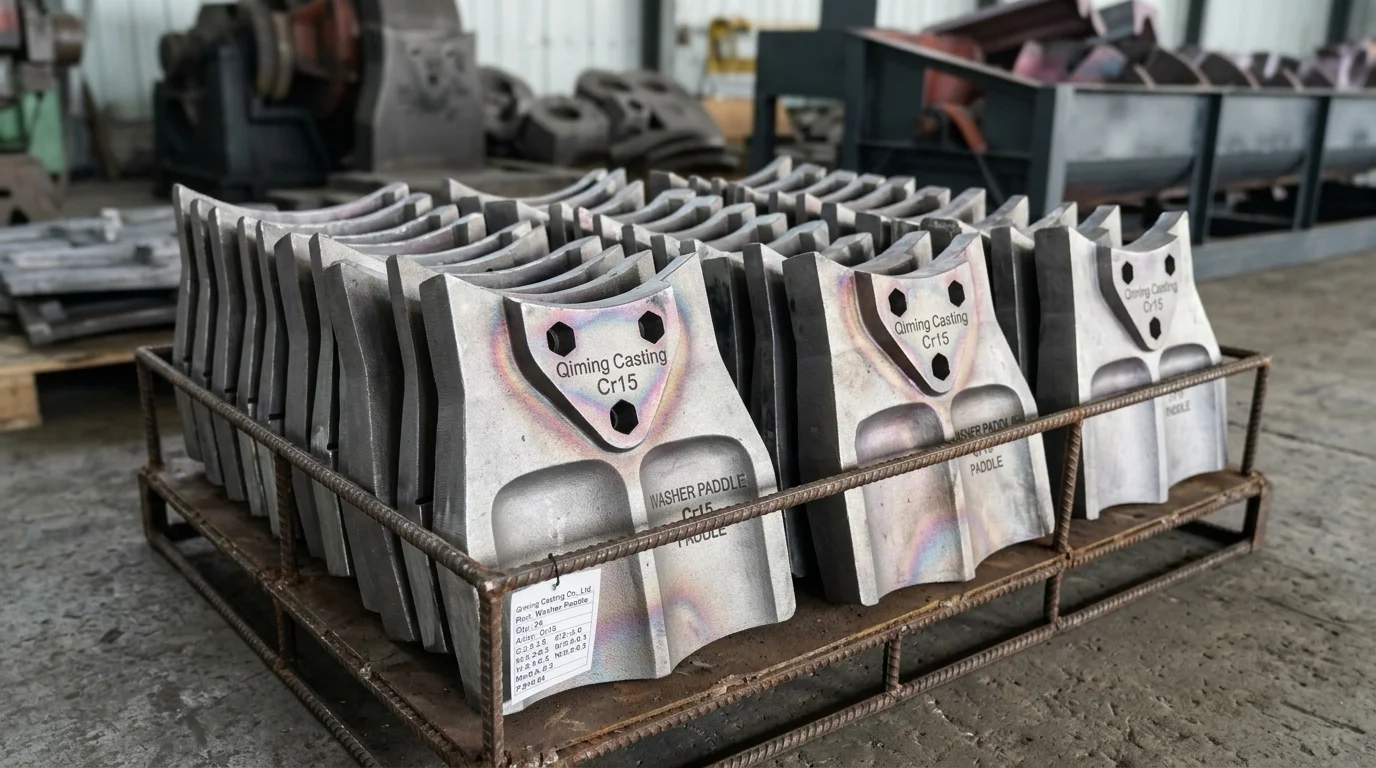
Cr15 High Chrome Material Specification
Qiming Casting’s washer paddles are cast from Cr15 high chromium white cast iron, a proven abrasion-resistant alloy that forms a dense network of hard M₇C₃ chromium carbides throughout the matrix. This microstructure delivers exceptional resistance to the sliding abrasion and wet corrosion that define sand washing environments.
Chemical Composition
Role of Each Alloying Element
Carbon (C) — 2.70–3.00% High carbon drives the formation of M₇C₃ chromium carbides, which are the hard phase responsible for wear resistance. At this carbon level, carbide volume fraction reaches approximately 28–32% of the microstructure — delivering sustained abrasion resistance against silica sand throughout the paddle’s service life. In practice, this means your paddles hold their cutting edge longer, extending replacement intervals and reducing unplanned downtime.
Chromium (Cr) — 14.0–17.0% Chromium is the defining element of this alloy class. A Cr/C ratio above 5:1 ensures that carbides precipitate as M₇C₃ (Vickers hardness: 1,800–2,200 HV) rather than the softer M₃C carbides found in lower-chrome irons. Chromium also forms a passive surface oxide that resists corrosion in the continuously wet, slurry-laden environment of a sand washer. For operations running multiple shifts, this corrosion resistance is what keeps paddle condition predictable between scheduled maintenance stops.
Molybdenum (Mo) — 0.20–0.40% Molybdenum increases hardenability and suppresses pearlite formation during cooling. The result is a more consistently martensitic matrix after heat treatment — higher hardness, better wear uniformity, and reduced variation between castings in the same batch.
Nickel (Ni) — 0.30–0.60% Nickel stabilizes the austenite-to-martensite transformation and adds toughness to the matrix without reducing hardness. It is particularly beneficial in thicker paddle sections where slower cooling rates could otherwise produce softer, undesirable transformation products.
Vanadium (V) — 0.30–0.50% Vanadium forms fine VC carbides that act as nucleation sites during solidification. This refines the overall carbide and grain size, producing a more uniform wear surface, improved impact resistance, and better dimensional consistency across the casting. The practical benefit is more even wear progression — paddles degrade uniformly rather than developing weak spots that trigger early failure.
Titanium (Ti) — 0.08–0.12% At this trace addition level, titanium acts as a strong grain refiner. It modifies the primary carbide morphology and improves matrix toughness — reducing the risk of brittle fracture when paddles encounter occasional impact loading during operation. This is particularly relevant in log washer applications where oversized rocks or tramp material can enter the feed unexpectedly.
Silicon (Si) — 0.50–0.80% Silicon deoxidizes the melt during casting and improves fluidity, which is important for filling complex paddle geometries cleanly. It also contributes a degree of corrosion resistance in wet service conditions.
Manganese (Mn) — 0.60–1.00% Manganese improves hardenability and combines with sulfur to form MnS inclusions. This prevents the formation of FeS at grain boundaries — a known embrittlement mechanism that Mn addition effectively neutralizes.
Phosphorus (P) ≤ 0.04% and Sulfur (S) ≤ 0.04% Both are controlled to low residual levels. Phosphorus forms brittle phosphide networks that reduce impact toughness; sulfur creates grain-boundary inclusions that weaken the casting under load. Strict control of both ensures consistent mechanical performance from batch to batch.
Mechanical Properties
These properties translate directly to extended service intervals and lower per-ton processing cost in continuous sand washing operations.